
Conventions without convictions
The absence of policy discourse is down to how political parties are designed

Nigeria’s two recent ruling parties, APC and PDP, convened in Abuja over the past week. These differ from nominating conventions, where primaries are held to select nominees for elections. Those are scheduled for later in April. These events, however, were meant to achieve two things. First, to ratify the selection of party leadership and, second, to gain momentum ahead of the 2027 elections.
Parties largely achieved the former. APC convened at Eagle Square, Abuja, with 31 governors and over 8,000 delegates on the floor. PDP met at the National Velodrome and notably endorsed Nyesom Wike as its de facto national leader by installing his loyalists in party leadership roles. ADC will convene later in April, but will spend most of this week welcoming defections from Kano, led by former presidential candidate Rabiu Kwankwaso. Elections have virtually arrived, and parties are finalising arrangements ahead of formally confirming nominees before INEC’s May deadline.
But parties failed on the latter point. Neither APC nor PDP utilised their conventions and the public’s watchful eyes to articulate their plans for the future. Tinubu acknowledged the challenges with electricity but remained bullish about the party’s ascendancy. PDP’s Wike notably focused on opposition member Peter Obi, former governors Bukola Saraki and Sule Lamido preached party unity, and Natasha Akpoti-Uduaghan christened Wike as the party’s ‘national leader’.
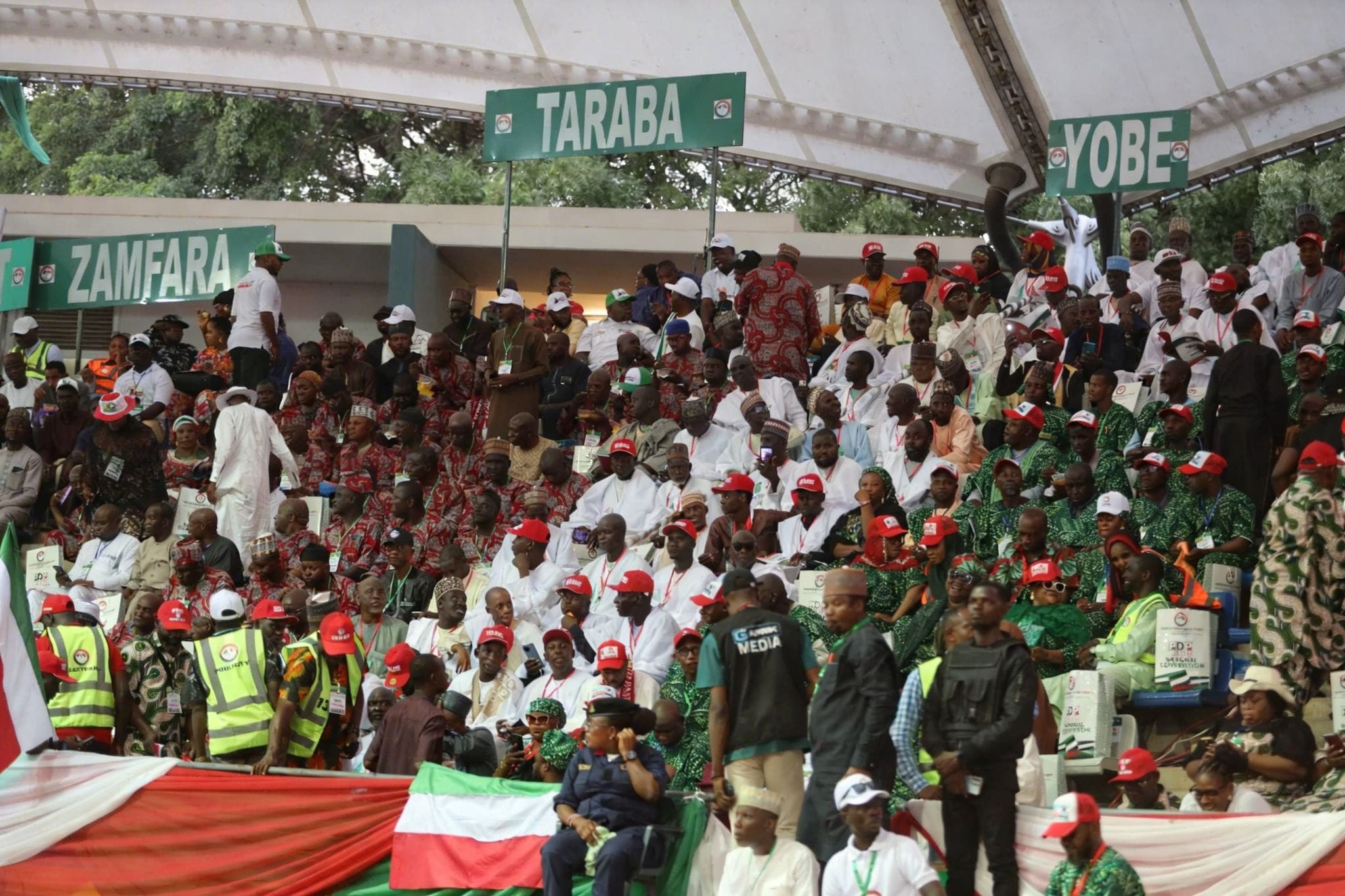
The messaging from these conventions largely reinforces the notion that Nigeria’s political parties, at least in the Fourth Republic, do not function the way they should. They are vehicles for accessing power, not institutions for exercising it.
The Dual Functions of the Party
Parties fulfil two major roles: presenting a vision for society and helping citizens gather around shared political aims. Giovanni Sartori is a well-cited scholar in this field, highlighting that they present candidates for election and are “the institutional channel through which and by which the citizens are represented in modern democracies”. Citizens do not just need parties to win elections, but to provide the outlet to express how they feel society should be run.
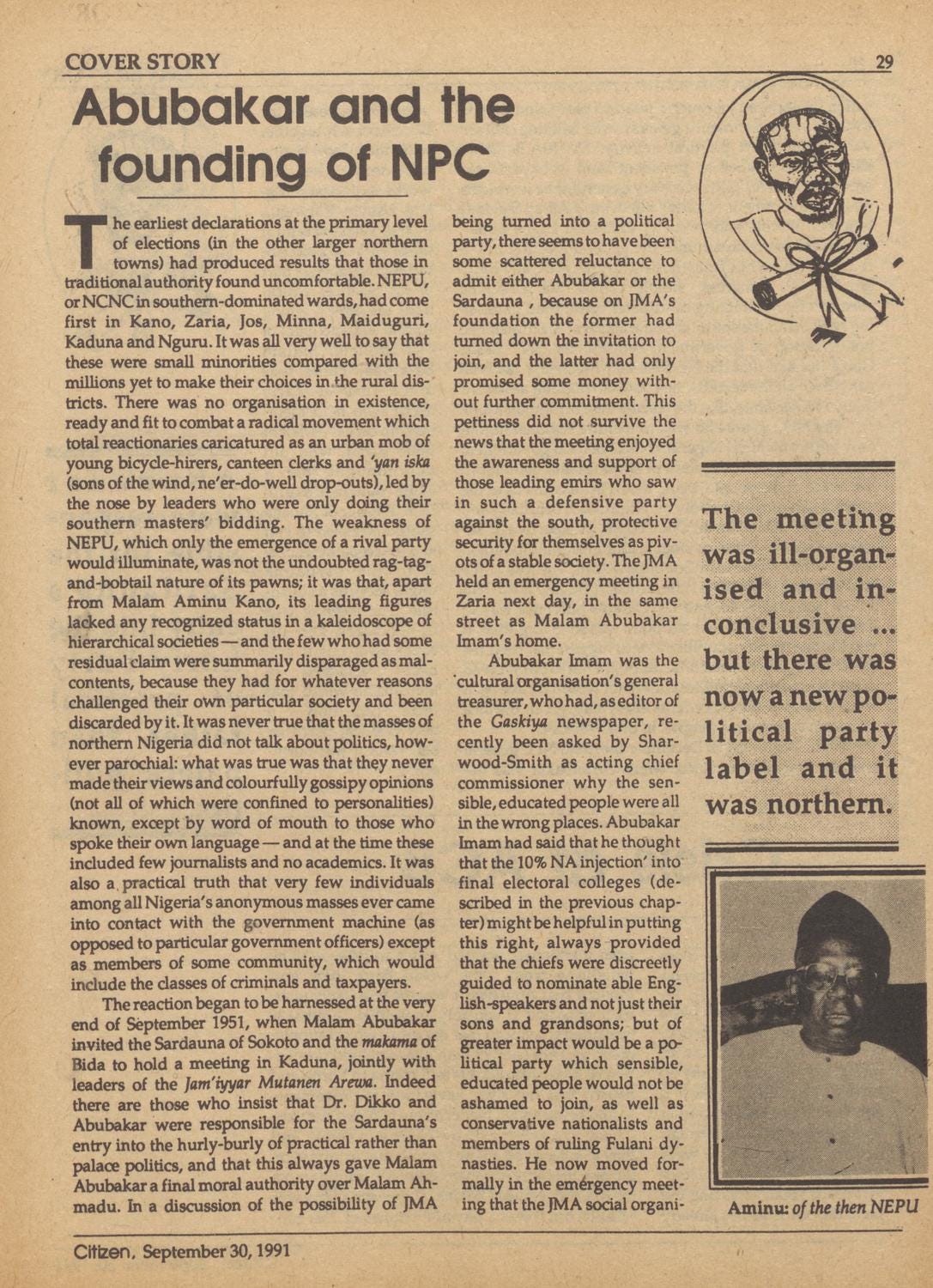
By this standard, Nigeria’s political parties used to deliver. In the First Republic, each party had clear ideological aims, even if couched in identity and regionalism. Awolowo’s Action Group had a social democratic programme, pushed forward through free education and regional development. Azikiwe’s National Council of Nigeria and the Cameroons advocated for pan-Nigerian nationalism and a centrist economic policy. Even Bello and Balewa’s Northern People’s Congress had conservatism and federalism at the heart of its campaign. All parties were clear about the responsibilities of the federal and regional governments and proceeded accordingly.
The Second Republic had ideological successors to these parties. Awolowo and Azikiwe led the Unity Party of Nigeria and the Nigerian People’s Party, respectively, with the same beliefs they held in the 1960s. Shehu Shagari was the nominee of the National Party of Nigeria, which had many ties to the NPC government he had served under as a minister. Even the Third Republic created two parties ‘a little to the left and a little to the right’ to highlight these discussions.
These divisions help provide robust debate. Nigeria’s more contentious discussions are not really debates; they are just well-couched presentations for groups to make money. State creation is simply a means of gaining access to the federal purse. State of origin or state of residence is used to manage fears among some groups that they will be ‘overrun’ by others. Religious arguments around laws to carry out are tied to waning fears around influence. The country is deprived of tangible solutions because honest discussions are not had to begin with. Political parties are meant to provide the platforms for these discussions; they have largely failed to do so.
What Institutional Work Looks Elsewhere?
If Nigerian parties have abandoned the dual functions Sartori describes, it is worth asking what it looks like when parties actually do the institutional work. We do not have to speculate. Other African parties have done it—with instructive successes and failures.
There are strengths to how electorally successful Nigerian political parties have been able to function. For starters, it is not easy to establish ward, local, state, zonal, and national structures in a country as large and as populous as Nigeria. It is why PDP can stretch its comatose status—there are many villages and hamlets where there are still PDP signboards from its successful ’99 campaign. These structures make it easy for the political elite to guarantee elections. So what if we retcon them to work for party engagement and effective governance?
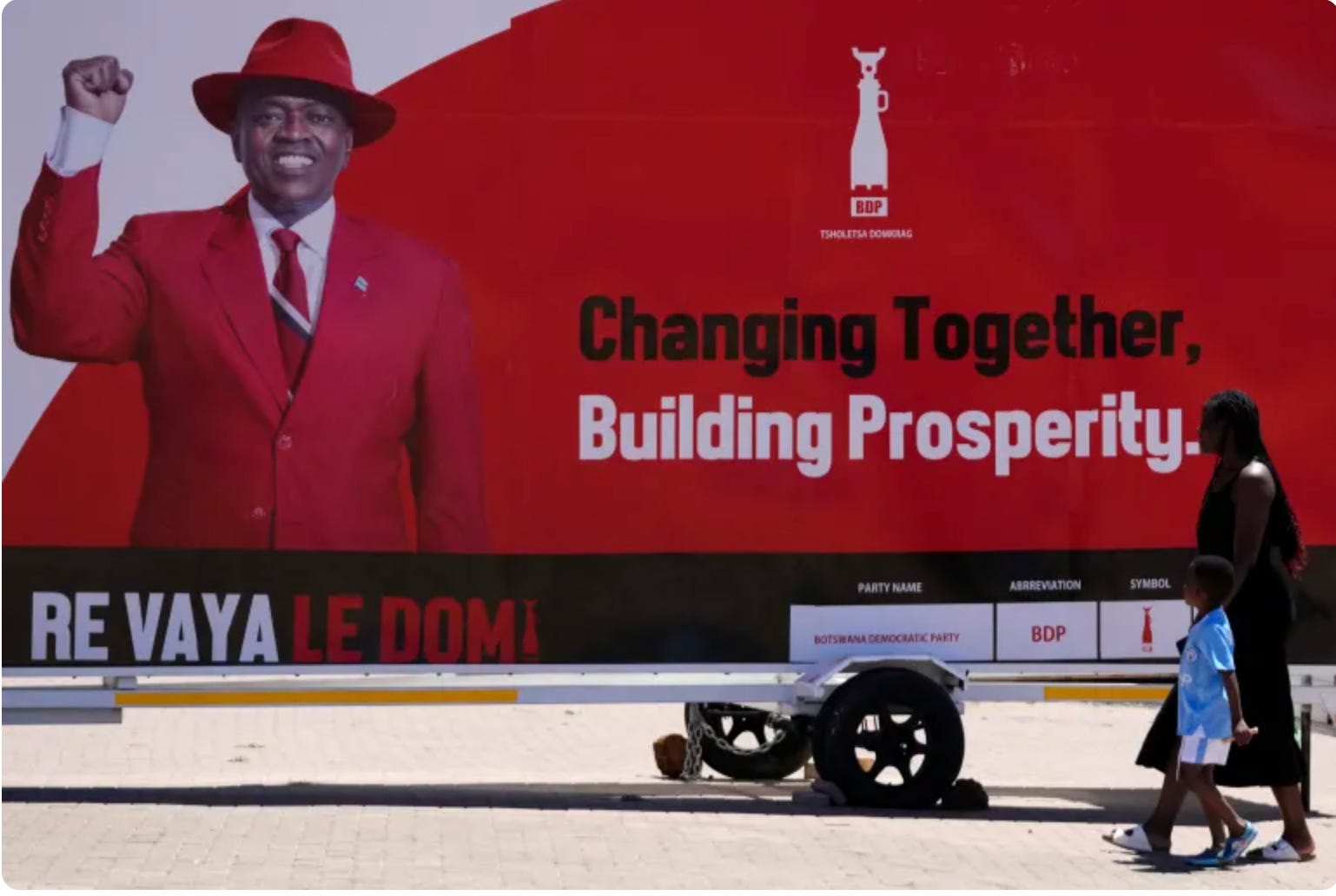
APC and PDP have, at some point or another, presented the spectre of a one-party state. What they have not presented is the thinking behind how to really entrench it. The Botswana Democratic Party (BDP) governed for an uninterrupted 58 years, from independence in 1965 till it was defeated in the 2024 elections. It did so, winning elections acknowledged as free and fair, because it put in the institutional work to operate. It maintained policy coherence across leadership transitions and invested in independent policy research through the Botswana Institute for Development Policy Analysis (BIDPA). It governed through well-documented, engaged National Development Plans that were debated. At its core, the tradition of consultative governance is rooted in the kgotla, public forums where leaders actively engage with citizens. The absence of such forums, aside from perhaps town halls during elections, shows how differently Nigerian parties perform their functions. Interestingly, BDP’s failure came from the political environment that it created, which enabled effective opposition efforts.
Other examples, such as Tanzania’s Chama Cha Mapinduzi (CCM) and Ethiopia’s Ethiopian People’s Revolutionary Democratic Front (EPRDF), offer further variations. The CCM embedded itself in a network of local cells and policy committees, giving it a grassroots presence unmatched in East Africa. The EPRDF, despite its authoritarian tendencies, operated an extensive system of internal study groups and cadre development that ensured its members were at least conversant with the party’s developmental state ideology. Its successor, the Prosperity Party, was formed in 2019 when Prime Minister Abiy Ahmed merged three of the EPRDF’s four constituent parties into a single national organisation, a deliberate break from the coalition’s ethnic federalist structure that the TPLF rejected as illegal, and one of the catalysts for the Tigray war. Much of the EPRDF’s cadre infrastructure has not survived the transition.
These are not models to import wholesale, especially given the different outcomes and consequences of the absence of dissent and engagement. But they share a trait Nigerian parties lack entirely: the party is understood as an institution that does ongoing intellectual and organisational work between elections, not merely as a machine that activates every four years to process ambitions.
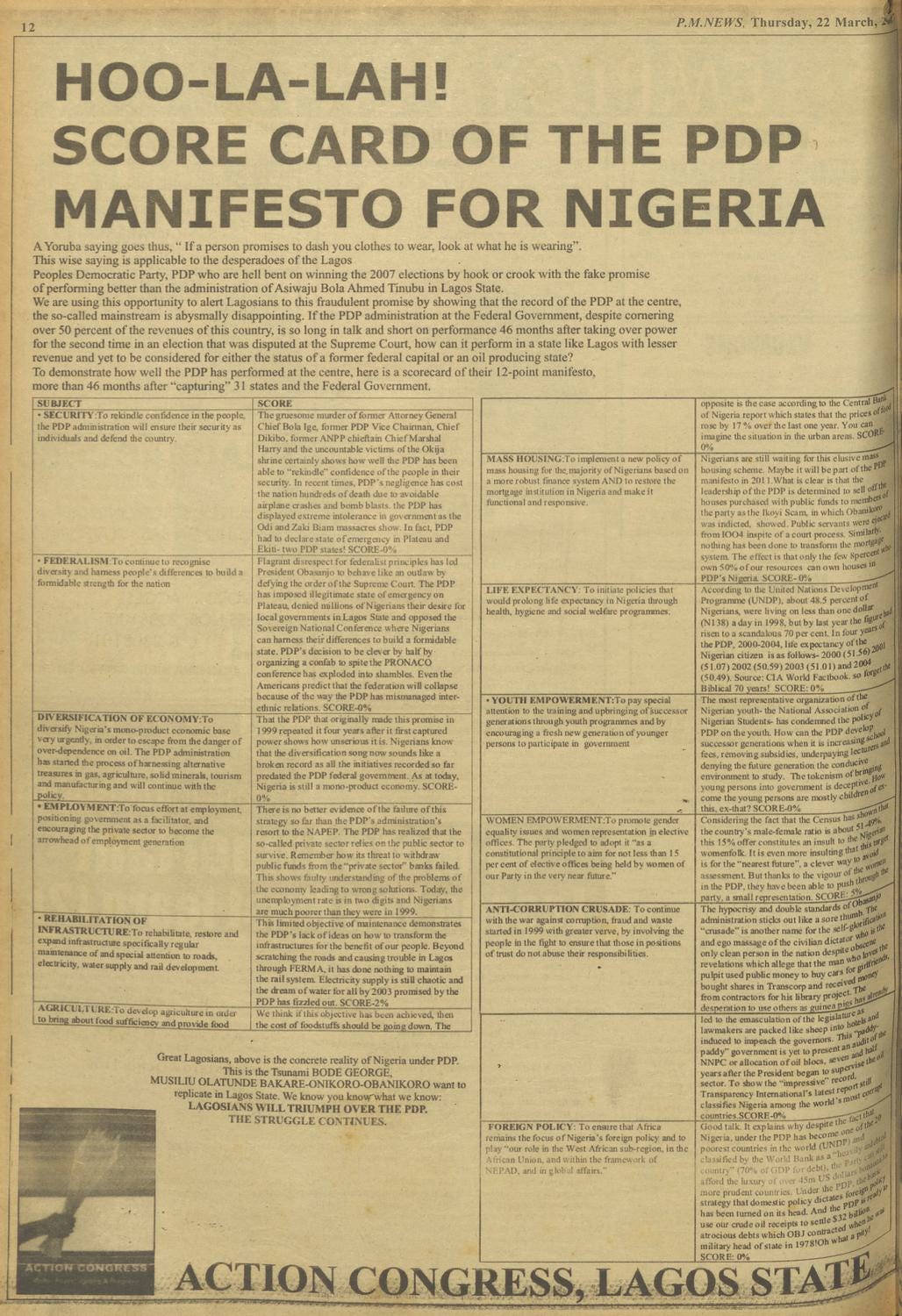
Nigeria’s political parties are short-sighted, working only over electoral cycles rather than planning for decades to ensure structured institutional change. This is why, despite 16 years of PDP rule and an upcoming 12-year anniversary for APC, there has been an uneven approach to governance. PDP’s manifesto, as appears on its website, still cites the hope of becoming one of the top 20 economies by 2020—a target that would make it a pioneer in time-travel politics. APC, Nigeria’s ruling party, does not even have a manifesto page on its website; instead, it focuses on its electoral superiority and an AI-generated image of the president. Because there is little accountability, they can afford to remain holding companies for electoral ambition.
The Consequence of Parties Failing
Functioning political parties are important to how democracy works for both citizens and the governing elite. In an article called ‘Ruling the Void: The Hollowing of Western Democracy’, Peter Mair argues that parties in the West have largely abandoned the representative and expressive roles in favour of governing. The masses are no longer engaging with politics, and the elite are moving towards the protected sides of the state.
For the masses, this represents reduced electoral turnout, partisan identification, and greater electoral volatility. They do not see parties or politicians as relevant. For the elite, they create structures that allow them to both maintain access to state resources and avoid electoral competition. The outcome is a ‘hollowed democracy’ where parties retain the illusion of membership but are really just dictated by a smaller group, and there is no real deliberation. This also means there is no real accountability.
If this sounds familiar, consider what this means in a Nigerian context. Historically, and elsewhere, parties have worked because there are internal structures to hold leaders accountable. Resources are owned by the party, not by individuals. Strongholds are the party’s, not an individual’s—there are U.S. states where simply having a Republican or Democratic label beside a candidacy guarantees their election.
But in Nigeria, these are owned by individuals. Wale Adebanwi refers to it as ‘the corporate agency of elites’, where they can negotiate between ethnic groups and the states. Parties are no longer platforms for citizens to express their political engagement; they are ways for elite individuals to do so. There is no bigger example than the recent wave of defections. Instead of parties negotiating, campaigning and gaining followers across states, they simply have to try and flip a governor. Parties have been built on the absorption of elites—we demonstrated it here through the ways APC and PDP were built—and the growing opposition coalition, ADC, is following the same blueprint by hoovering up opposition candidates.
Sadly, the responsibility of functioning political parties is not just on politicians; it is for everyone. The middle class has also withdrawn from the spaces where these decisions and negotiations are made. Ebenezer Obadare and Wale Adebanwi argue that the Nigerian state has lost its restorative and redemptive powers as a result. Party leaders determine the narrow options of candidates we have in elections. But these leaders do not often represent the wide range of experiences and lived conditions in society. The result is parties and politics left to the very people whose interests are best served by keeping the system exactly as it is.
To summarise, Nigerian political parties do not provide citizens with space to express themselves politically. This manifests in three ways: there is little active participation in politics, leading to weak political accountability and, eventually, compromised governance. In a more mature democracy, a party able to leverage these gaps would get rewarded electorally. For 2027, we’ll need to focus on fixing what we currently have.
The Messiah Trap
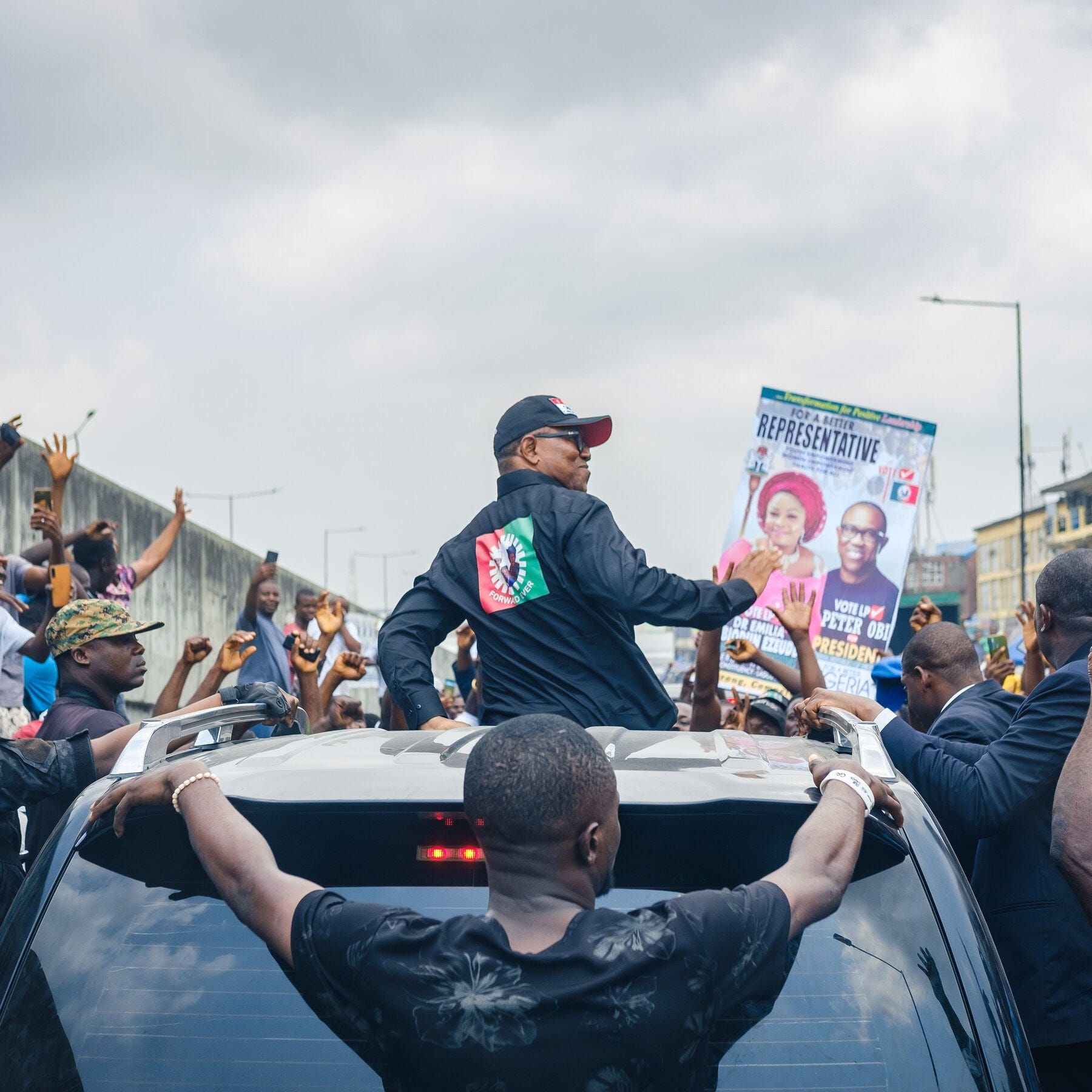
The oft-cited solution is to pray for a messiah. This is why political movements and defections have often been seen in a bigger light. In 2014, Buhari was seen as the single force capable of leading an opposition not only to defeat Jonathan but also to address corruption and insecurity. In 2018, Obasanjo’s Coalition for Nigeria Movement was meant to help coordinate opposition to Buhari’s re-election. Ironically, it briefly adopted the ADC as its vehicle. In 2022, Obi’s Obidient movement generated mass enthusiasm driven by its digital and decentralised approach in engaging young people. Buhari secured the election but was unable to rise to the demands of the office and the moment. Obi’s movement elected legislators who have since defected to the ruling party. Ahead of 2027, fanfare has erupted over the defections of Atiku, Obi and Kwankwaso to the ADC.
The pattern is always the same: a charismatic figure attracts popular enthusiasm, channels it through an existing party structure, and then either captures the party for personal purposes or is captured by the party’s existing logic. But this means that movements are subsumed by individuals. The ADC’s current coalition is built entirely on the same recycled principals who spent decades rotating through Nigeria’s other parties. If they lose, they will retrace their steps. If they win, they will follow the same pattern we have seen before.
The uncomfortable truth is that this implicates citizens, especially those in the middle class who are in the unique position to engage with both awareness and context. The Nigerian condition means that it is often difficult to combine living conditions and show up at ward meetings, engage, organise and build.
This was not always the case in Nigeria. The Nigerian Youth Movement of the 1930s and 1940s succeeded precisely because educated, professional Nigerians saw party formation as their responsibility. Awolowo’s Action Group was built by lawyers, teachers, and journalists who did the ward-level organising themselves. That tradition has been almost entirely abandoned. The result is that parties are left to the very people whose interests are best served by keeping the system exactly as it is. We produce brilliant analyses of why things are broken while leaving the actual machinery of power to the people who benefit from the breakage.
The System Works As Designed
The instinct, at this point, is to prescribe: mandate costed manifestos, reform party financing, and strengthen INEC oversight. These are reasonable proposals. They have also been stated, in various forms, by every governance reform report and donor assessment of Nigeria for the past two decades. The reason they have not been implemented is not that they lack merit. It is that they threaten the incentive structure that makes Nigerian parties function the way they do.
Nigeria’s federal government controls the vast majority of national revenue, distributing it downward through a federation account that makes governorships the primary mechanism for accessing resources. Elections are winner-takes-all: there is no proportional representation, no coalition incentive, no reward for coming second. In this structure, parties do not need policy platforms because policy is not what wins elections. Patron acquisition is what wins elections. A governor who defects brings his state’s political machinery with him. But a manifesto brings nothing.
This is not a failure of the system. It is the system working exactly as designed. The conventions at Eagle Square and the Velodrome were not empty because politicians are lazy or corrupt, though some are both. They were empty of policy because the political economy does not reward policy. It rewards control.
Ethnicity can operate within this structure, not as a barrier to ideology but as its substitute: where parties offer no programmatic reason to support them, ethnic and regional identity becomes the only available heuristic for voters deciding where their interests lie. The prebendal logic that Joseph identified in 1987 is not a cultural pathology. It is a rational response to an incentive structure that has remained fundamentally unchanged across four republics.
This means that telling Nigerians to simply participate more—to show up at ward meetings, to contest party positions, to demand better candidates—is, by itself, insufficient. It is like telling someone to reform a company whose business model is designed to exploit them. The system needs to change so that participation becomes consequential. The question is what that change looks like.
Where the work is happening
One place to look is not at the parties themselves, but at the spaces where Nigerians are already doing the work that parties should be doing. BudgIT tracks government spending at the state and local levels and makes the data publicly accessible, a function a party’s policy research unit should perform, if any party had one. Tracka monitors whether constituency projects are actually delivered, the accountability role that a functioning party structure would fulfil internally. During EndSARS, the Feminist Coalition crowdfunded over $400,000 for legal fees, medical costs, and logistics, the mobilisation infrastructure a party’s grassroots network is supposed to provide.
In each case, technology enabled citizens to perform functions that parties have abdicated. And in each case, the party system did not absorb the capacity. It either ignored it, co-opted the figureheads, or actively resisted it. This is not accidental. A party that adopted BudgIT’s transparency model would constrain its own ability to distribute prebends.
This is not to suggest that technology is the answer. It plainly is not, at least not by itself. The same digital platforms that enabled EndSARS coordination are also vectors for disinformation, hate speech, and the echo chambers that deepen the ethnic and religious polarisation parties already exploit. Social media can organise a march, but it cannot, on its own, build the institutional architecture—the policy units, the internal accountability mechanisms, the cadre development systems—that parties in Botswana or South Africa built over decades.
The challenge is not to replace traditional party politics with digital activism. It is to recognise that Nigerians are already politically engaged—through their phones, their data, their civic organisations—and to ask why the party system remains structurally incapable of making that engagement matter.
That is the real question for 2027 and beyond. What would a political system designed to make parties accountable to citizens actually look like? Are Nigerians willing to build it, even when it means dismantling the machinery which the current elite, across all parties, depend on? These are questions that conventions should be addressing. Their inability to do so shows their limits.
________
Written by: Afolabi Adekaiyaoja
Edited by: Temitayo Akinyemi, ChiAmaka Dike, and Hillary Essien
Timely as always and I liked that you pointed out that Nigerians are politically engaged in all these various forms already the gap here is mobilising and organising all these efforts into a current or new political party.
As always, loved reading this and hopefully, Nigeria’s politics and engagement with it become elevated in my lifetime