
The Issue with 'Claiming' Success
Champions Arsenal, My Father's Shadow and Nigeria's diaspora identity crisis

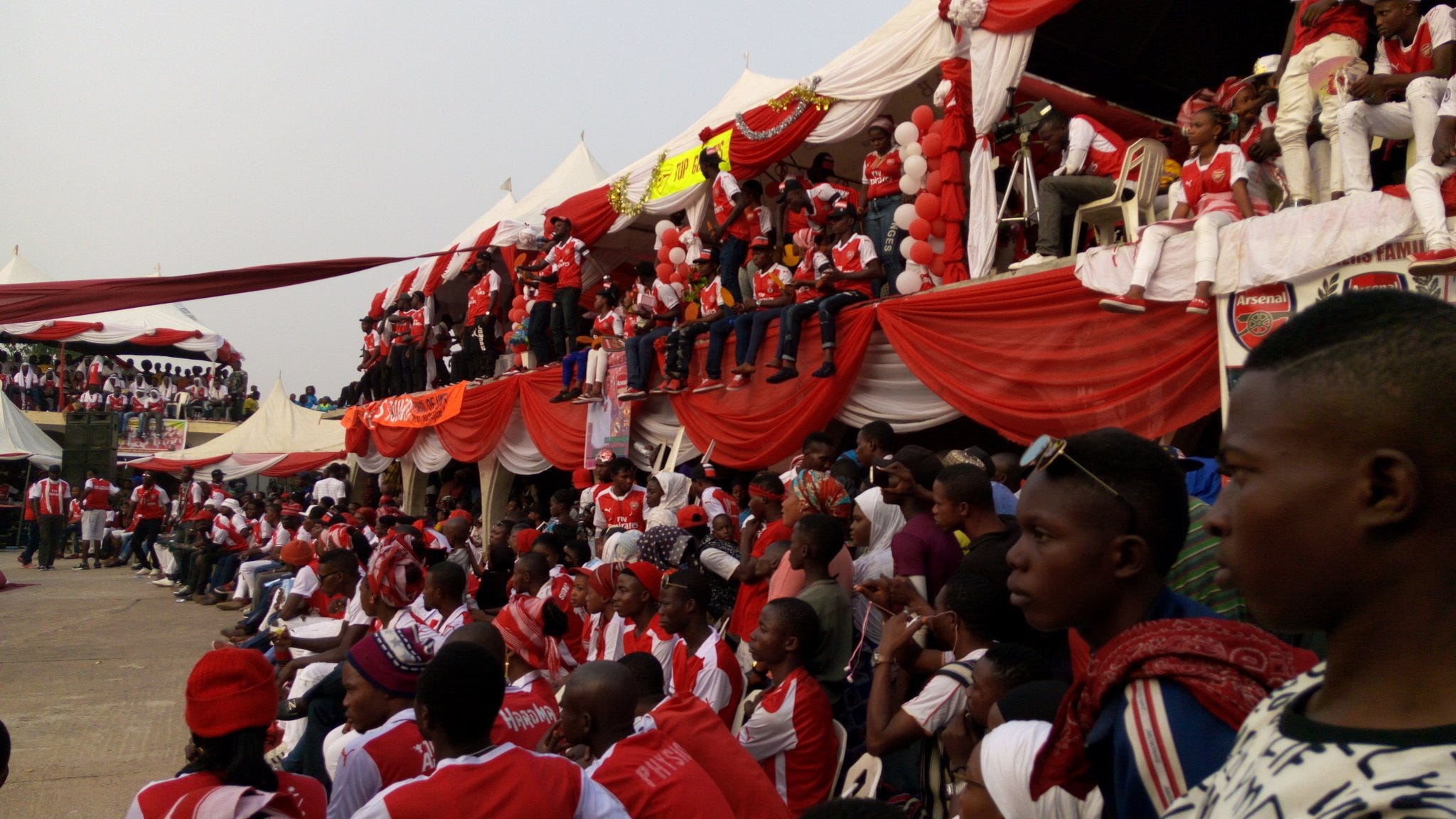
On Tuesday night, Arsenal were confirmed as Premier League champions for the first time in 22 years. Across Lagos, Abuja, Port Harcourt, and every Nigerian WhatsApp group with more than three members, fans erupted in jubilation and relief. Rival fans cowered behind outdated facts (who cares who has the most Premier League titles), and neutrals wondered what about this win made so many football fans react so strongly.
Arsenal is well-documented for its multicultural and multiracial history. But three of the names shaping this title victory, at least as a Nigerian, include: Bukayo Saka, Eberechi Eze, and Noni Madueke. Saka is undoubtedly the face of the club. Eze’s transfer last summer was an epochal moment, since he returned to a club that had released him at thirteen. Madueke’s transfer from Chelsea was more contentious, but he has played this season and will be at the parade.
All three have Nigerian names. All three are English. All three play for England. All three are of Nigerian heritage. And all three have been claimed, with varying degrees of accuracy and enthusiasm, as Nigerian victories. Their victory has been cited as evidence that Nigerian talent, even when it grows up in Ealing, Greenwich, or Barnet, finds its way to the top.
It started with Papilo
When Nwankwo Kanu signed for Arsenal from Inter Milan in January 1999, he did not merely join a football club; he recruited a country. Kanu was born in Owerri, raised in the Nigerian football system, and became an Olympic gold medallist with the Super Eagles before he ever wore the cannon on his chest. When he scored that hat-trick against Chelsea, coming off the bench at 2-0 down and winning 3-2, the celebration was as loud in Nigeria as it was in Highbury. Supporting Kanu was supporting Arsenal.
For an entire generation of Nigerians, this was not a choice but a sequence: love the player, love the club. Other Nigerian players have performed this recruiting function elsewhere—Mikel Obi at Chelsea, Ighalo at Manchester United—but none created the bond that Kanu built with Arsenal.
But there is an irony in the fact that the club Kanu made ‘Nigerian’ now fields three players of Nigerian descent who are, by every institutional and biographical measure, English. Saka’s parents are from Kwara and Ogun States. His full name, Bukayo Moses Ayoyinka Temidayo Saka, carries the weight of a Yoruba lineage that predates the English football academy system by centuries. He has acknowledged publicly that choosing Nigeria was a real possibility: “It was the wish of my father,” he said in 2023, “but things happen, and you have to live with your decisions. I feel very much Nigerian, and nothing can change that.” Eze and Madueke are both of Igbo heritage. Both were eligible and, at different points, courted to play for the Super Eagles.
What the claiming reveals
The question this raises is not whether Nigerians are right to claim Saka, Eze, and Madueke. The question is what this pattern of claiming reveals about Nigeria’s relationship with its own diaspora, and about the structural conditions that produce the claiming impulse in the first place.
Start with the mechanism. Kanu went to Arsenal as a Nigerian international. He represented Nigeria at the Olympics, the World Cup, and AFCON. His Arsenal career was an extension of a Nigerian football identity that had already been fully formed. The emotional logic was straightforward: he is ours, therefore they are ours. Ditto Mikel, who also played a key role in Nigeria’s last AFCON win and showed ‘the desire’ required to succeed as a player.
Saka, Eze, and Madueke are a different case entirely. They are products of Hale End, Crystal Palace’s academy, Tottenham’s youth setup, and the broader network of English football development. They were scouted, coached, and developed by English institutions. They chose to represent England at senior level because that is where they grew up, where they were formed as players, and, quite frankly, where the system worked. The Nigerian football federation did not develop them. It did not fund their training. In Saka’s case, it apparently came close to securing his allegiance, but could not close the deal.
What Nigeria contributed was the parents. And the parents contributed everything that precedes football: the names, the food, the language spoken at home, the cultural grammar that shapes how a young man carries himself in the world. These are not trivial contributions. But they are not the same as institutional development, and the distinction matters because it illuminates a pattern that extends well beyond sport.
“Nigerian at Cannes, British at the Oscars”
Consider, in parallel, the case of My Father’s Shadow (d. Akinola Davies Jr., 2025). It is set entirely in 1993 Lagos, told in Yoruba, Pidgin, and English, and stars a predominantly Nigerian cast. Its lead, Sope Dirisu, was born in London to Nigerian parents. The movie premiered at Cannes in May 2025 and won a Special Mention for the Caméra d’Or. It has been ‘owned’ by two cultures: it was the British submission to the Oscars in 2026, which won a BAFTA Award for Outstanding Debut, while also sweeping the major awards at the Africa Magic Viewers’ Choice Awards.
“Nigerian at Cannes. British at the Oscars.” The phrase, coined by Shock, became shorthand for a structural absurdity that the film did not create but could not escape. Davies is British-Nigerian, domiciled in London. The funding came from BBC Film and the BFI’s National Lottery. The post-production was completed in London. Under Academy rules, the film’s eligibility followed the money, not the story.
The AMVCA controversy that followed asked the same question Nigerian football fans implicitly ask every time Saka scores for England: is this ours? The answer, in both cases, is structurally identical. The talent is Nigerian in origin, but the system that developed it is not. The excellence is real, but the ownership is contested. And the reason the ownership is contested is that Nigeria did not, and could not, provide the infrastructure that would have made the question unnecessary.
The Distance Between Feeling and Infrastructure
This is where the comfortable narrative of diaspora pride meets the uncomfortable reality of institutional failure. The reason Saka plays for England is not that he does not feel Nigerian. By his own account, he does. The reason is that England’s football development system identified him at age seven, coached him through an elite academy, and provided him with a professional pathway that the Nigerian football federation—with its factional politics, its chaotic administration, its inability to retain its own athletes—could not.
Similarly, the reason My Father’s Shadow is seen as a British project is not that Akinola Davies does not consider himself Nigerian. After all, its production company, emphatic ground support, and engagement have shown it is mindful of the setting of its story. It is that Nigeria has no public film funding mechanism, no co-production treaty framework, and a distribution system that returned the film a modest ₦16.8 million at the domestic box office despite critical acclaim. The movie will not break into the upper ranks of Nollywood productions that Nigerians have rewarded at the box office.
The pattern is structural rather than incidental: it is difficult for Nigeria to provide finished products. Nigeria produces the raw material: the talent, the stories, the cultural identity, the names that carry generations of meaning. Foreign systems provide the infrastructure that turns raw material into finished products. There is a cognitive dissonance when Nigeria and Nigerians claim the finished product as their own, in a gesture that is simultaneously deeply human and structurally revealing. It is why it can be amusing when Nigerian officials fall over themselves to celebrate other sporting heroes when they succeed abroad—Anthony Joshua, Tobi Amusan, etc.—but fail to build the infrastructure at home that would produce similar stories without the asterisk.
The claiming itself is not cynical. Nigerians are not trying to profit from these stars, but to recognise their potential and take pride in their achievements. This impulse is real, and human, and worth respecting. But it should not obscure the structural deficit that makes the claiming necessary in the first place: the absence of functional domestic institutions that would produce their own Sakas, their own Cannes-premiering films, their own Academy-eligible productions. The pride is genuine, but the gap it papers over is real as well.
The Reversed Relationship
Arsenal, to their credit, understand the commercial and emotional reality of this relationship. Their 2024-25 away kit, designed in collaboration with Labrum London, was an explicit tribute to the club’s African fanbase. It featured pan-African colours, cowrie-shell motifs, a launch video filmed on the streets of Lagos featuring Kanu and Saka side by side, and soundtracked by Ebo Taylor. The club knows that its Nigerian supporters are not casual observers. They are, in terms of volume and intensity, among the most committed fan communities Arsenal has worldwide. The club markets to them accordingly. There is a patch on the stadium’s exterior that celebrates the ‘Nigerian Gunners’. They are featured prominently in adverts.
But there is something worth sitting with in the image of Kanu and Saka in that launch video. Kanu, the Nigerian who went to Arsenal. Saka, the child of Nigerians who grew up at Arsenal. The generational shift is total. In a single generation, the direction of the relationship reversed. Nigeria no longer exports its footballers to Arsenal. Arsenal develops the children of Nigerians who have left.
And on Monday night, when Saka’s grandmother reportedly travelled from Ijomu-Oro in Kwara State to watch him help clinch the title, the image exposed its gap.
What Comes Next
Nigeria’s diaspora identity crisis is not about who feels Nigerian. Saka feels Nigerian. Davies feels Nigerian. There is also the wider question of those who chose to play for the Super Eagles—Aina, Iwobi, Troost-Ekong, Lookman—who acted on that feeling. The crisis is about the distance between feeling and infrastructure, between cultural identity and institutional capacity. It is about a country that produces people the world wants to claim, and that claims them in return, without ever building the systems that would make the claiming unnecessary.
This speaks to a structural issue in how the country builds and forges identity, and to the divides that mean a national identity is still far from certain. The associations with foreign clubs do more to represent ‘cross-cultural’ bonds in a hyper-partisan Nigeria than political parties and labour groups. Supporters of other major clubs, and Manchester United, will no doubt feel the weight of their rivals lifting a major title. And they will see the divide that such euphoria crosses, between political rivals and ethnicities, because of how people associate with these institutions. That a Premier League club can unite Yoruba and Igbo, Muslim and Christian, PDP and APC supporters in a way that no domestic institution currently manages is itself a finding worth sitting with.
The legacy of Nigeria’s ongoing ‘japa’ wave, where tens of thousands of young professionals acquire foreign citizenship each year, will not be felt now, but in decades to come. The pipeline that produced Saka’s parents, Yoruba professionals moving to London in the 1990s seeking opportunity, has not stopped. It has accelerated. And the consequence, a generation from now, might be another wistful celebration of a ‘proudly Nigerian’ talent who was never really Nigeria’s to claim.
—
Written by: Afolabi Adekaiyaoja
It’s how this piece subtly addresses the talent debate
A much-needed essay about the gap in infrastructure for the arts; film, writing (even if it wasn't addressed in this essay), and football.
There are pockets of this essay that sent shivers down my spine because of how crisp the writing was. Great job, Afolabi.
I hope that the infrastructure in the coming years cater to the arts. Nigerian excellence, Nigerian excellence, but did you help them grow, though?