
The Second Life of a Budget
As Nigeria heads towards a presidential election, what happens to federal spending in the months before they vote, and can voters truly see the fuller picture?

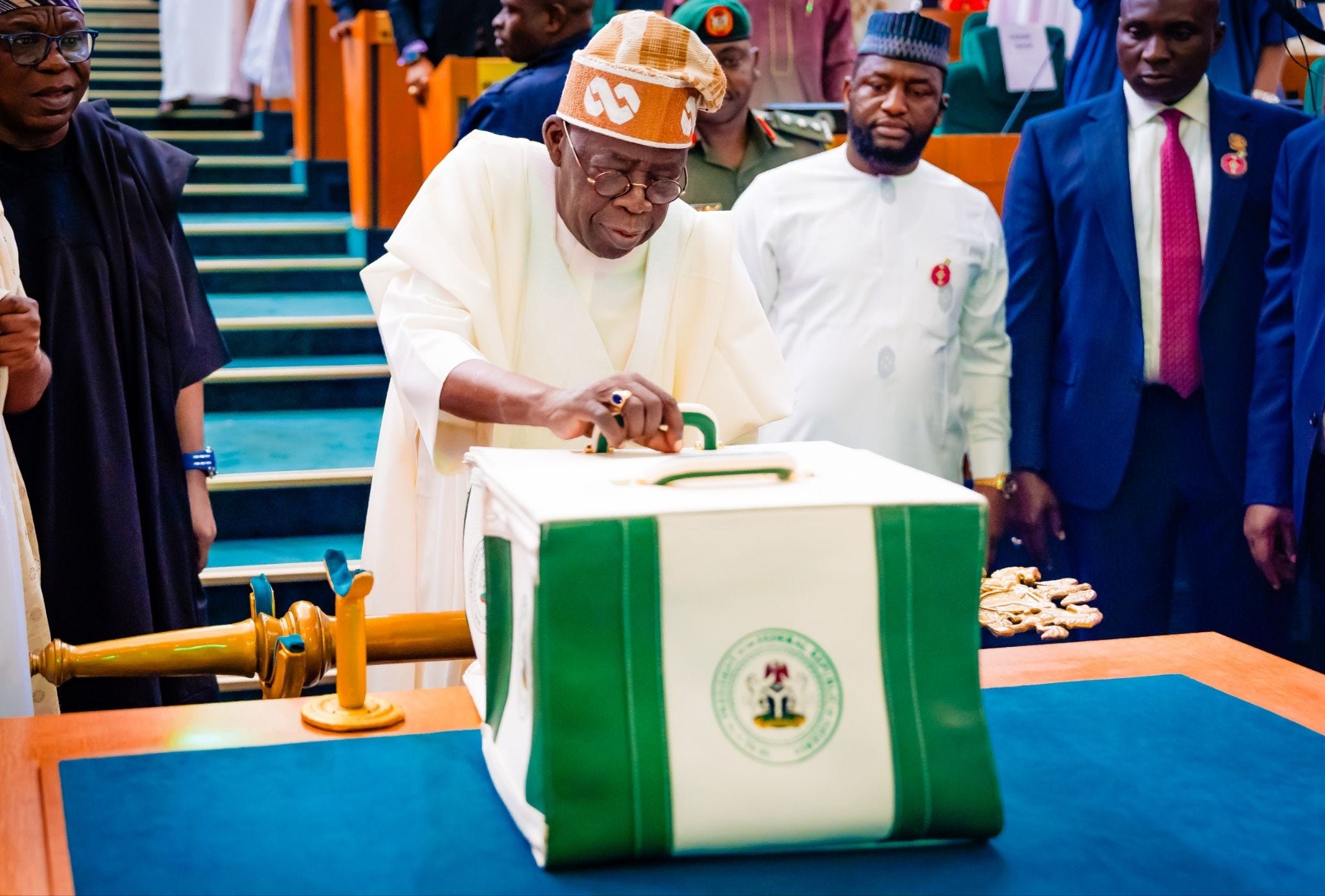
Tracka, BudgIT’s public-project monitoring platform, revealed that Nigeria’s 2026 budget set aside ₦22.15 billion for 106 royal-palace projects across 45 ministries, departments and agencies, with eleven locations unclear in the budget data. The Nigerian Press Council, an agency one would normally associate with journalism, has classroom blocks and solar streetlights under its name; the Council says lawmakers nominated the constituency projects.
This was part of Nigeria’s 2026 ₦68.32 trillion budget, and it is meant to show what Nigeria’s government chose to fund. I wanted to know whether an approaching election changes what the federal government prioritises to fund, and whether it is possible for Nigerians to see those choices clearly enough before they vote.
Most people expect governments to utilise their incumbency by commissioning capital projects and infrastructure landmarks before polls. But the subtler way they wield their incumbency is by timing when the record of accounts is published and how citizens can use that to evaluate them.
I kept thinking of Christopher Nolan’s The Prestige (2006) while reading the budget. In the film, the magic trick has three parts: the pledge, where the object is presented to the audience; the turn, where it changes or disappears; and the prestige, where the object returns. In my view, a budget works in the same way. Appropriations, which is what the government intends to spend, is seen first. The harder part is when money is released, delayed, redirected or carried over; the turn is the point, and the prestige is the eventual record of what was actually spent.
It matters in Nigeria because a budget allocation is not a guarantee that the full amount will ever be spent. In 2019, the federal government budgeted ₦2.09 trillion for capital spending but spent roughly ₦1.17 trillion, while in 2020, it budgeted about ₦2.49 trillion and spent about ₦1.60 trillion. So when a ministry or programme is allocated an amount of money in the budget, one should see it as only a plan and not a final spending figure.
The Pledge
For a moment, Atiku Abubakar seemed to have handed me an answer. In July, the former vice-president said the Service-Wide Vote had risen from roughly ₦638.34 billion in 2025 to ₦12.8 trillion in 2026, an increase of about 1,918 per cent.
To understand why his original statement had all the ingredients of a fiscal scandal in Nigerian politics — a huge number, a budget line few people understand and an election getting closer — it’s worth unpacking what the Service-Wide vote means. The Service-Wide vote is a centrally managed place for costs that cuts across several ministries. It includes things like salary adjustments, pensions, security and health spending, and older government liabilities. Unlike a ministry’s budget, with specific line items that make it easy to track, it holds more of the federal government’s bills. This means that it’s easier to excuse any misappropriation because it is an expectedly important line charge that can survive being vague and undefined. A sudden and steep increase would, and should, expectedly attract scrutiny in an election year.
The claim had its issues before the Budget Office responded. In the first statement, ₦638.34 billion was the 2025 baseline; two days later, in Atiku’s response to the APC, the same ₦638.34 billion had become the 2024 figure while the 1,918 per cent increase stayed the same. Once the base year moves, the percentage no longer tells the same story. Budget Office director-general Tanimu Yakubu then said the comparable 2025 Service-Wide Vote was ₦9.305 trillion, against ₦12.827 trillion in 2026, which puts the increase at 37.8 per cent. That is still a large rise, but it is a very different claim from a twenty-fold jump.
The breakdown from the Budget Office shows why the label of a ‘Service Wide Vote’ can be misleading, and I showed the full scale of expenditure in the chart below. Some of the biggest items, however, were generated from other years. About ₦3.5 trillion is for outstanding 2025 obligations and another ₦1.3 trillion for contractor liabilities carried from 2024. Together, those older bills make up more than a third of the entire Service-Wide Vote. A contractor paid this year may have finished the work two years ago, and a project commissioned this year may be settling an older bill. Nigeria’s budgets have become very good at carrying their past around with them.
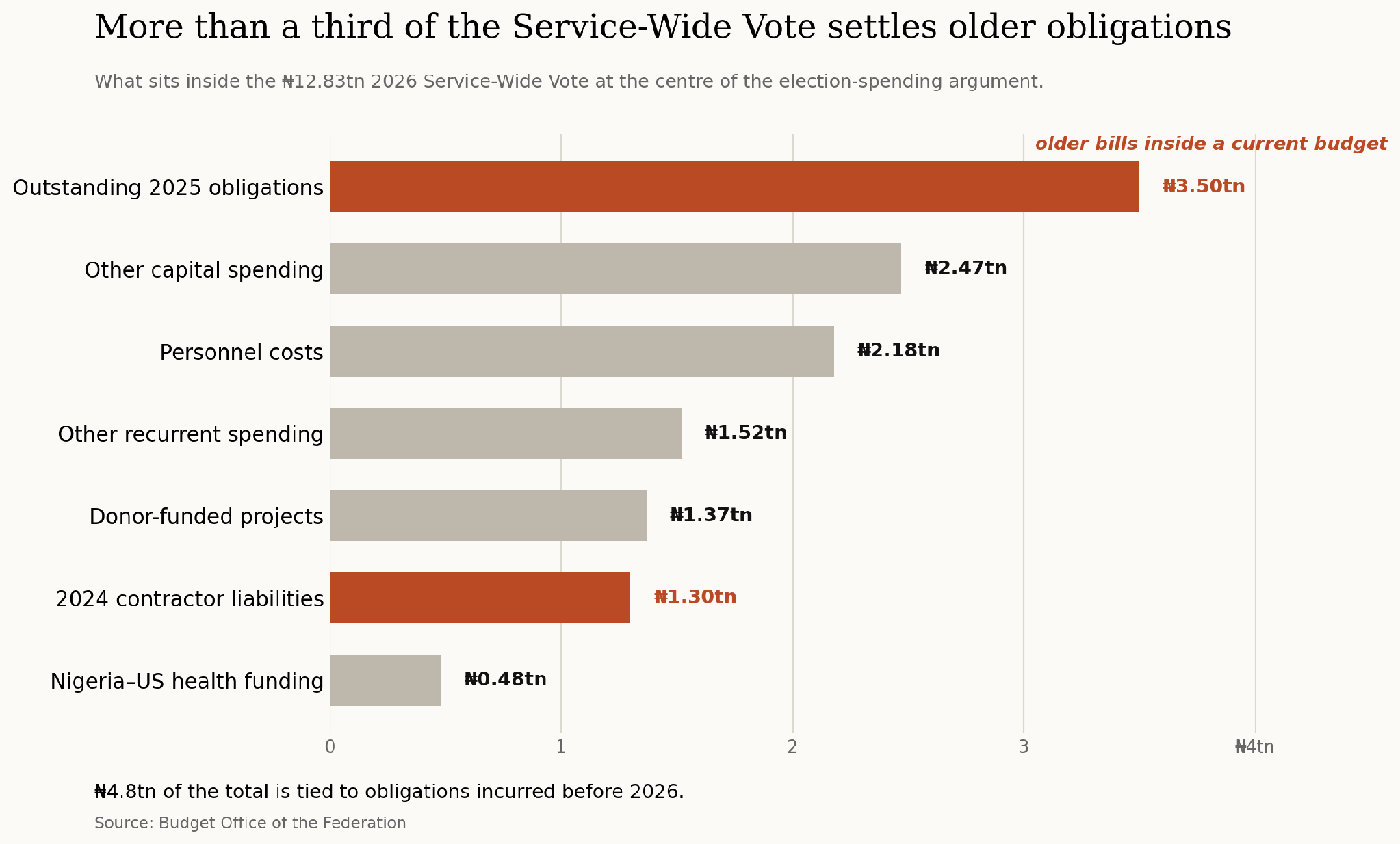
Correcting the arithmetic still leaves the increase itself unexplained. The Budget Office did not publish a clear 2025 breakdown showing which parts of the Service-Wide Vote grew and by how much. Atiku’s 1,918 per cent claim falls apart; the 37.8 per cent rise still needs explaining.
The Turn
Economists have spent decades asking whether governments handle money differently as an election approaches. Early work, including Nordhaus’s 1975 model, argued that governments have an incentive to boost the economy before an election by lowering unemployment to win favour with the masses, even if it led to massive inflation afterwards. Later research queried whether governments facing an election are more likely to keep visible funding, such as wages and subsidies, from cuts when there are not enough financial resources to fund everything. Clémence Vergne’s study of 42 developing countries found more election-year spending on things people feel quickly. For Nigeria, the question is this: if the government cannot fund everything before an election, does it then prioritise the things voters would notice first (like roads) or do other needs come first?
The obvious year to test was 2022, immediately before the last general election. The government spent about ₦14.79 trillion of the ₦18.14 trillion it had planned, but the shortfall was uneven. Running costs such as salaries and pensions held up, while capital spending on projects and infrastructure fell far below plan, just like the kind of shift Vergne describes. However, this does not mean capital projects disappear before an election. Governments can still build and commission very visible projects. The question is whether, across the budget as a whole, those relevant projects absorb more of the shortfall of cuts while recurring expenditure such as salaries and pensions is protected.
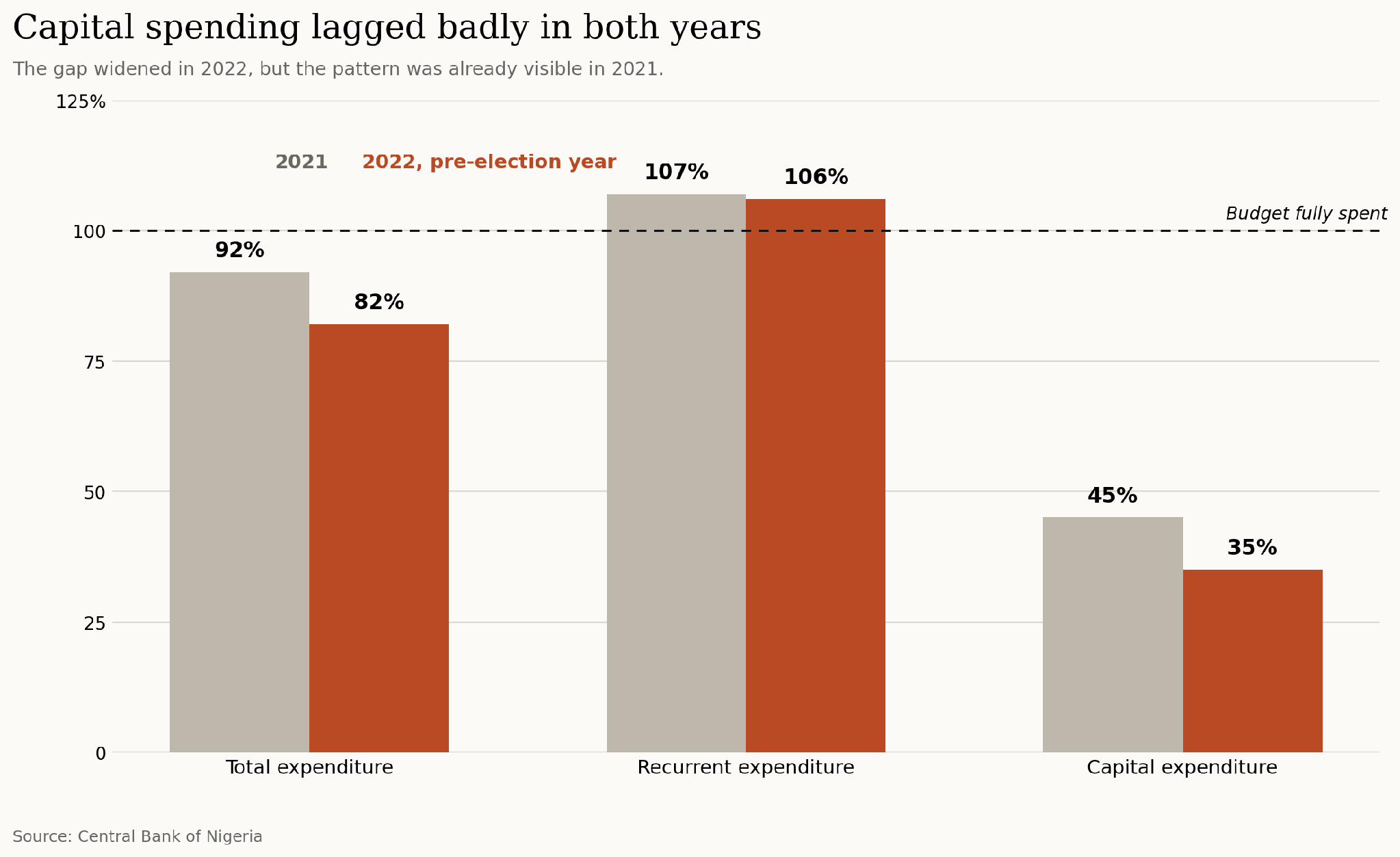
Then I checked 2021, and the pattern became much less convincing. The same imbalance was already there: the government was meeting running costs much more fully than its capital budget. However, this only tells us what was happening at the federal level. States control large budgets of their own, and any analysis of election-year spending will need comparable state-level data, too. 2022 also came with a serious revenue problem. The CBN’s fiscal series shows oil revenue 33.6 per cent below budget, while President Buhari told the National Assembly that ₦1.59 trillion had already gone to petrol subsidy in the first half of the year. The subsidy cost provided another possible explanation for weak capital spending besides the election.
So 2022 could not prove the election-year story. The annual numbers leave open the possibility that elections affect particular months, programmes, releases or locations, but they do not show a clear effect in total spending.
So I turned to Nigeria’s quarterly Budget Implementation Reports, the government’s own records of how much of the budget has actually been spent. I expected to spend time comparing quarters and ended up comparing publication dates instead.
The Prestige
Before the February 2023 presidential election, the official account of federal spending in the second half of 2022 was incomplete. The Q1 and Q2 reports were available before the election; Q3 arrived in July 2023 and Q4 in November, both after the vote. The previous cycle was similar: the 2018 Q3 report appeared one day before the 2019 presidential election, and Q4 came months later. In two election cycles, voters went to the polls without the full federal spending record for the months closest to the vote.
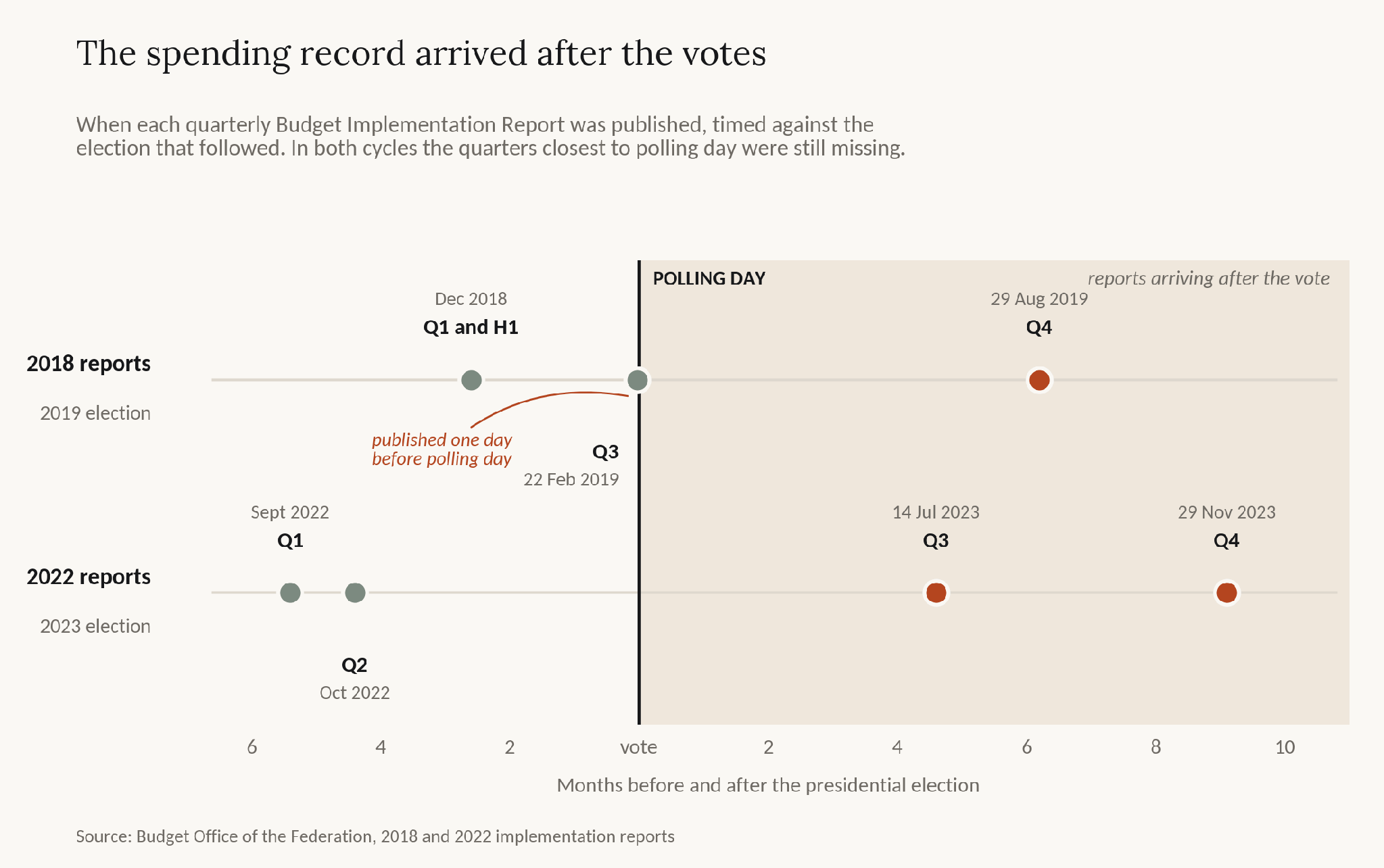
Those dates matter because the government was still making claims about performance. In October 2022, with campaign season underway, late President Muhammadu Buhari used his final budget speech to point to ‘transformational investments’ in infrastructure. I went back to the government’s campaign claims to see whether the missing Q3 report told a different story.
I could not establish that it did.
What I could establish was that the government was already showing voters completed projects before the full spending record was available. When the annual figures were released, only 35 per cent of the capital budget had been spent, which means that most of the capital spending planned for 2022 had not been executed by the end of the budget year. Infrastructure spending came through several routes, so one quarterly report could never fully capture this. What it could do, however, was place the visible projects beside the wider capital budget.
BudgIT publicly asked for the Q3 2022 report in June 2023, eight months after the quarter ended; the Budget Office posted it the following month. By the end of 2022, the federal government had executed only about a third of its planned capital spending. Specific roads and projects could be identified as their ‘success points’, but it only represented a part of the investment it had promised for the year, while some of the rest may have been delayed or rolled over. And since capital execution was already only about 45 per cent in 2021, an election alone cannot be used as the best explanation for this gap.
My next suspicion was whether the reports were arriving late because the government did not want poor spending figures in public before the election, as some of the reports closest to election day were only published afterwards. Then I checked years without a presidential election, and the same delays were there. The first three quarterly reports for 2023 were all published on 5 July 2024; the 2024 Q3 and Q4 reports arrived on 27 August and 17 October 2025. Chronic federal reporting weakness fits the record better. The Budget Office also gives a specific reason for the recent delays. In a statement made on 7 January 2026, Director-General Tanimu Yakubu said the 2025 budget was repealed, re-enacted and extended into June 2026, leaving officials to reconcile overlapping accounts. His broader argument is that Nigeria’s fiscal year follows the appropriation law rather than automatically running from January to December. That makes a simple calendar-deadline accusation harder to sustain.
That defence does not make the federal lag inevitable. Lagos posted its Q1 2023 budget performance report about a month after the quarter closed. It called the figures provisional and said the report was produced to meet a four-week deadline. It’s important to note that Nigeria’s Ministry of Budget has a bigger problem: enforcement of the laws. There are already reporting deadlines, but they have been missed repeatedly with little consequence. If there are no costs to breaking the laws, there is little pressure for the pattern to change. Oyo published its Q1 reports for both 2023 and 2026 on 28 April. The comparison has limits because state budgets are much smaller than the federal budget. But Lagos and Oyo show that faster reporting is possible, and Lagos shows that a report can still be useful even when some figures are provisional.
The International Budget Partnership’s Open Budget Survey 2023 serves as evidence of the broader picture. Nigeria scored 31 out of 100 for transparency, below the global average of 45 and down from 45 in 2021. IBP linked the fall to late in-year reports and a late mid-year review. The survey looked at material available by 31 December 2022, so it is not a judgement on the 2026 budget. It shows that reporting delays were already a problem before this election cycle.
Most voters will never read a Budget Implementation Report, and they do not need to. Journalists, legislators, civic groups, opposition teams and researchers use them to test what government says in public. More than a century ago, the economist Amilcare Puviani described part of this as fiscal illusion: that people tend to see the benefits of government more clearly than the costs. A finished road is easy to see; a project that received no release may leave nothing visible at all.
The Timing
The 2026 budget makes the timing problem concrete. President Tinubu signed the ₦68.32 trillion Appropriation Act on 17 April, with the law taking effect from 1 April, while the capital part of the 2025 budget stayed open until 30 June. For three months, federal ministries were working with two years’ capital budgets at once. Add the older obligations already sitting inside the 2026 Service-Wide Vote, and even a basic question such as ‘what did government spend this year?’ starts to require a family tree. The National Assembly’s upward revision also included money for preparations for the 2027 elections. Those costs are part of running an election and have to be separated from any claim about campaign advantage.
That overlap changed how I think about incumbency. We usually talk about the advantage of being in government in terms of money, visibility and control of the state machinery. Timing belongs on the list too.
Government can commission a road today and claim the credit today, while the report showing what happened to the rest of the budget may arrive months later. Even though you have a completed road (or the popular choice of a flyover), we should begin to ask ourselves what happens to everything else that should ideally be funded alongside it. Buhari’s last budget speech is a good example, as he spotlighted projects such as the Second Niger Bridge and Lagos-Ibadan Expressway as evidence of his infrastructure record in his tenure. That gives an incumbent a timing advantage, as its achievements are visible now, while the fuller record needed to judge them and put so-called achievements in clearer context can come later. I arrived at that point only after the easier explanations failed: Atiku’s number broke down, the 2022 pattern became weak once 2021’s numbers and the revenue problem were added, and the reporting dates looked suspicious until years without a presidential election showed the same delays.
The January election turns that gap into a deadline. After the Electoral Act 2026 changed the timetable, INEC moved the presidential and National Assembly elections to 16 January 2027. Section 30 of the Fiscal Responsibility Act says quarterly implementation reports should be published within thirty days of each quarter’s end. Yakubu argues that the 2026 fiscal year should be read from the April start of the appropriation rather than from 1 January. The legal timing can be argued over; the election date cannot. Voters will still be asked to judge the year on 16 January.
The archive shows why this matters. A Q3 2025 macroeconomic and financial analysis appeared only on 14 May 2026, and a consolidated report for 2024 was added on 14 July 2026, more than eighteen months after that year ended. As of 9 August, the 2025 page still listed only three documents and there was no 2026 quarterly category. Q3 2026 closes on 30 September, just 108 days before polling.
There’s real-life evidence that the timing of information revealed matters at the ballot box. In Brazil, researchers found that when federal audits exposing corruption were revealed before local elections, incumbents stood a lower chance of re-election than reports presented after an election. Nigeria’s budget reports are not the same as a federal audit, but the principle remains that information that arrives after an election cannot shape a choice voters have already made.
That brings me back to The Prestige. By January, voters would have seen the pledge in the form of the budget the government said it would deliver. They will also have seen parts of the turn in the infrastructure commissioned, payments made and programmes launched along the way. What may still be missing is the fuller actuality of what was spent, what was delayed and what was untouched as the prestige. If this comes after the elections, voters will have had to, once again, make their judgement before the magic trick is complete.
—
The Village
I fell into a bad habit every journalist has, which is assuming people will care about a story simply because we think it matters. Afolabi Adekaiyaoja and Seyi pushed me to explain my theories with more clarity and to help the average reader understand what happens to a budget in the run-up to an election. If any part of this essay resonates with you, it is courtesy of their questions. Hillary Essien also gave useful copy edits.