
The Spectre of a One-Party State
Is it possible to run a one party state successfully in Nigeria?

At some point, while editing The Lifecycle of a Nigerian Ruling Party, the map showing current APC governors changed three times. The frequency would have been higher if it had included legislative defections; APC started the current session with 59 of the 109 senators, but defections have raised that to more than 80. The supermajority it holds in both chambers of the national assembly, state governorships, and state legislatures means it is in a position to push through major constitutional changes. This includes creating new states, restructuring government responsibilities and even amending term limits. This has brought the question of whether the APC can indeed turn Nigeria into a one-party state.
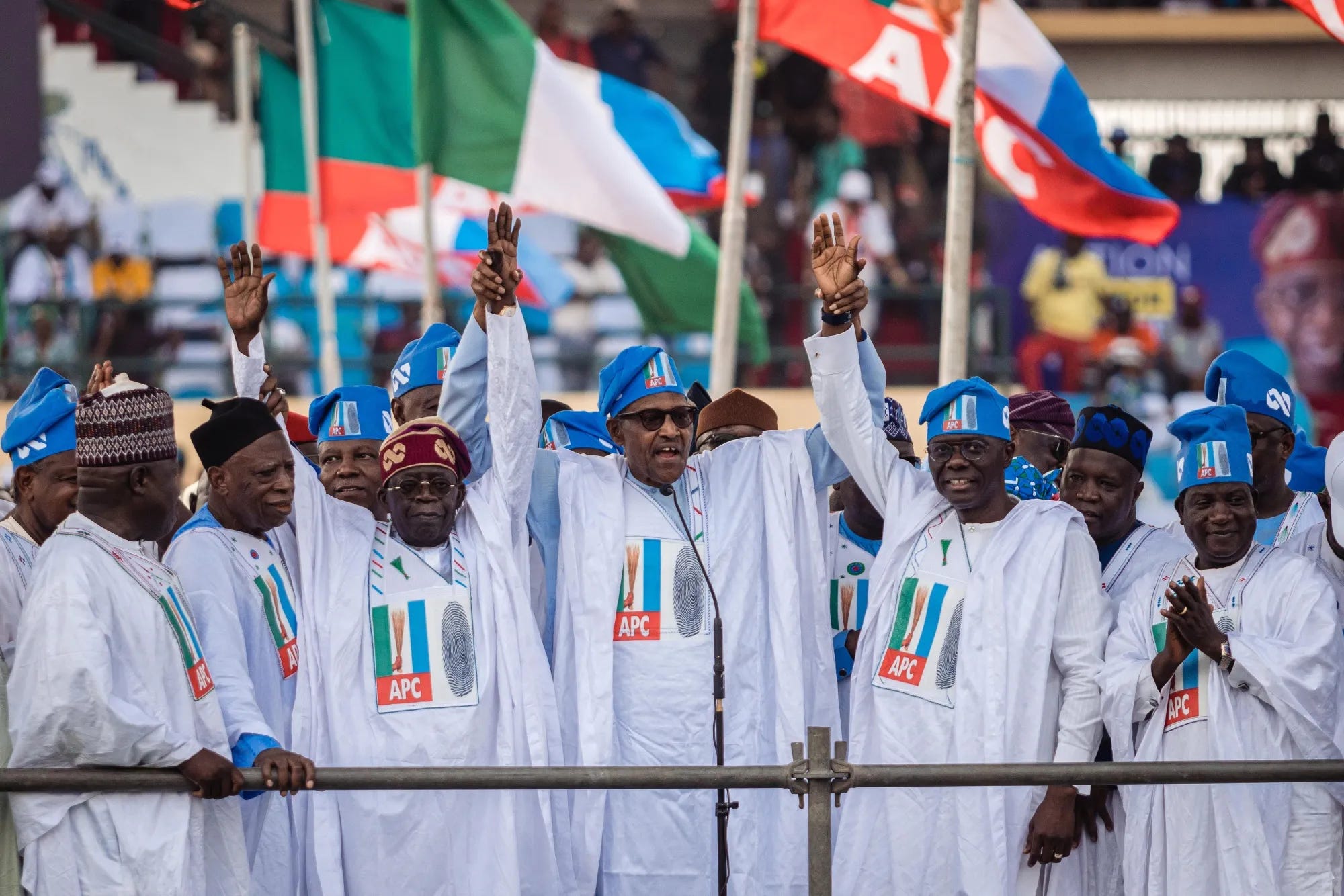
APC’s state control goes against conventional Nigerian and multiethnic African democratic logic: people vote along identity lines, and these are often ethnic, religious and regional. This also runs counter to the results of the last presidential election. In 2023, the frontrunners won the most votes in their home zones. It also means that if a party does well in say, North West, it should not be as dominant or strong in the South East. Yet APC controls governors in zones won by Peter Obi, Atiku Abubakar and Bola Tinubu.
It reinforces the idea that identities overlap closely with economic circumstances and political history. This sudden ‘dawn of a one-party state’ reveals a trap to simplify what Nigerians want from their governments and why they vote the way they do.
The Identity Trap
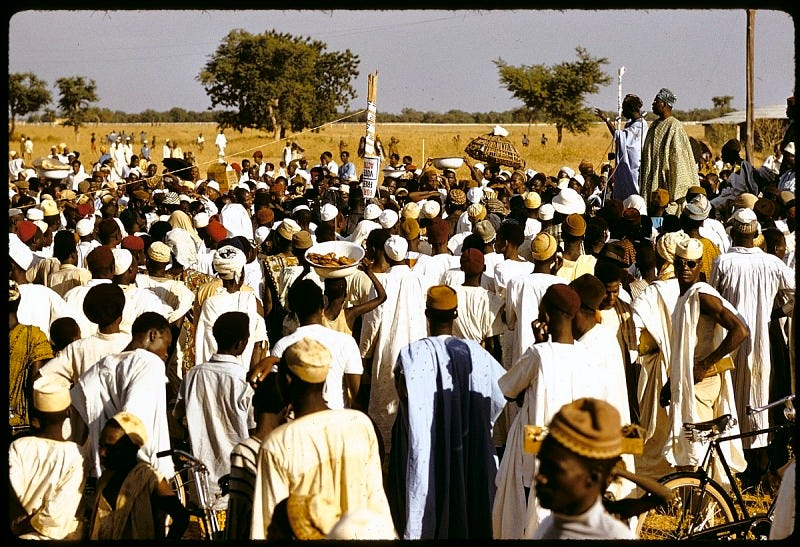
In the earlier Republics, conservative parties, such as the Northern People’s Congress (1960-66) and National Party of Nigeria (1979-83), drew their strength from the North. Similarly, Obafemi Awolowo’s Action Group (1960-66) and Unity Party of Nigeria (1979-83) pursued a more socialist and relatively liberal programme rooted in the South. Voters could distinguish between parties not just by who led them, but by what they stood for.
This pattern partially resurfaced in the Third Republic. The Babangida regime created two state-created parties that followed expected ideological lines. The National Republican Convention, positioned “a little to the right,” drew from the conservative northern establishment. The Social Democratic Party, “a little to the left”, attracted a broader, more progressive coalition anchored in the South. Yet the distinction was shallow: both parties were imposed from above rather than built around genuine programmatic differences, and the annulment of the 12 June 1993 election ensured the experiment never matured.
Notably, these distinctions have largely disappeared in the Fourth Republic. Sa’eed Husaini argues that Nigeria’s governing parties have converged on centre-right economic positions since 1999, a consensus so thorough that manifestos across parties now read as variations on the same theme.
But this convergence is not truly national; it only happens among the elite. The parties agree at the top; the voters they represent do not. Leila Demarest has shown that Nigerian parties incentivise politicians to direct resources towards party elites rather than to constituents. This weakens the ties between legislators and the citizens who elected them.
The result is a political class that has settled its internal disagreements over economic policy and the basic terms of access to power. However, the ethnic, religious, and regional fractures that shape how citizens actually vote remain unresolved. People know parties less by policies and more by personnel. This gap, between what elites have agreed on and what citizens experience, continues to widen.
This disconnect is part of what shapes the party system. Most established democracies coalesce around two broad tents or positions. In Nigeria, those tents are not ideological: they are the ruling party and everyone else. The pattern has repeated itself: PDP dominated from 1999 to 2015, and the opposition consolidated into the APC specifically to dislodge it. Now that the APC holds the centre, the same gravitational pull draws politicians towards it, not out of conviction, but because proximity to power and resources are the primary incentives.
APC currently has a supermajority. But this situation sits atop every unresolved identity claim, regional grievance, and factional ambition that Nigerian politics has always produced. Context matters in understanding whether this is a true reflection of the country or a temporary alignment that its own contradictions will undo.
The Map vs The Mandate
The biggest mistake the APC would make is to mistake the gale of defections for sudden mass support. The more apt description is that governors have made calculated decisions to protect their careers. That decision means little to everyday citizens, who can still punish leaders seen as distant or out of touch.
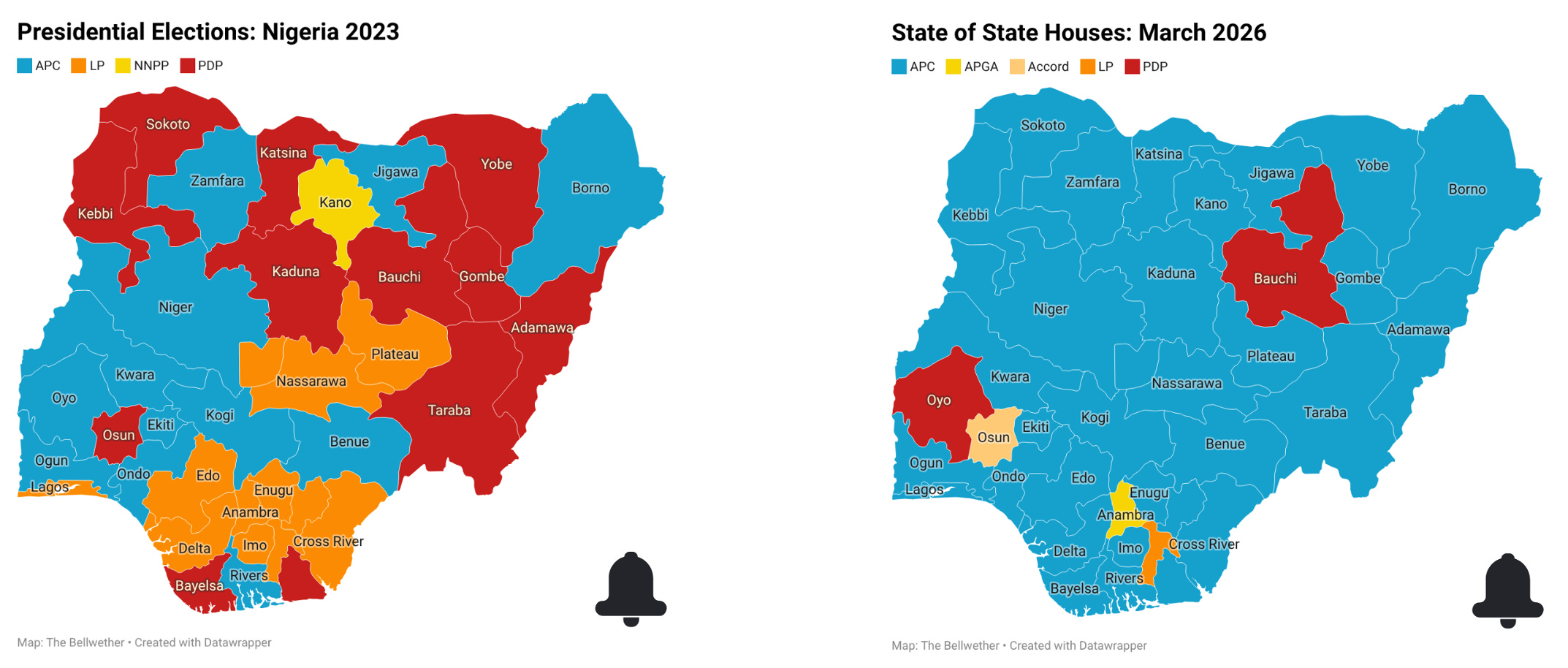
The maps above show where votes went in 2023 and where power currently sits in 2026. A party’s strength is better considered by looking at the state of play in these states. After all, a governor’s defection tells us who controls the machinery, but not who is more familiar with it.
Nigeria has also had controversial electoral processes in past contests, including the 2023 election. Election observers documented discrepancies in declared results in several states. This means the reliability of some declared results remains in question.
The maps reveal a consistent pattern. While APC has absorbed new governors, the actual voter dynamics in some states remain uncertain. In states like Adamawa, where Atiku’s political leaning has been influential, and Bayelsa, where Senator and former Governor Seriake Dickson’s newly formed Nigeria Democratic Congress (NDC) will contest, there may be a stronger contest than expected. This is because consolidations, consultations, and defections do not confirm shifts in the electorate.
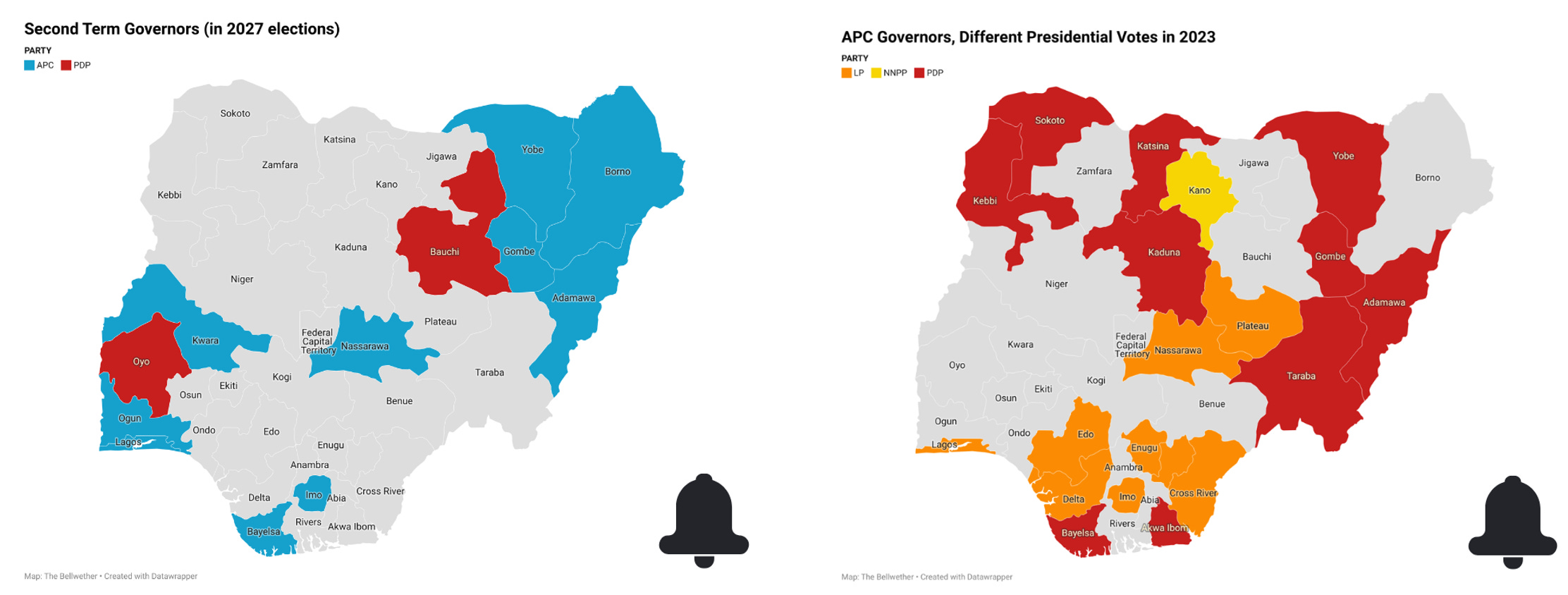
A major question APC will have to address is how to manage incumbencies without mandates. It will defend in states where it swept both presidential and gubernatorial seats. These include Borno, Ogun and Kwara, with stalwart governors who have assumed national profiles.
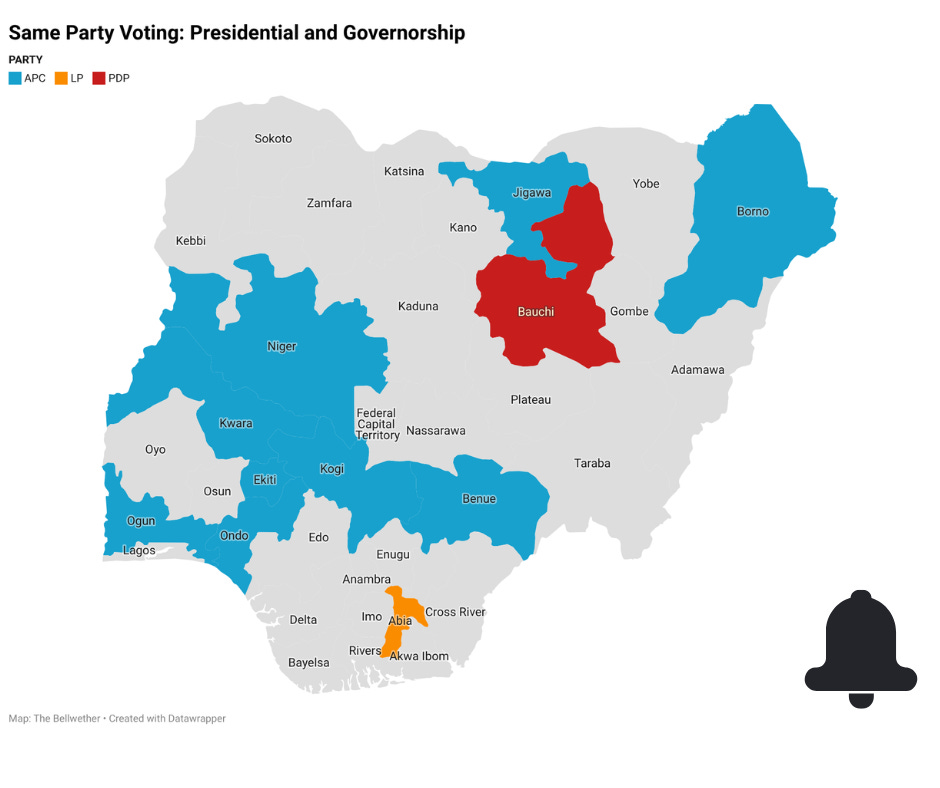
It will also have to contend with the South East and South South zones, where it has governors in states the party has never organically held before. The question will be how to appeal to citizens accustomed to decades of supporting other parties. It might benefit from governors who are seeking re-election, but a handful of them are in states that already voted for another presidential candidate in 2023.
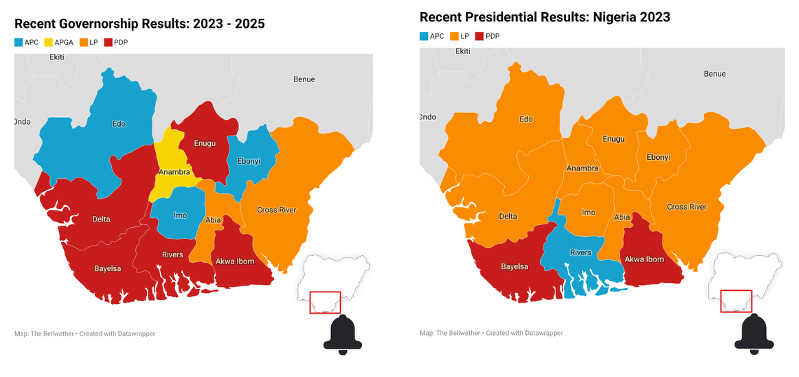
The state of play, in short, looks unassailable. But looking and being unassailable are different things. This gap between the two concepts is where the real story of Nigerian democracy lies today.
Hollow Ground
The mathematics of the APC’s true strength conceals issues that defection headlines have hidden. APC will have ten governors term-limited in 2027, both general and off-cycle, and will have to manage these key succession contests. Some of these will be in states such as Imo, Lagos, and Ogun, with the added issue of managing the different factions and ambitions seeking the post. This will include legacy APC members and those accompanying defectors. Each of these distinct political networks, with different stakeholders, will come with competing claims on the narrow pool of offices and appointments.
Beyond those who are term-limited, some first-term defectors will likely be working with those they defeated in 2023. Reconciling both groups and ambitions will not be easy, and this issue was at the heart of PDP’s own implosion on an even smaller scale. This is without even considering previous ‘next-in-line’ candidates with the preferred successors of newly added governors. The succession ladder will see several rungs replaced, and it won’t be a clean transition.
All these will be conducted under the looming spectre of a presidential and party leadership transition in 2031. Tinubu has deftly managed Lagos APC, but a national party will be a different situation. Northern politicians and platforms have accused the president of supporting and platforming fellow Southerners, in particular Yoruba. To do this ordinarily is hard, but to do this alongside governing, to varying degrees, is a unique and daunting challenge.
APC has so far been able to skirt this challenge because viable alternatives do not seem to exist. APC has at least handled the basic functions of the party, including conducting primaries, litigating when necessary, and coordinating campaigns. Politicians have defected because they can trust that, but this trust can easily run out.
Tinubu’s administration has had to reconcile with the impacts of an uneven fuel subsidy removal, the harmonisation of foreign exchange windows, and years of unresolved fiscal pressure. The result is one of the hardest cost-of-living crises in Nigerian history. Difficult situations sow doubt, and an opposition that can articulate that doubt can reap the benefits.
But the flip side of this economic situation is that it also serves the ruling party. Harsher economic conditions mean the patronage pipeline is narrow, and this favours an incumbent that controls these resources. It results in more would-be defectors staying in line since a half-loaf is better than none.
This situation shows the party is on hollow ground. But there is an even clearer example: the upsets that dotted the 2023 elections. Obi defeated Tinubu in a state he had represented three times, as a senator and a two-term governor. Kwankwaso’s upstart party dislodged APC from Kano’s governorship house. The oft-cited APC-PDP lost the presidential vote in 12 states and the FCT. These were not isolated aberrations. It was proof that Nigerian voters, when given viable alternatives, will exercise genuine electoral agency.
The question hanging over 2027 is whether the energy of 2023 can be replicated. Major opposition figures have since defected to the African Democratic Congress (ADC), making it a major opposition party. Whether this represents a genuinely new political formation or simply another phase of elite realignment remains to be seen.
ADC has not been tested and will need to hit the ground running by uniting, choosing a candidate, and actively courting members to run in down-ballot races. This is what APC did in 2014, on its way to earning the electorate’s trust. This is especially likely if economic conditions continue to test citizens, as the country faces a cost-of-living crisis and electricity shortages. An opposition can leverage this to their advantage if trained carefully.
The hollowness of this one-party-state argument is that it is not composed of strongholds. They do not guarantee inevitability, and there will be opposition politicians who feel confident enough to contest. And while the government can still rely on patronage to help fuel its campaigns, this has never been a durable method for party management.
Nigeria, however, has one example of durable subnational dominance. It looks nothing like what APC has built.
The APGA Model
Only one party has held power at state level for nearly two decades without federal patronage as its primary engine. The All Progressives Grand Alliance (APGA) has governed Anambra since 2006, with all three of its governors—Peter Obi, Willie Obiano, and now Charles Soludo—winning two terms. Notably, in an off-cycle election that tends to attract more attention, Soludo was recently re-elected, sweeping all 21 local government areas.
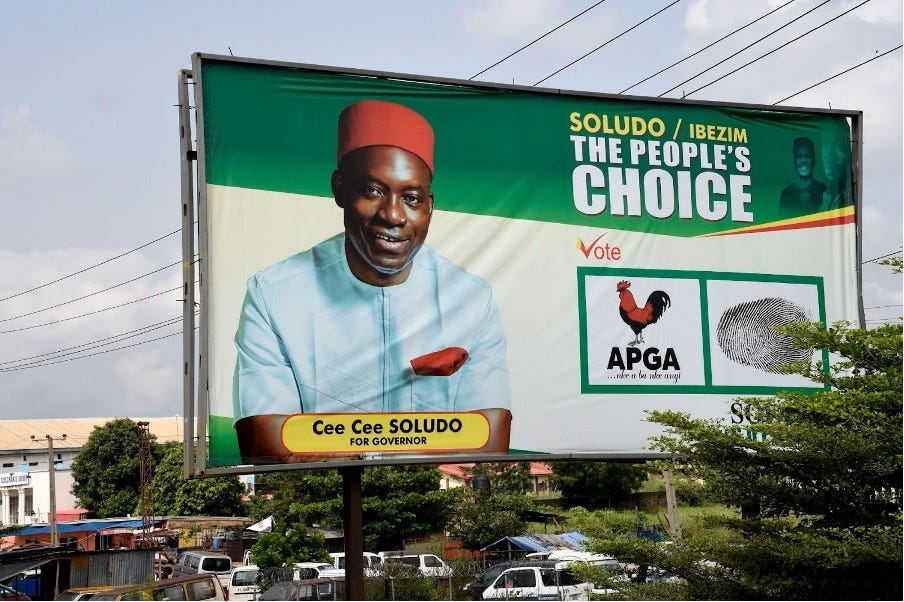
Soludo’s victory is especially ironic given that he ran for governor in 2010 as a member of the then-ruling PDP and, after a term as governor of the central bank, still lost to Obi under APGA. Chris Ngige, a former governor and future minister, ran for his old seat in 2013 as an APC member and still lost to Obiano. Senators, Ministers and prominent politicians have sought to dislodge APGA, but have lost to a ‘third party’ that has remained relevant due to its strength in the state.
What APGA lacks in federal support, it makes up for in identity. The party was founded around Odumegwu Ojukwu, leader of the secessionist Biafran state and former military governor of the Eastern Region. At the 2003 elections, Ojukwu represented the unfulfilled aspirations of Igbo political consciousness. And while he lost that year’s presidential race to Obasanjo, the party has pursued a programme that has appealed to Ndi Anambra. Citizens vote for APGA as a platform and not just for individual personalities. Its strong grassroots campaign, well-vetted candidates, and ability to maximise state resources sustain it. These build trust and ensure citizens back the party’s choice.
It was evident when Soludo’s victory only came once he moved to the party, despite trying and failing before. It was further demonstrated when Obi, who carried the state in 2023, was unable to dislodge the party after endorsing PDP and LP candidates. The platform had outlasted his personality.
This pattern, a platform that outlasts its personalities, is what the APC will meet in several states. The absence of a clear identity continues to haunt the party. After all, it can count former PDP members, Buhari-era conservatives, Tinubu-era progressives and recent political defectors with no clear unifying trait other than a desire to be in power. This shallow unity means that it can be sold out, and there is no similar strength of platform at the expense of the individual.
APGA’s limitations present differently. It has been a consistent force in the South East but has only been able to extend beyond Anambra once, when Rochas Okorocha was elected governor of Imo before he defected to the APC. Moreover, identity-based dominance is durable but also geographically bounded and has a narrow ceiling. APC can operate beyond its networks and cross multiple ethnic lines. But while it is dependent on patronage, APGA survives contact with voters. A successful Nigerian political party will need to move beyond these models to succeed.
The Limits of Ambition
APC survives nationally because it controls what people need access to. The economic pressures already described continue to narrow that access. If and when patronage runs thin, or the presidency favours a faction that did not recruit the current wave of defectors, there is no residual loyalty to fall back on.
A formal one-party state is not the destination Nigeria is heading towards. The PDP’s era of near-total dominance ended because internal contradictions became irreconcilable. Nigeria’s large ethnic blocs, multiple sub-regional interests, an increasing cadre of politicians, and an uneasy political settlement through power alternation make one-party dominance structurally impossible. Because every group believes its turn is due, and that guarantee of unrealised, unbridled ambition will likely lead to splintering.
Citizens, too, have tools beyond the ballot. Despite being weak electorally, Occupy Nigeria’s protests in 2012 against the PDP government drove the then-Goodluck Jonathan to the negotiating table.
What is dangerous is not the number of states APC controls, but the gap between the party’s map and the country’s actual political temperature. APC is consolidating elite control against the direction of voter sentiment. The gubernatorial map shows dominance; the 2023 results and the cost-of-living crisis show discontent. When these two realities collide, as they will in 2027 and beyond, the correction will be significant.
APC has built Muhammadu Buhari House, so it does not have to deal with the empty monument to PDP’s unfulfilled ambition. But it has not built an idea base that makes us understand what it has sought to achieve. It has acquired governors and prioritised them over numbers. APGA survives in Anambra because its voters know who the party is for, and that is why they trust the individuals running it.
The spectre of a one-party state is just that — a spectre. APC’s dominance rests on defections rather than mandates, sustained by patronage rather than ideology, and stretched across regions where it has never organically won voter trust. History offers no precedent for this arrangement surviving. But what should concern Nigerians is not the constitutional question; it is the democratic one. The distance between who holds power and who the electorate would choose grows wider with each defection, each tilted primary, each weakened institution. If that gap continues to widen, it will not matter how many governors the APC claims. What will matter is whether citizens still believe that their vote can close it.
________
Written by: Afolabi Adekaiyaoja
Edited by: Temitayo Akinyemi, ChiAmaka Dike, and Hillary Essien
I thoroughly enjoyed this in the way that my brain just kept going ‘hm I’ve never thought of this in this light.’ On another note, I’m inclined to believe that APGA’s sub National dominance can be linked with the igbo’s traumatic history in the fight for political representation. But then again that thought idea collapses when you consider the remaining I south eastern states that have been unable to replicate sustained sub national victory. Idk. But this so so well written. Given me so much to think about
I'd love to edit for you.
It's a really great article