
He Who Pays the Umpire
Who does Nigeria's electoral commission actually answer to, and why has that question never been settled?

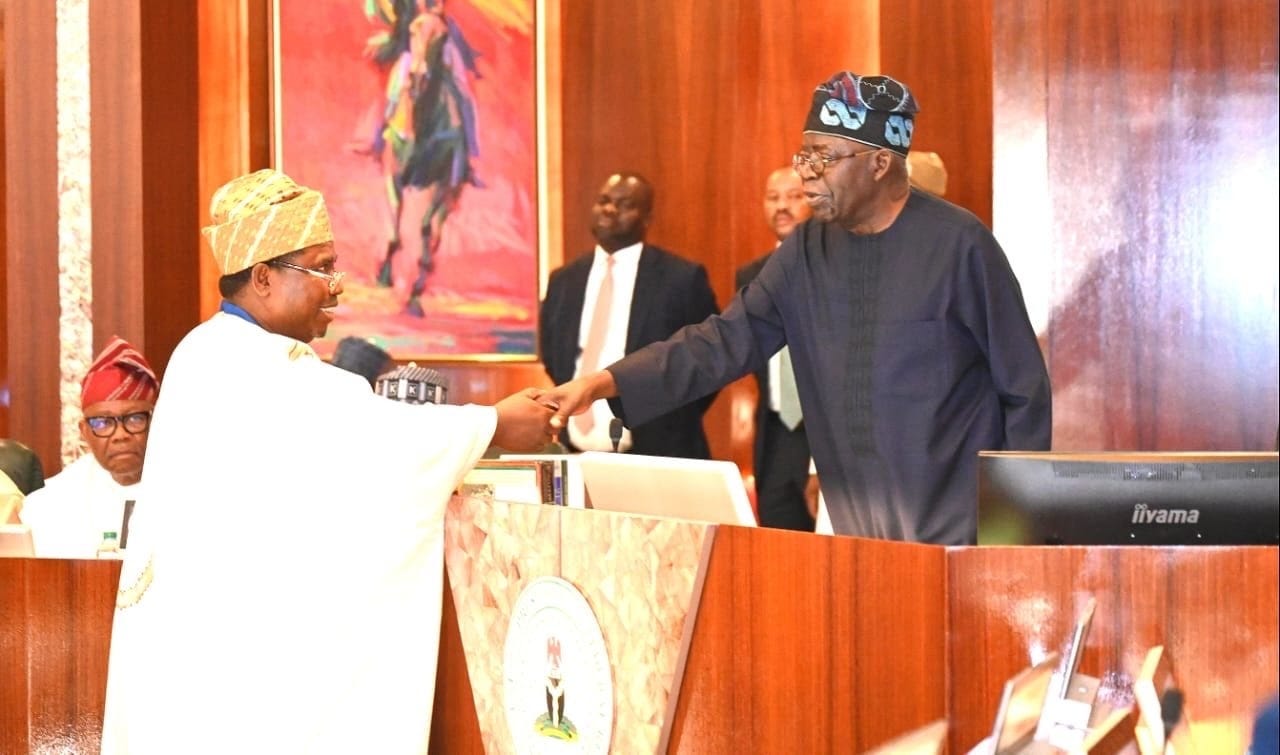
On 23 October 2025, Bola Tinubu swore in his nominee, Professor Joash Ojo Amupitan, as the Independent National Electoral Commission’s (INEC) sixth substantive chair. The whole process was completed in a fortnight, with Amupitan nominated on 9 October and confirmed unanimously by the Senate on 16 October.
The National Council of State, responsible for ratifying the nomination, offered no objection. The Senate, whose majority belongs to the president’s party, offered none. There was no acknowledgement of the irony that Amupitan would oversee an election where Tinubu would be a candidate.
Within six months, Amupitan would run afoul of religious, opposition and activist groups in an assembly of critics that his immediate predecessors had not faced. These controversies bring up the same question: is INEC accountable to the Nigerian people or to the person who appoints its chair?
However, Amupitan should not be considered as the problem, but rather, the problem’s latest expression. The structure that produced him has survived five presidents and three constitutional amendments. This essay is about why this flawed system thrives, and what it would take to change it.
Seventeen Years on a Shelf
Section 154 of the 1999 Constitution gives the president the power to nominate the INEC chairman, subject to Senate confirmation and ratification by the National Council of State, made up of present and former national leaders. A commission that is meant to be independent of the executive is, at its most fundamental level, created by the executive. No administration since 1999 has moved to change this.
In 2007, in response to the aforementioned flawed elections, then-President Umaru Yar’Adua established an Electoral Reform Committee to review Nigeria’s election administration. It was led by former Chief Justice of Nigeria Mohammed Uwais, who had served on the Supreme Court bench for over a decade and commanded wide institutional respect across party lines. His 22-member committee drew from the judiciary, civil society, retired police officers, and academia. Among its members was a political scientist named Attahiru Jega. The committee received 1,466 memoranda, held public hearings across the country, and submitted a 254-page report on 11 December 2008. Nigeria had just endured its worst election since 1999. Yar’Adua had given the committee a full year and a substantial budget, and for once, civil society had reason to believe the recommendations might actually be implemented.
What the committee put on the table was substantial. The power to appoint the INEC chair and commissioners should move from the president to the National Judicial Council. The commission’s budget should be a first-line charge on the Consolidated Revenue Fund. A separate Electoral Offences Commission should be established to prosecute electoral crimes. No elected official should be sworn in until all legal disputes about their election have been resolved. The committee not only listed its proposals but also prepared draft bills covering each recommendation, ready for the National Assembly to act on.
Yar’Adua’s government, to its credit, accepted most of them. The financial autonomy recommendation was incorporated into the 2010 constitutional amendment. The party’s primary requirements, continuous voter registration, and the 180-day tribunal deadline were incorporated into the Electoral Act 2010. But Yar’Adua’s government, through a White Paper, rejected the bid to move the appointment of the chair from the president. In 2012, Uwais himself broke his silence, telling a dialogue on electoral law reform that ‘instead of implementing the recommendations holistically, the Federal Government decided to pick and choose.’
Jonathan did not revive the appointment recommendation either. When he resubmitted the full, unedited report to the National Assembly in March 2010, a gesture that civil society praised, INEC gained financial autonomy under Section 81 and administrative independence under Section 160. The appointment power stayed with the president. The proposed Electoral Offences Commission was never established. The recommendation that no elected official be sworn in until election petitions were resolved was never implemented. The Resident Electoral Commissioner appointments remained the president’s. The legislature took the reforms that cost the executive nothing and set aside the ones that would have cost it something.
Then Buhari won in 2015.
No president had a better reason to know what a captured commission could do. He had lost three elections and wept openly at a press conference after promising he had run his last race. In October 2016, after over a year in office, rather than implement Uwais, he set up an entirely new committee, chaired by former Senate President Ken Nnamani, to review the same ground.
The Nnamani committee submitted its report in May 2017, making similar recommendations to insulate INEC from executive control. Some of its recommendations on electoral technology made it into the Electoral Act 2022: the Bimodal Voter Accreditation System (BVAS) and the legal backing for electronic transmission of results both drew on that reform momentum.
But these changes did not come with the necessary policy to ensure their effectiveness. The 2023 election showed how those provisions could be undermined in practice without the structural changes the report had also called for. The appointment power was never touched. Between 2016 and 2019, Buhari rejected attempts to amend the Electoral Act on three separate occasions. In 2019, Nnamani himself publicly condemned the INEC appointment process as “faulty” and called for implementing the Uwais recommendations. The president who commissioned that review did not act on it.
Tinubu, who came to power in the most disputed election of the Fourth Republic, oversaw his own amendment to the Electoral Act in February 2026, which included a mandatory transmission via the INEC Results Viewer (IReV) portal and codified BVAS, but left Section 154 untouched. These are not failures of political will. They are choices, made by specific men, about a specific power they wanted to keep.
The Deal
Nigeria is a federation whose political architecture runs on a managed distribution of offices, contracts, zoning arrangements and electoral outcomes across regional, ethnic and religious blocs that have never produced a stable settlement. The president’s control over INEC is not an anomaly within that architecture. It is load-bearing. His ability to hold a coalition together across Northern governors, Southern oil interests, Lagos, the commercial capital, and Middle Belt constituencies depends, in part, on his ability to credibly promise that the next election will not undo the arrangement. A genuinely independent INEC does not just threaten individual politicians. It threatens the deal.
The PDP and APC have held the presidency since the return to democracy, including with National Assembly supermajorities at different points. Both parties, in opposition, argued for reform. Both, in power, ignored it. A 2025 study in World Affairs found that despite the Electoral Act of 2022, INEC’s activities remain “massively influenced by political interferences.” An unnamed APC source told The Whistler in early 2026, without embarrassment:
“The demand for INEC neutrality often depends on political convenience. Political actors push for reforms when they are in opposition, but once in power, they resist the same changes.”
The word “independent” survives all of this because no one is well served by resolving what it means. The “I” in INEC makes gestures legible to the international community that funds them — the AU, the UN, the EU, the State Department — while Section 154 sits untouched. It keeps Nigeria on the invitation list for the Summit for Democracy. The word costs the presidency nothing and buys it the appearance of a democratic state. Everyone with the power to resolve the ambiguity has a valid reason, albeit a selfish one, not to.
But the problem runs deeper than the chair. The same hand that appoints the chairman also appoints the Resident Electoral Commissioners (RECs), the 37 officers who oversee elections at state level, manage collation centres, and are present when results are announced or disputed. The chair cannot discipline a REC without referring the matter back to the president who appointed them both.
The 2023 Adamawa governorship election showed the limits of a chair’s powers. REC Hudu Yunusa Ari unilaterally declared Aisha Binani, the APC candidate, winner before collation was complete, a declaration INEC’s national headquarters called “null, void and of no effect.” Ari was suspended, and the proper result, a PDP victory, was announced the following day.
In August 2022, a coalition of eight civil society organisations had warned Buhari that his REC nominations included APC members and asked the Senate to reject them. The Senate confirmed them anyway. In April 2025, as Yakubu’s tenure closed, INEC quietly proposed to the joint National Assembly committee on Electoral Matters that this chain of control be broken at least for the RECs, renamed as State Directors of Elections and appointed by INEC itself. The National Assembly did not act on it. The Electoral Act 2026 does not contain it.
What this mirrors is not incidental. Nigeria’s State Independent Electoral Commissions, which conduct local government elections, are even more deeply captured than INEC. Governors appoint their members. In most states, the ruling party has not lost a local government election in the living memory of its constituents. INEC sits at the top of an electoral architecture in which every tier of appointment runs through the executive that the elections are meant to hold accountable. The word “independent” does not change that architecture; rather, it describes a function that does not exist.
The Jega Myth
Besides being a professor of political science, Attahiru Jega was a former ASUU president who earned his activist bona fides by organising against the Babangida government in the early nineties. When Goodluck Jonathan nominated him as INEC Chair on 8 June 2010, the National Council of State, including Buhari, Obasanjo, Babangida, Abdulsalami, Gowon and Shagari, approved unanimously. Previous nominations had not always passed without complaint. Civil society had criticised Maurice Iwu’s 2005 appointment over his perceived closeness to the Obasanjo administration. Jega’s was different. For once, nobody objected.
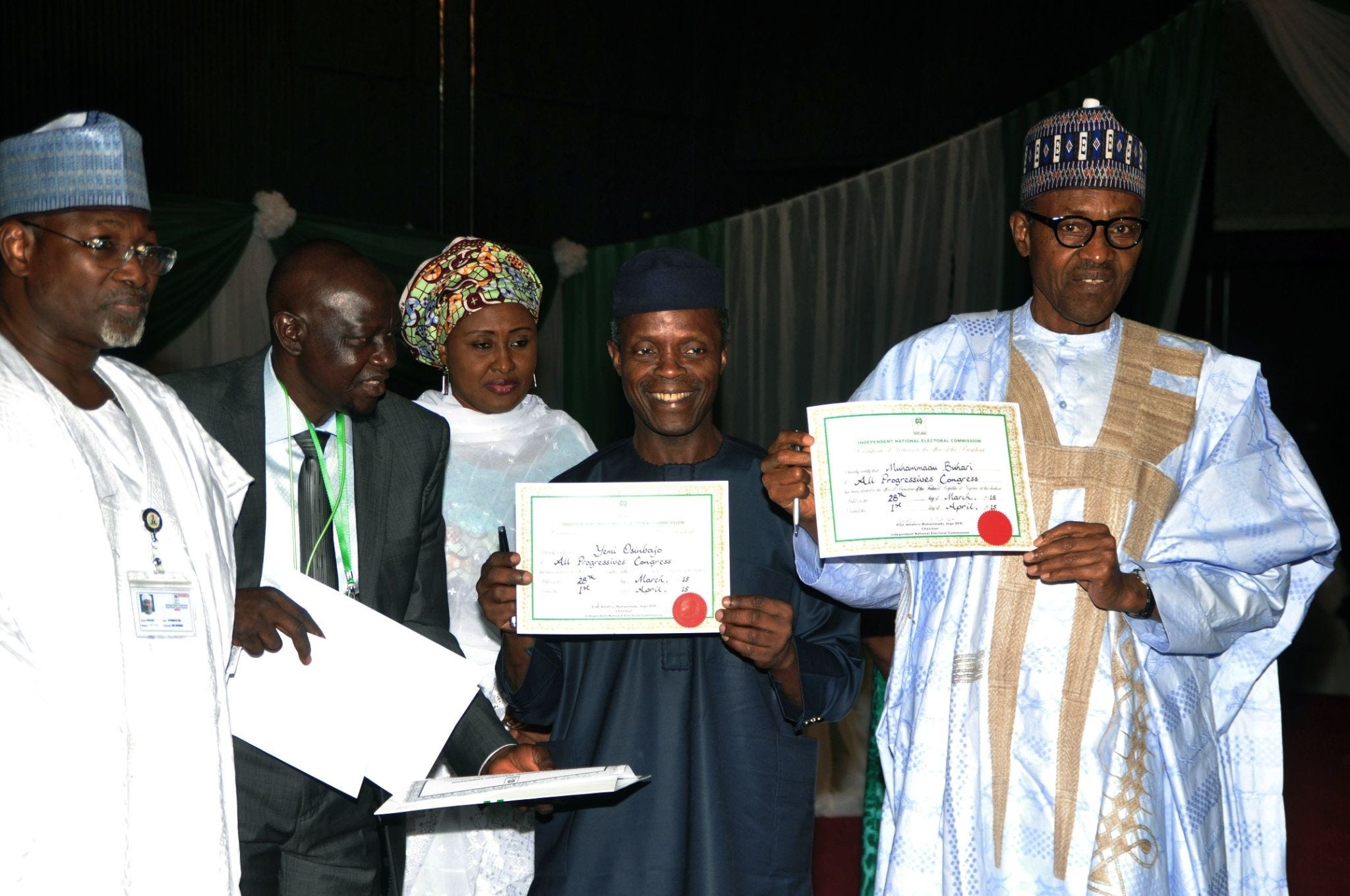
Jega’s mythos was secured when he became the first INEC chairman to preside over an election in which an incumbent president, who had nominated him to the post no less, lost re-election. On 28 March 2015, Muhammadu Buhari defeated Goodluck Jonathan, who then conceded in a famous phone call; something no incumbent president had ever done before. The electoral observers were satisfied. Buhari, years later, at a leadership award ceremony, would credit the outcome to “the patriotic zeal of President Jonathan, the impartiality of the electoral umpire, INEC, and exemplary conduct of the political parties, foreign pressure and other actors.”
While Jega displayed personal integrity, what Buhari described was not a functional institution. Jega himself understood this. In a 2017 interview with the Africa Research Institute, he praised the Jonathan administration for never deliberately starving INEC of funds. That praise, genuine as it is, tells you more about how fragile the arrangement was than about how well it was designed.
Having acknowledged that the Uwais reforms were important, Jonathan chose to demonstrate his commitment to them by appointing a member of the very committee. We do not know whether Jonathan did this in genuine good faith, or whether giving the reformer the job was a way to contain the reform. What we do know is that his acceptance carried an implicit argument: that character could substitute for architecture. It was also an argument that the Uwais Committee had specifically made against. Jega’s appointment was Jonathan performing the spirit of the report while leaving the crux of it alone. The question Nigeria never asked in the aftermath was, what happens when those conditions do not align again?
After leaving INEC in June 2015, Jega spent years publicly advocating for precisely the reforms that would have changed how the office he just vacated was filled. The man who embodied the system’s capacity for self-correction has spent the decade since his tenure arguing that the system still needs fixing. He is now Special Adviser to President Tinubu on Livestock Reforms.
Buhari, who had just won an election on the back of INEC’s credibility, appointed Mahmood Yakubu, a Bauchi-born professor of political history and former TETFund executive secretary, to succeed Jega. In 2023, Yakubu’s commission deployed the BVAS and the INEC Result Viewing Portal after years of public promises that results would be transmitted electronically in real time. Those of us journalists who sat refreshing the portal through the night of 25 February remember when the updates stopped. INEC announced a technical glitch. Results were collated manually. Tinubu’s legal team argued that the IReV was a viewing portal rather than a collation system, and that INEC’s failure to use it as it had publicly committed to do was not grounds for nullification. Research has since documented glaring discrepancies between the IReV results and the announced results.
Joash’s Inheritance
In 2020, half a decade before Joash Amupitan became INEC chair, he contributed an eighty-page legal brief to a publication arguing that attacks by Boko Haram and Fulani herdsmen against Christians in northern and central Nigeria met the legal definition of genocide. He stated that “Fulani ethnic militants and state institutions” were working toward “Islamising Nigeria,” and that the international community should consider referring Nigeria to the International Court of Justice. The Supreme Council for Shari’ah described it on 7 November 2025 as “toxic, provocative and bigoted.” On 28 January 2026, at the Council’s Pre-Ramadan Lecture in Abuja, its president, Sheikh Bashir Umar, declared that Nigerian Muslims would not recognise or legitimise any election Amupitan conducted.
Then, in April 2026, Farooq Kperogi documented in a column that an account bearing the handle @joashamupitan had made several posts supporting APC and Tinubu in the aftermath of the 2023 elections. After his nomination, the handle was changed, relabelled as a parody account, and locked. Kperogi confirmed the original ownership through Grok, X’s AI bot. And while there are concerns around Grok’s accuracy, it demanded a response. INEC’s spokesman, Adedayo Oketola, denied that the account belongs to Amupitan and claimed that a forensic investigation had cleared the chair. Amupitan has not personally addressed it.
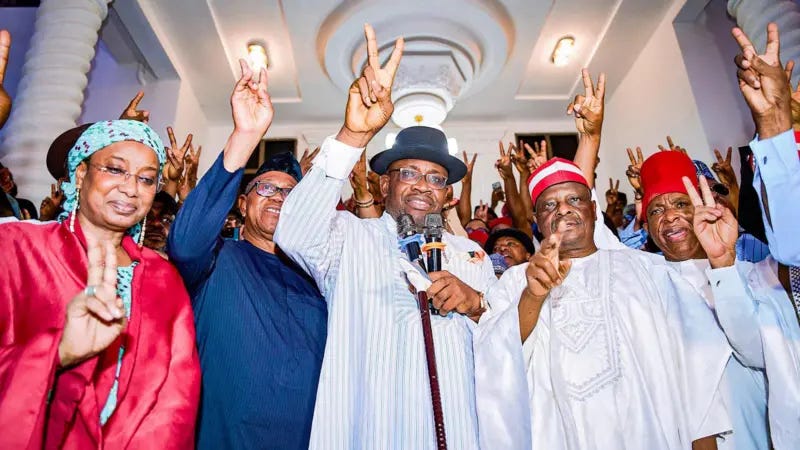
The ADC crisis arrived weeks later. When Kwankwaso formally defected from the NNPP to the African Democratic Congress on 30 March 2026, with Peter Obi, David Mark and Rauf Aregbesola in Kano to mark the occasion, the party briefly looked like the vessel the fractured opposition had been searching for. Within days, a leadership dispute erupted. The Court of Appeal ordered all parties to maintain the status quo. On 1 April, INEC announced it was withdrawing recognition from both factions and removing Mark and Aregbesola from its portal. Obi, Kwankwaso, Mark and Aregbesola marched to INEC headquarters. It took a Supreme Court ruling to temporarily resolve this.
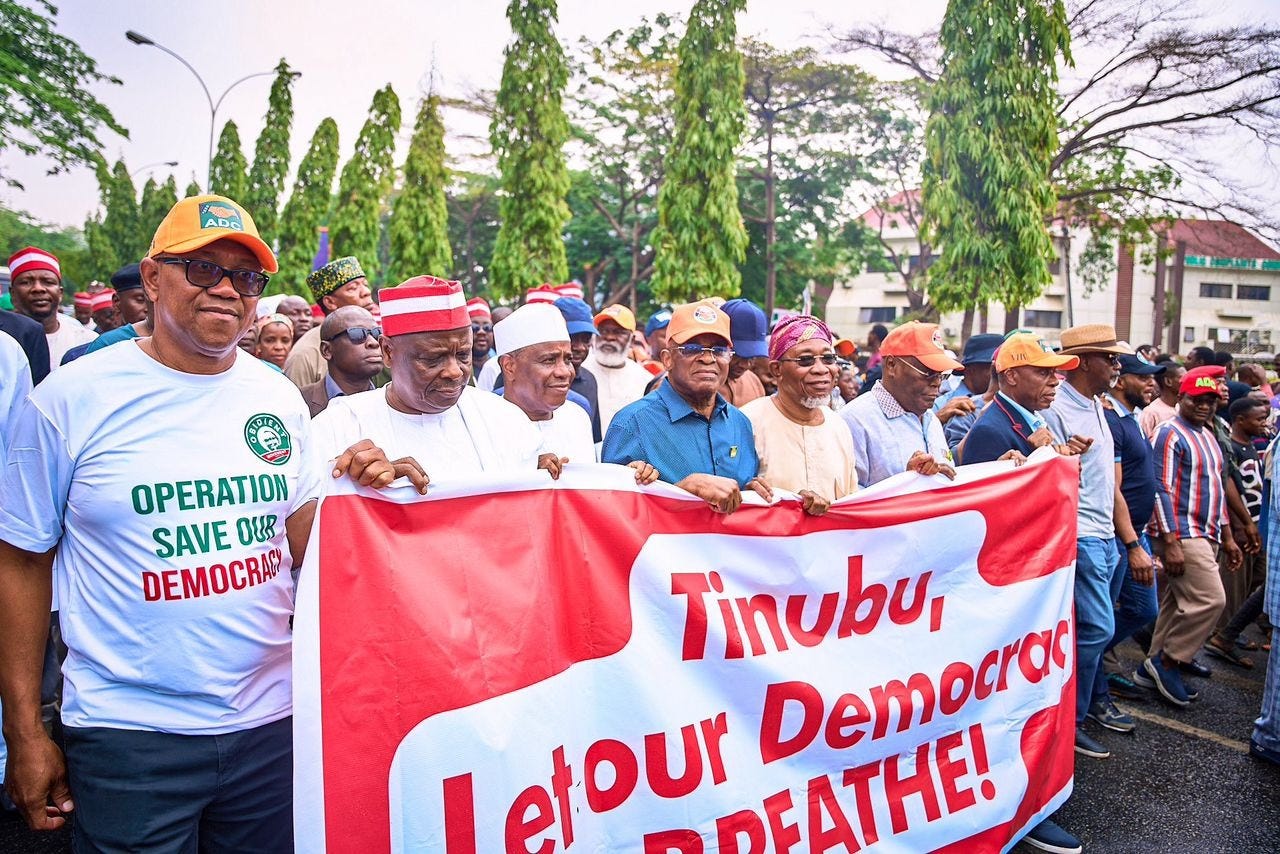
On 3 May, Obi and Kwankwaso formally left the ADC for the Nigerian Democratic Congress (NDC), citing what Obi described as a “toxic environment” shaped by relentless litigation. However, the party they moved to also carries its own implications for INEC. Obi left the ADC, citing INEC interference, and arrived at a party the commission had registered only three months earlier, in violation of its official screening process. Its registration has been challenged in court, alleging the NDC obtained registration without properly applying and without meeting INEC’s own guidelines.
To be fair, none of this makes Amupitan uniquely bad at the job. But the issue remains that his controversial appointment makes a bad situation worse. Academic analysis of INEC’s structure has consistently found the commission’s independence “systemically constricted” across three fronts: the appointment system, the funding pathway, and its reliance on other state institutions. The chair is not necessarily the issue. What has accumulated around this one is.
What Should ‘Independence’ Look Like?
Ghana’s Electoral Commission is worth naming here, not as a model Nigeria should unilaterally copy, but as a demonstration that the problem Nigeria has is not inevitable. Its commissioners are appointed by the president on the advice of the Council of State, a body whose composition includes regionally selected representatives and non-partisan judicial and defence positions. This representation means it properly covers a range of interests, not just serving and former political elites.
Its electoral commission has administered seven competitive elections since 1992; three of them saw incumbents lose. The 2008 election was decided by less than half a percentage point, went to a runoff, and the result held. Ghana’s electoral system has also had its fair share of trials, with electoral disputes and the commission attracting controversy. But bounded executive discretion produces a different starting point than unbounded executive discretion.
Section 154 has survived five presidents, three constitutional amendments, two major reform committees, and the most disputed election in the Fourth Republic. So, we can agree that it is a tough beast to kill. The question is not whether it will change, but what would have to be true for it to change. Which president can willfully decide that the power to pick the umpire is one that they can afford to give up? Which National Assembly majority would have to agree? Neither condition has existed in INEC’s twenty-seven years.
What will forever exist is the meaning of the ‘I’ in INEC. The word has survived everything this country has thrown at it. It is, in that sense, the most independent thing about the commission.
Amupitan will conduct the 2027 election under a legitimacy deficit that no forensic audit has closed. He will do so as the nominee of a president whose political future as a second-term candidate or kingmaker depends on the election’s outcome. Nigeria has had captured commissions before, but it has not always had one whose chairman enters an election year with a major religious body declaring his results illegitimate before a ballot has been cast. What that looks like in practice, the country will find out in January.
The commission will still be called independent. The next chairman will still be a presidential nominee. Mahmood Yakubu managed that arrangement for ten years. He is in Doha.
—
Written by: ChiAmaka Dike
Edited by: Afolabi Adekaiyaoja
Corrections (8 May): A sentence concerning Tinubu’s lawyers arguing about IReV was added. Another, citing the possible inaccuracy of Grok, X’s AI, was included. Lastly, the inferred reason for Obi and Kwankwaso leaving ADC was changed from ‘relentless mitigation’ to ‘relentless litigation’.
Mannn, you people are doing the Lord's work
This is a hugely fantastic read and I really did learn and take a lot from it than I ever knew about the warped electoral system. Political office holders would always act in their interests at all times.