
Is there a Nigerian Bellwether state?
Osun and Ekiti might look like voting indicators for 2027, but the truth is less obvious

In politics, analysts often look for bellwethers, places that have successfully set the trend by matching a national result. In the UK, the party that has produced the winner of the Dartford constituency election has gone on to form the government, often winning the election, since 1964. In the United States, it’s been a three-way tie among Michigan, Pennsylvania, and Wisconsin since 2008, although states like Ohio have been right 30 out of 33 times since 1896.
Nigeria’s general elections run on a four-year cycle. However, governorship elections in eight of the country’s 36 states now fall outside it, largely due to judicial rulings. When Ekiti and Osun elect their governors, they take part in the last elections before the general election, offering the closest chance for such predictions. In fact, people even use the term ‘bellwether’ to describe these elections.
On the electoral record, Nigeria appears to have bellwether states: two states have, in some form or another, consistently voted with the majority in presidential elections (accounting for 2007’s missing data). But while the bellwether concept seeks to identify which populations can serve as representatives of the wider electorate, it descends from median-voter logic, which only makes sense in a system that rewards capturing the middle. Nigeria’s presidential system rewards not only a national plurality but a geographic spread of states. As a result, the search for a single, representative state assumes a kind of competition that our fragmented electorate does not necessarily produce. This search asks what we actually measure when one state repeatedly votes for the winner, and whether these voters resemble the country’s views. The cynical answer is that politicians have just been better at recognising power shifts. Unpacking this speaks to the challenge with data and analysis post-Osun and ahead of the next elections, as well as the harsh reality of Nigerian politics a quarter century after a return to democracy.
“Dress Rehearsals”
The obvious place to look for a Nigerian bellwether is the closest off-cycle elections. Ekiti (June) and Osun (August) are both in South West Nigeria and take place months before a general election. In most cases, the parties have resolved any post-primary disagreements and can present a united front to campaign for their gubernatorial tickets. Any party’s victory is often seen as a predictor of success or failure in the coming months.
The record does not support this argument.
In 2014, Ayodele Fayose defeated incumbent Governor Kayode Fayemi to take Ekiti for the PDP, while Rauf Aregbesola was re-elected governor of Osun on the platform of the APC. Months later, PDP’s Goodluck Jonathan lost the presidential election. In 2018, Kayode Fayemi regained the governorship in Ekiti, and Gboyega Oyetola succeeded Aregbesola in Osun. Both APC victories preceded Buhari’s re-election in 2019. But in 2022, while APC’s Biodun Oyebanji was elected in Ekiti, then PDP’s Ademola Adeleke defeated Oyetola in his bid for re-election in Osun. APC’s Tinubu would go on to win the 2023 presidential election, dismissing the idea that he needed Osun to win the election.
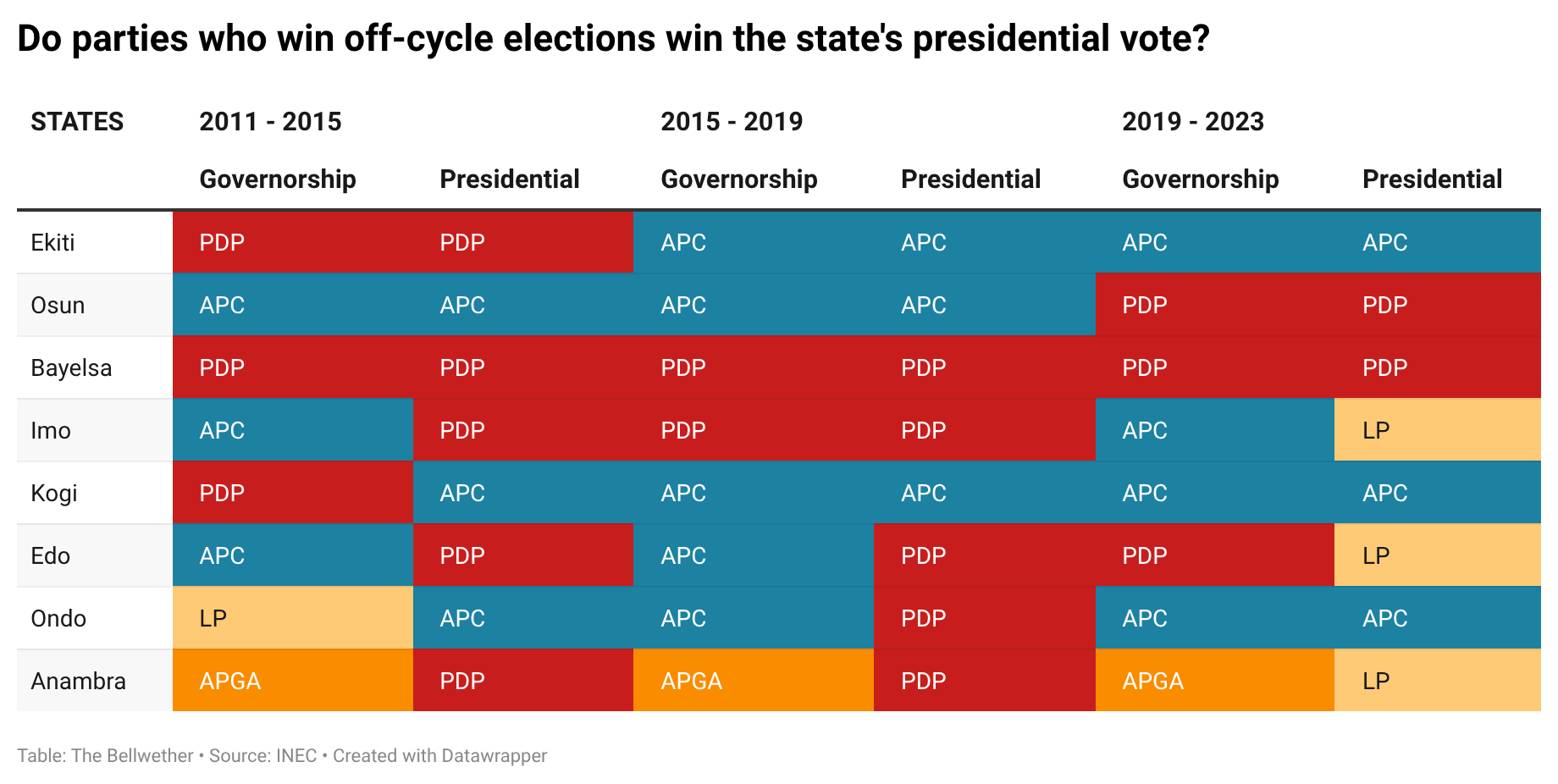
If we extend this argument to all eight of Nigeria’s off-cycle states and go back through the last three election cycles, there is a haphazard pattern of off-cycle governorship elections preceding party victories in those states. In three of those states – Ekiti, Osun and Bayelsa – the pattern has been consistent: winning the governorship election has preceded winning the state’s presidential vote. But even there, Ekiti (2015), Osun (2023) and Bayelsa (2015 – 2023) have failed to predict the national mood. Some discrepancies include Kogi only breaking once, when PDP held the seat before losing it later in 2015. Ondo also saw Buhari win in 2015 during Mimiko’s term under PDP, and then Atiku win in 2019 during Akeredolu’s term.
The more glaring case in Anambra can be explained by APGA’s dominance in governorship elections and the inability of APGA presidential candidates to be as competitive. Interestingly, Edo has also never voted for an APC presidential candidate despite winning three of the last four governorship elections and producing two national chairs. Imo also returned PDP candidates in 2015 and 2019, before backing Obi in 2023.
Off-cycle governorship elections are the nearest thing Nigeria has to a mid-term poll, but they are poor substitutes for one. It also fails to consider local political considerations, incumbency factors and the variation between federal and state interests. Obi’s dominance in the 2023 elections did not translate into Labour victories in the off-cycle governorship elections that followed: in the Imo state election, held months after the presidential poll, or in Edo a year after, or even in Anambra where he was a former two-term governor. Likewise, Adeleke’s victory might log as an opposition win, but he has still endorsed Tinubu for re-election. Governors are important in Nigerian politics, but perhaps a larger dataset might help get a clearer picture of where and how.
It is also worth asking why the calendar exists at all. Off-cycle elections mostly exist because court decisions changed the election calendar. Unlike U.S. midterms, which are actually designed to be held that way, these elections were not meant to serve as predictors and are simply there because of tribunal decisions. It would be weak to read them as signs for the future.
Middle Belt Bells
When looking at federal elections, we find two states that have reliably voted for the eventual presidential winner since 1999. Kogi and Kwara, in the heterogeneous North-Central zone, backed the PDP presidential candidates from 1999 to 2011 and were part of the trend of following the APC from 2015 to date. If we go even further back to the Second Republic, Kwara, which then included parts of present-day Kogi, voted for Shagari in both 1979 and 1983. If we go even further back to the 1959 elections to the Federal House, candidates from the NPC won most of the seats in present-day Kwara. For decades, and now consistently, that area has been a reliable bellwether for Nigerian elections. Kogi, it is worth noting, sits in both halves of this search: it is an off-cycle governorship state and one of two that has never missed.
There are two obvious points for this. First, both states are easily accessible to a large proportion of the country. Kogi borders 10 other states and the FCT, more than any other state. For context, this means its neighbours are from five of Nigeria’s six geopolitical zones. It is also home to the confluence of the Rivers Niger and Benue, providing a critical transport and trade hub between the north and south.
Second, both states reflect Nigeria’s diverse ethnic and religious demographics. While some zones are largely homogeneous in ethnicity, religion, or language, the North Central is notably distinct in lacking a single dominant group along any of these lines. This melting pot is clear across most other states in the zone, including Benue and Nasarawa, but is even clearer in areas with major groups, such as the Igala, Ebira, and Okun — who can trace different origins in different parts of the country. Ilorin is an Emirate, while a significant number of its residents are Yoruba and have no Oba. Kogi is also home to prominent groups such as the Nupe, Idoma, Igala, and Okun.
Neither explanation survives when we look at the evidence. The results might prove prescient of the eventual election winner, but they do not tell us more about how these populations mirror national outcomes. We can make the case that Labour was particularly strong in the South East, where Obi is from, but it was also strong in Benue and Nasarawa, other states in North Central, as well as the FCT. That Kogi and Kwara did not reflect strong Labour numbers in the election might point to other factors that don’t readily get covered above. If diversity produced the record, Benue and Nasarawa would have it too. There is also a duller possibility worth considering: 36 states across a small number of presidential cycles will throw up a perfect record or two by accident. Correlation over seven data points is grounds for finding a mechanism, not an argument.
Nigeria lacks the demographic data needed to determine whether Kogi and Kwara truly resemble the national electorate, thereby allowing us to gauge if support for southerner Tinubu over northerner Atiku in 2023 was a result of a population change after backing Northerner Buhari in preceding elections. But there is another dataset that helps explain the change more clearly and helps us identify what the Bellwether truly is.
Direction of Travel
Most of the time, bellwether trends can be seen in election results preceding a change or in polling data indicating a change. But Kogi had a PDP governor in 2015, and Kwara also elected a PDP governor in 2011. The easiest clue to how this changed appeared in 2015, and the easiest test of why that change was not as voter-based as it was came in 2019.
In 2014, two-term Kwara State governor and Senator Bukola Saraki defected to the APC, accompanied by his protégé and handpicked successor as governor, Abdulfatah Ahmed. Kogi politicians, including two former state assembly speakers and two governorship aspirants, defected from the PDP to the APC. As more politicians saw an opportunity to stake their influence on a viable alternative, APC support swelled, leading to the PDP’s displacement in several states. Some might argue that Buhari’s long-time Northern support encouraged many politicians from Northern states who felt schemed out of PDP planning following Jonathan’s decision to seek re-election. In any case, Kogi and Kwara represented states that had been reliably PDP strongholds prior to 2015; most core Northern states in Buhari’s column had long supported him in presidential elections but reliably returned PDP governors.
However, by 2019, Saraki had become Senate President and later returned to the PDP ahead of a 2023 presidential bid. Ahmed was a term-limited governor, and Kogi had elected APC’s Yahaya Bello in November 2015. Nigeria’s governorship-heavy politics would have expected Kwara to return to the PDP under the influence of its two recent governors. Yet, the Ó Tó Gẹ́ (It is enough) movement saw opponents align to whittle Saraki’s influence. APC regained the governorship, and Saraki lost his own Senate seat. In 2023, PDP was unable to regain both the governorship and the presidential vote.
Saraki’s defeat reads, at first, as refuting everything argued here: voters overriding an elite bloc, thereby restoring the electorate as the thing worth watching. But Ó Tó Gẹ́ was not simply a spontaneous revolt. It was also organised and amplified by rival politicians who remained within the APC and had federal might after Saraki defected, including Lai Mohammed, a two-term cabinet member, and Gbemi Saraki, his sister, who was later rewarded with a cabinet post.
In Kwara, 2019 demonstrates something narrower than a voter revolt: where a prominent politician and the federal government disagree, the state follows the centre. As such, Saraki was never the bellwether. The real test for the direction of Nigerian elections is politicians’ direction of travel. This showed in 2014, when Saraki’s machine collided with a rival coalition aligned with the federal ruling party; incumbency at the state level was not enough to save it. We can similarly argue that in 2018, Saraki and other stalwarts, such as Rabiu Kwankwaso and Aminu Tambuwal, took the opposite route and were unable to defeat Buhari. Then, the trend was clearly not enough to upset another incumbent, as enough leaders in states did not tow this path. And, in 2023, when a splintered opposition helped the ruling party retain power.
Elite movement is predictive when it converges with a constituency that movers did not create. It rewarded bets in 2014 by those who created APC, but also those in 2023 who decided that Nigeria could elect a Muslim-Muslim ticket in the face of a fairly unpopular incumbent and popular opposition. Tinubu’s victory depended not only on his electoral base but also on holding together a broad political coalition, while his principal opponents were less united than they were in 2014. The distinction matters because otherwise the claim is circular: politicians move towards eventual winners, so their movement ‘predicts’ the winner. The 2013 defectors were not moving towards power but leaving a weak incumbent 18 months before the vote. This was a bet that paid off. In 2018, the bet did not, showing that this indicator carries information.
Herd Mentality
This is not an ideological argument. Katz and Mair’s account of the cartel party, in which organisations can weaponise state access to finance themselves and weaken rivals, explains why defection is an easy path to take and why it is a more active test of politics. For career politicians, party membership can therefore become less an ideological identity than a calculation about access, viability and survival. They also get bullish about doing so because they are not often punished at the polls. They are also not punished by the constitution. Section 68(1)(g) permits a legislator to change party only when there is a division in the party being left; Members leaving the PDP have weaponised this in recent times, and the non-enforcement of the law allows it. The non-enforcement is not an oversight but the design.
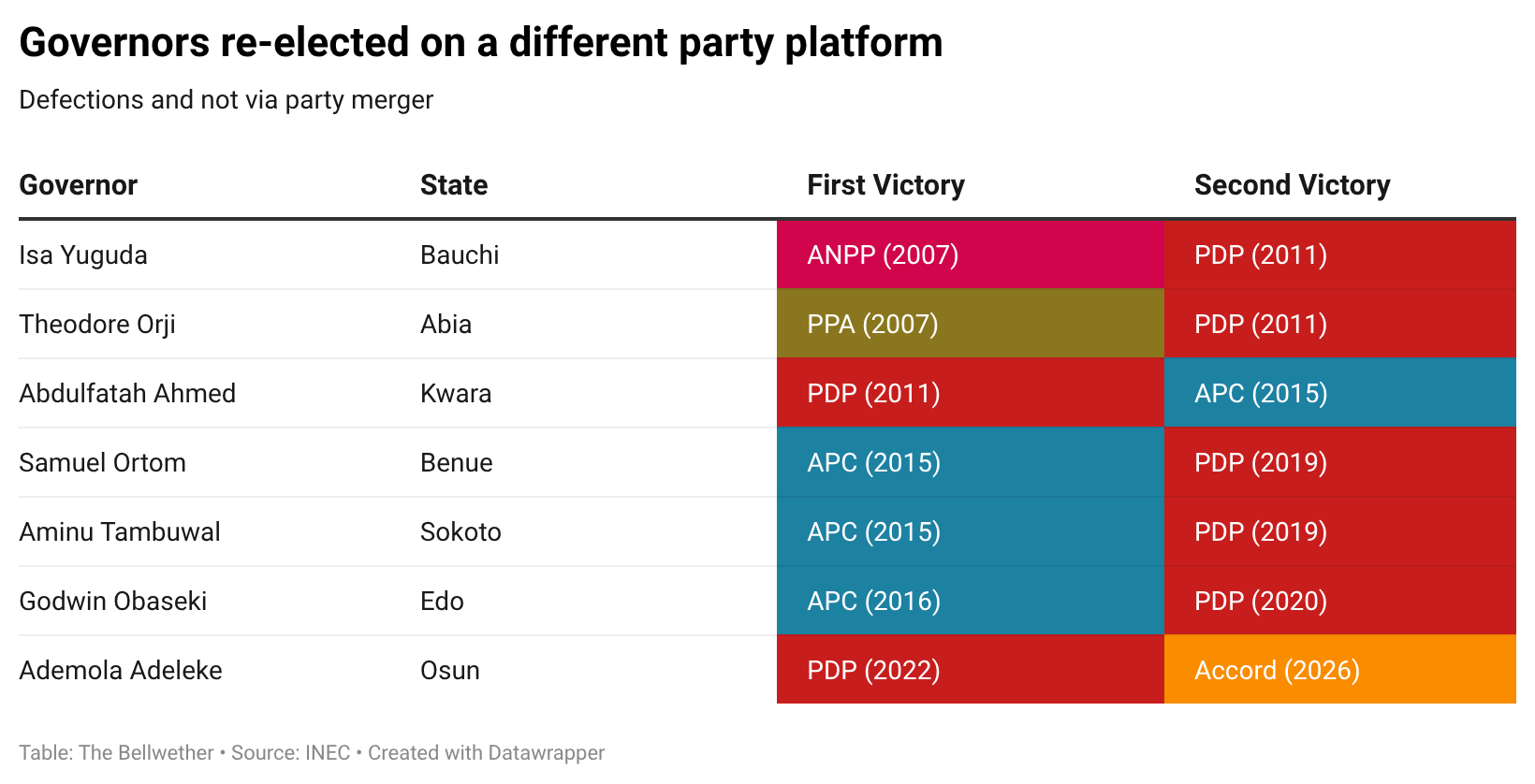
Nigeria’s legislature is rife with politicians who have defected and gotten elected — both Abia’s Alex Otti and Anambra’s Charles Soludo originally contested these seats under different parties before being elected after defecting. Following Adeleke’s win in Osun on Saturday, he becomes the seventh governor to win an election on one party’s platform, and then get re-elected on another’s. It is why most of PDP’s governors who defected to the APC will seek re-election, expecting to win.
Even the 2023 elections prove this. Obi’s candidacy has been held up as proof of a working system, but even he was an elite defector from the party for which he had been vice-presidential nominee in 2019. Kwankwaso was the presidential nominee of a party and ran against the two who had each elected him governor and senator. Both men led parties that each won a governorship seat. Kano’s Abba Yusuf has since returned to the APC, while Abia’s Otti declined to follow Obi to the NDC. The examples of 2023 have since proven the point because, as we prepare for 2027, they will form the ticket of a different party, with their supporters looking for a political home.
It also means that this exercise is really futile if there is no such thing as a Bellwether state, since, for that to function, we have to assume voters have informed loyalty to parties, which means parties outlast individuals. Before 2023, PDP had 13 states that consistently voted for its nominees, whether from Ogun, Katsina, Bayelsa, or Adamawa. This assumption has now been put to rest. Similarly, it would not be surprising if Labour and NNPP’s strong showings in 2023 drop since their nominees are not as popular as Obi or Kwankwaso. Whatever level of support Obi and Kwankwaso garner, or Atiku and Amaechi attract, will mean little or nothing when analysis begins for 2031. The rise of individual political giants has significantly influenced national political calculations. Nigeria does not have bellwether states, but bellwether politicians, not because any one of them can deliver a state, but because their herd-like collective movement tells us where viable political power is assembling.
“Indicative Trends”
A common assumption is that bellwethers set the direction for the flock. That is still the job of a shepherd; a bellwether simply moves where it has been told to go, and the flock follows the bell for direction. For much of the Fourth Republic, election analysis has sought bellwether states for 27 years, but even the evident answers simply follow directions set by those ‘shepherding’ Nigeria’s politics.
There is no counter to this in the present arrangement. Presidential turnout was 26.7% in 2023, but Ekiti’s recent governorship election, at 36.1%, was its second lowest figure. Osun’s 42% in 2022 was also a record low, with 2026’s election only marginally higher at 43.4%, despite a voter register that grows with each cycle. As voter turnout declines, the share of outcomes settled by politicians’ movement grows with it. This shows political movement and direction becoming more accurate because they become a larger share of the whole.
The conditions to stop this include decoupling party financing from governors’ access to federal allocations, enforcing constitutional sanctions for defection, and empowering laws that help opposition vehicles survive when their principals leave. Each would have to be enacted by politicians who benefit from the system as it exists, which is why it has not been done in 27 years.
Nigeria’s bellwethers were never states that predicted how the country would vote, and any ‘answer’ that treats a state as an ‘answer’ is an attempt to fit its politics into a model it never had. Each cycle in which fewer people vote is one in which the movement of a few hundred politicians accounts for more of what remains. Nigerian election analysis is getting more accurate, and that is the problem with it.
—
The Village
I sat with this piece for nearly two weeks, which is why I understand ChiAmaka Dike and Seyi pushing back a bit ‘too aggressively’ this time. The idea was to write something that would work regardless of Osun’s outcome and, aside from some tables and moves, we largely abided by it. ChiAmaka and Seyi also edited out some of the more dramatic assertions, and I think the piece is better off for it. Finally, ahead of the rest of the cycle, I am quite interested to see how some of our bets on how Nigerian political writing is received.