
The Consequences of an Unambitious Foreign Policy
Nigeria’s foreign policy has no domestic owner; this is why it continues to exist on the margins

The Latin phrase, ‘Civis romanus sum’, translates to ‘I am a Roman citizen’. The idea was that citizens could travel across the Roman Empire and expect to be safe and well treated. In June 1850, British Foreign Secretary Lord Palmerston invoked the same principle, arguing that British subjects abroad should have the same expectation that the ‘watchful eye and the strong arm of England will protect him against injustice and wrong’. And, while fictional, The West Wing’s U.S President Josiah Bartlet invoked the same sentiment when dealing with the idea of ‘a proportional response’.
Nigerians, particularly those in South Africa, might be left wondering what it means to be a Nigerian citizen abroad and what value that holds. Rising xenophobia against African nationals has cost South Africa greatly across the continent. It has affected the support that South Africa received in the World Cup. Ghana postponed a visit from South African President Cyril Ramaphosa. Countries repatriated their citizens, but even attempts by Nigeria to get compensation for its citizens have been rebuffed—Nigeria’s attempt was emphatically rejected by South Africa, which played on tropes of Nigerians running drug dens. Nigerian citizens look back at a relationship that included the introduction of a Mandela tax to support anti-Apartheid movements, chairing the U.N committee on apartheid and strong diplomatic support globally and rue how it has all changed.
This is the outcome of an increasingly weak and regressive approach to foreign policy. This is not a defence of the attacks in South Africa and an increasingly anti-immigrant posture that appears to focus squarely on fellow Africans. Instead, it looks at Nigeria’s increasingly unambitious approach to foreign policy and a detachment from this important area of statecraft. Nigerian foreign policy has not failed; it has simply revealed what it was built for: preserving elite legitimacy rather than protecting Nigerians. Expecting anything different is an exercise in disappointment.
An Established Pattern
The pattern of xenophobic violence between Nigeria and South Africa spans four administrations, two parties and several foreign ministers.
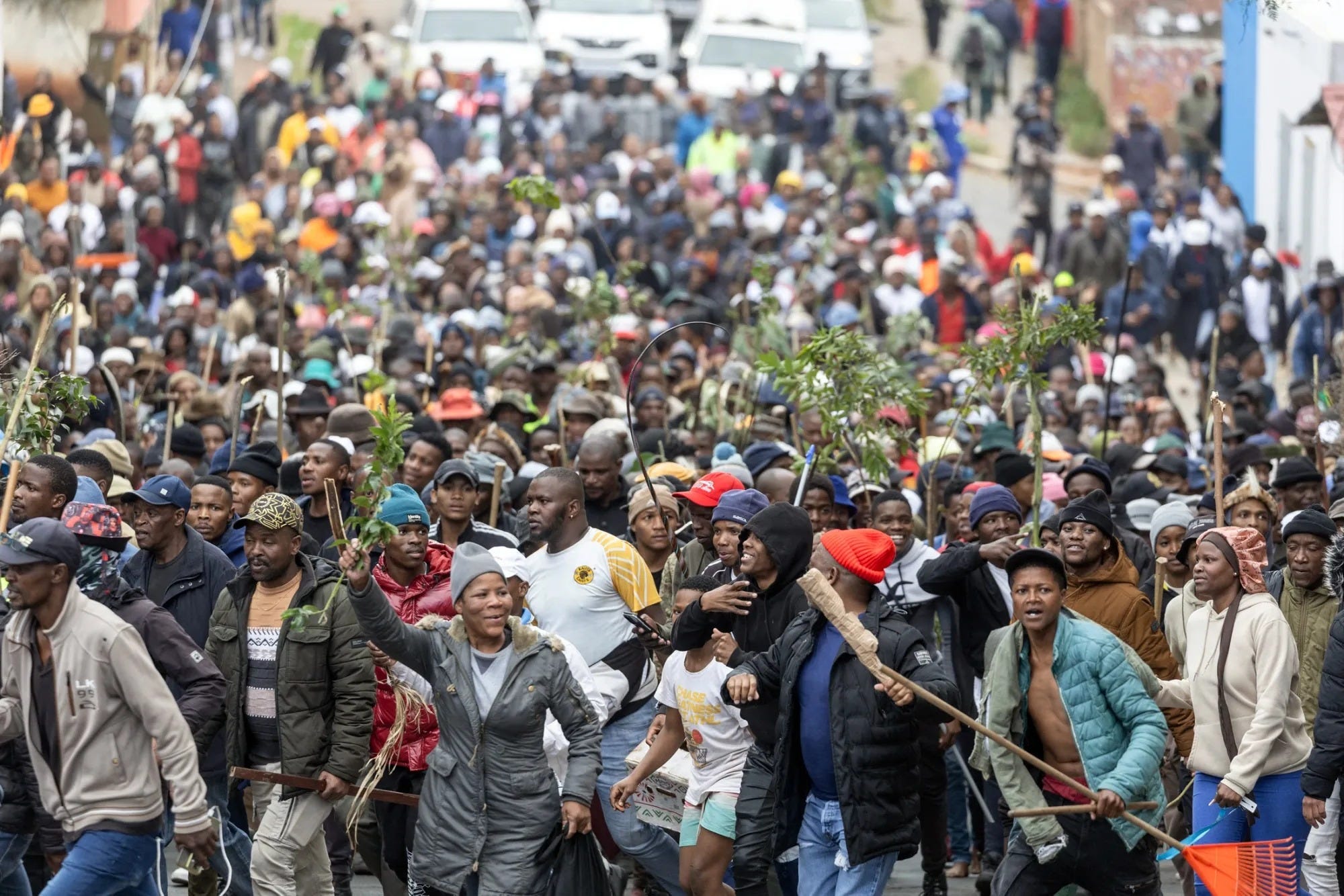
In May 2008, 62 people died in a wave of attacks on foreigners across South African townships. In April 2015, at least seven people died in the wave of attacks that spread from Durban after King Goodwill Zwelithini remarked that foreigners should pack their bags; Nigeria recalled its envoys for consultation in response. In February 2017, protesters in Pretoria handed the Foreign Ministry a petition against arrogant immigrants, ‘especially Nigerians,’ which saw a number of Nigerian businesses burned. In September 2019, riots in Jeppestown and Johannesburg’s central business district gutted around 50 businesses, mostly foreign-owned. Nigeria’s response was emphatic: Air Peace flew hundreds home for free, Nigeria pulled out of the World Economic Forum in Cape Town, crowds in Lagos stoned Shoprite outlets, and Ramaphosa dispatched a special envoy to Abuja to apologise. All seemed forgiven.
This time there would be no apology. Perhaps because of genuine citizen furore and domestic pressure that could lead to his impeachment, Ramaphosa and his government have declined to confront the movement. From late April, groups affiliated with Operation Dudula and former Durban radio host Jacinta Ngobese-Zuma marched through South African cities, ordering undocumented foreigners to leave by 30 June. In Johannesburg, demonstrators checked nationalities before attacking, and at least two Nigerians—Amaramiro Emmanuel and Ekpenyong Andrew, arrested in Pretoria and later found in a mortuary—died after encounters with SA security forces.
Two more followed in early July—Musa Yunana Joe shot in front of his shop and Emeka Charles Iroegbu, who the Nigerian Foreign Ministry claims died under police interrogation in Pretoria. The SA Police deny these reports and say they were drug arrests. Even these deaths are diplomatically contested.
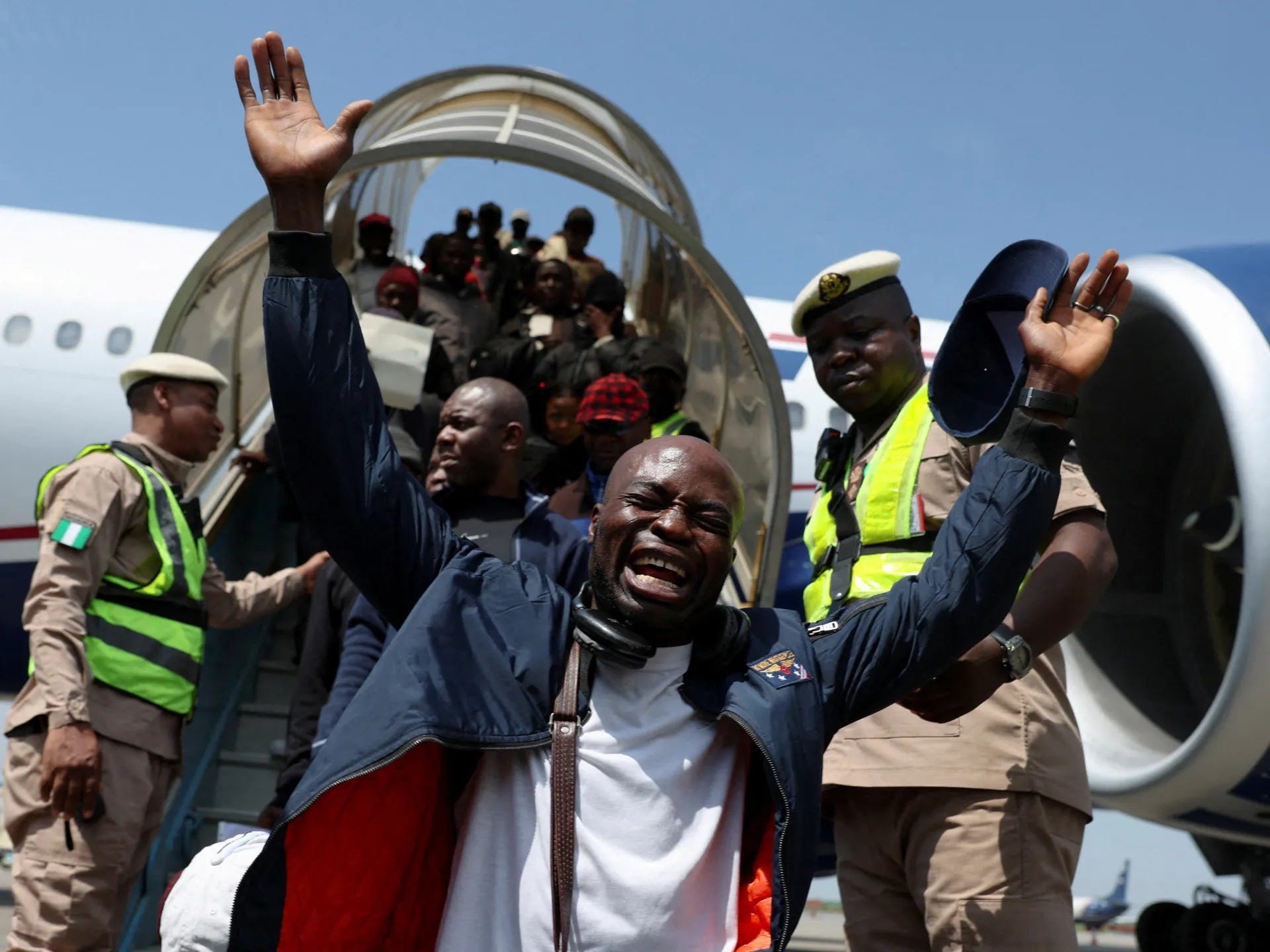
The first evacuation flight landed in Lagos on 11 June, carrying 262 evacuees. By early July, more than 850 Nigerians had been flown home in four batches, out of over a thousand who registered to leave, alongside a separate stream of 586 whom South Africa’s own Home Affairs processed for deportation, and thousands of Malawians, Ghanaians, Mozambicans, and Ethiopians running the same gauntlet.
The Foreign Ministry summoned South Africa’s high commissioner on 4 May. The next day, the Senate resolved to send a high-level delegation, led by its president, to express Nigeria’s strong displeasure. Foreign Minister Bianca Odumegwu-Ojukwu invoked the anti-apartheid debt in protest. But every one of these instruments had been used before. It is why South African ministers could brush them aside. In a famous exchange, Khumbudzo Ntshavheni, a minister in the SA presidency, pushed back against a Nigerian reporter’s question on compensation for Nigerian victims by asking, instead, to be shown the ‘drug dens’ run by Nigerians.
When the Nigerian Senate reconvened four days after the drug-dens remark, Senator Adams Oshiomhole (APC-Edo) proposed appropriating the Nigerian profits of South African companies to compensate victims and noted, in passing, that the May delegation had never actually been sent. Senator Abdul Ningi (ADC-Bauchi) demanded that diplomatic ties be severed. Senate President Akpabio (APC-Akwa Ibom) persuaded both men to withdraw their motions and instructed the Senate committees to review the implementation of its May resolutions and report back within weeks on the status of the first committee.
Throughout this process, Nigeria had no Ambassador in Pretoria. Tinubu recalled 83 Nigerian ambassadors worldwide in September 2023. This was not the first foreign policy incident that Nigeria faced without functional emissaries in place—in late October 2025, when Trump threatened military action over the killings of Christians, there was no one in Washington DC to respond to the questions. Femi Fani-Kayode only received his letters of credence on 6 July, the same week that Ntshavheni made her curt comment.
Nigerians were being hunted through South African cities by nationality, and there was no representative in the country to deftly manage the crisis because ambassadors had been recalled and the entire foreign policy architecture, from legislators to the ministry itself, proved unable to attend to the crisis. This is not a lapse in the system; this is the system today.
A Giant’s Footprint
Nigeria calls itself the ‘Giant of Africa’. While its foreign policy has not matched this title recently, there was a period when its muscular approach was felt and respected.
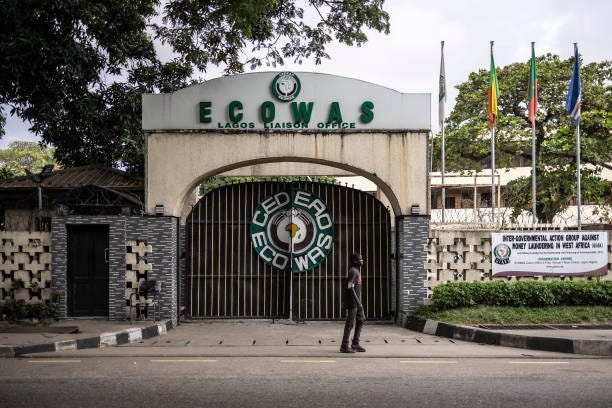
To start with, in the aftermath of the Nigerian Civil War (1967—70), Nigeria co-drove the creation of the Economic Community of West African States (ECOWAS) in May 1975, ensuring that the founding treaty and subsequent headquarters were based in Nigeria. This process ensured the creation of an institution that could, and for a time did, serve as a vehicle for the country’s regional ambitions. Nigerian heads of state have chaired ECOWAS nine times since 1975, more than those of any other member state. This is usually recounted as a tribute. It is better understood as an inheritance: the regional hegemon managing the region’s affairs, in a building it paid for, under a treaty it wrote.
In November 1975, the military regime of Murtala Muhammed recognised the MPLA as the government of Angola, against explicit American pressure. President Ford had written personally to African heads of state urging them to hold the line against the Soviet-backed movement. The letter was hand-delivered in Lagos by Ambassador Donald Easum on 3 January 1976. Nigeria published it, and called it a gross insult. Murtala’s answer, delivered at the OAU’s extraordinary summit in Addis Ababa in January 1976, was the most famous speech in Nigerian diplomatic history and a public charge that the United States had chosen white supremacy over African self-determination, and that ‘Africa should no longer take orders from any country, however powerful.’ Nigeria did not stop at rhetoric; it moved money and material to MPLA and forced the continental body to follow recognition.
In 1979, the Obasanjo regime went further and seized the assets of a superpower’s oil company. On the eve of the Commonwealth summit in Lusaka, with British Prime Minister Margaret Thatcher wavering on majority rule in Rhodesia and British Petroleum (BP) implicated in oil reaching apartheid South Africa, Nigeria nationalised British Petroleum’s 20 per cent stake in its Nigerian joint venture and its entire marketing subsidiary. This was an instrument of pure coercion, deployed at real cost to Nigeria’s own oil sector, that helped concentrate British minds in the run-up to Lancaster House. The nationalised company survives in Lagos as a corporate fossil, itself a metaphor for Nigeria’s foreign policy decline: African Petroleum was renamed Forte Oil in 2010, then Ardova in 2019, and delisted from the Nigerian Exchange in 2023.
The Babangida regime in 1990 was the major donor, troop contributor, and driver in the formation of the ECOWAS Monitoring Group (ECOMOG), which played a defining role in stabilising a region that had been bedevilled by coups and unstable government changes. Nigeria provided at its peak around 12,000 of ECOMOG’s 15,000 troops in Liberia, and Obasanjo would later put the bill at $8 billion and at least 500 Nigerian soldiers killed — an accounting no legislature approved or audited.
But Nigeria’s foreign policy successes have mostly followed a single trend that highlights a more fundamental flaw—they occurred during military regimes that were not accountable to an electorate. Gowon, Murtala, Obasanjo, and Babangida all achieved these while overseeing military regimes. There was no legislature to consult and no election to lose.
It is easy to make the connection that democracy stymied Nigeria’s foreign policy ambition; after all, Tinubu’s attempts to forestall Niger’s coup in July 2023 were blocked by a Senate resolution and firm opposition from Northern politicians. But the more uncomfortable diagnosis is that, while Nigeria’s foreign policy ambitions and successes have reflected its sense of position in the world, they were never connected to Nigerian citizens in the first place.
Good for Whom?
Nigeria’s foreign policy doctrine, with Africa as the centrepiece, survived perfectly intact because rhetoric is free. It has been frequently referred to in virtually every inaugural address, foreign ministry mission statement, and Independence Day broadcast since Balewa stated it in 1960.
The machinery, meanwhile, was quietly dismantled when structural adjustment gutted the foreign service’s budgets in the 1980s. The Abacha years converted diplomacy into sanctions evasion, and by the Fourth Republic, the ministry had become what a former foreign minister, Ike Nwachukwu, described in May as “missions struggling to meet basic obligations.” Tinubu’s first foreign minister, Yusuf Tuggar, stated that the delay in sending ambassadors was due to insufficient funds to staff these missions. A giant without its presence can only rely on the memory of its impact.
Democratic structures might have prioritised other elements of governance, but citizens also bear the brunt of this. No candidate for president has had to declare a foreign policy doctrine or approach because the electorate has not prioritised it. Candidates will refer to the recent SA issue only while it is in the news, and ignore it once the crisis dies down. Foreign ministries can tout ‘victories’ in securing Nigerians’ elections to plum positions in regional and international organisations, but even those engagements lack citizen investment—what does it matter if you are in the AU or ECOWAS if you still face attacks when visiting fellow member states?
The honest objection here is Obasanjo’s second act between 1999 and 2007. He was arguably the most energetic statesman on the continent—midwifing the African Union, co-authoring NEPAD, brokering peace in Liberia, São Tomé, Darfur. But this does not break the pattern; it establishes it. Obasanjo’s shuttle diplomacy was never once an election issue.
It was not a PDP manifesto; his re-election in 2003 was essentially due to incumbency and a bias in exploring his foreign policy chops from his previous stint in power. An argument can even be made that funds to push his engagement came from barely scrutinised budgets at the onset of the return to democracy. When Obasanjo left power in 2007, his activism faded, and the political system did not notice the departure. A capability that leaves with an incumbent is a hobby with a budget.
Who Pays?
The situation in South Africa might be a blip for politicians and businessmen with investments there, but it is costly for citizens who have no direct means of exerting power. South Africa has extensive business with Nigeria—more than 80 million MTN subscribers in its largest market worldwide, millions of DStv households for Multichoice, and, until the parent company’s 2021 exit and the brand’s final wind-down this year, devoted users of Shoprite.
None of this means the state is incapable. In March 2012, South Africa deported 125 Nigerians at OR Tambo airport over allegedly fake yellow fever cards; Nigeria deported 84 South Africans on identical grounds within two days, and Pretoria delivered a formal apology within the week. And where the incentive was revenue rather than citizens, Nigeria has squeezed South African capital harder than any regulator in African history—the $5.2 billion fine imposed on MTN in 2015 for unregistered SIM cards, which was eventually settled at $1.67 billion. Between an apology extracted in a week and a billion-dollar settlement extracted in instalments, Nigeria has demonstrated its ability to protect its citizens abroad when there is an incentive.
Lastly, the effects of a weak foreign policy on its citizens are most visible in the most visceral example—the passport. Senior politicians and appointees can either afford the exorbitant visa costs or use diplomatic passports. But the average Nigerian cannot move as easily. In the April 2026 Henley Index, Nigeria’s ranking improved from 95th to 90th, but the number of places Nigerians could enter without visas dropped from 46 to 44. If Nigeria compares itself with its contemporaries, it would see that Ghanaians can now go to 67 countries and South Africans to 101.
If it wanted to reflect, it would see that ‘small’ The Gambia, whose democracy it helped entrench by removing former dictator Yahya Jammeh, has a passport that can unlock entry to 68 countries. Visa regimes do track migration risk and operate on a reciprocity basis, as Nigeria’s own restrictions cut both ways. But these countries punish Nigerians because they cannot trust the government to document, attend to and, if necessary, repatriate its citizens. The system has never been held accountable, so it continues to run roughshod over expendables.
At No Political Expense
The record shows that Nigeria’s foreign policy was never built to protect Nigerians abroad. The only era when it projected real power was when Nigerians could not vote on it or when it became an expensive interest. In an era of increased interconnectedness, when actions in foreign capitals affect far-off continents, it has become easier for citizens to emigrate rather than hold leaders accountable.
The regret is that there are more casualties than readily acknowledged. Other African countries would rightly expect a country with Nigeria’s population and economic weight to be more assertive in holding South Africa to account. Regional neighbours would hope that a buoyant economy and robust foreign policy would trickle down the Atlantic and also help keep their leaders in check. Even Western capitals would appreciate a partner to collaborate on diplomatic efforts. A region that could use an assertive Abuja, and partners that could use a reliable one, are casualties too. But the sharpest reading belongs at home. What citizens see in an inconsistent and unclear foreign policy approach is the low value placed on their lives.
Elections are only months away, and no candidate has yet been asked a foreign policy question—none expects to be. The president’s successor will most likely deal with the same issues at the same price: none at all.
—
The Village
Hillary Essien was up at 2 am when this piece finished. If she did not do early edits, we miss our Wednesday deadline for the first time. Seyi and ChiAmaka Dike sold me dreams on WhatsApp that it was decent and then left me with over 100 comments. But, as always, the piece is better off for it.
This is also The Bellwether’s 20th piece. Thank you to everyone who has read, restacked, shared, commented, insulted, argued and engaged. Here’s to the next 20.