
The Machinery of Ethnicity
How the conventions built to manage Nigeria's diversity became the system that entrenches it.

The 2023 elections split Nigeria along its most familiar lines, ethnicity and religion, with each side claiming that its candidate represented the country’s diversity. Every argument about who should lead was, at bottom, an argument about where they were from and what they believed. But the last time Nigeria held a genuinely competitive presidential election with this many viable candidates, in 1979, less than a decade after the civil war, the politics of identity worked in the opposite direction. Every single ticket featured an Igbo politician. Five parties, five tickets, five Igbo candidates or running mates. The political class treated cross-ethnic inclusion not as a formula to be satisfied but as a condition of viability. What changed between those two elections, and what it costs Nigeria today, is the subject of this essay.
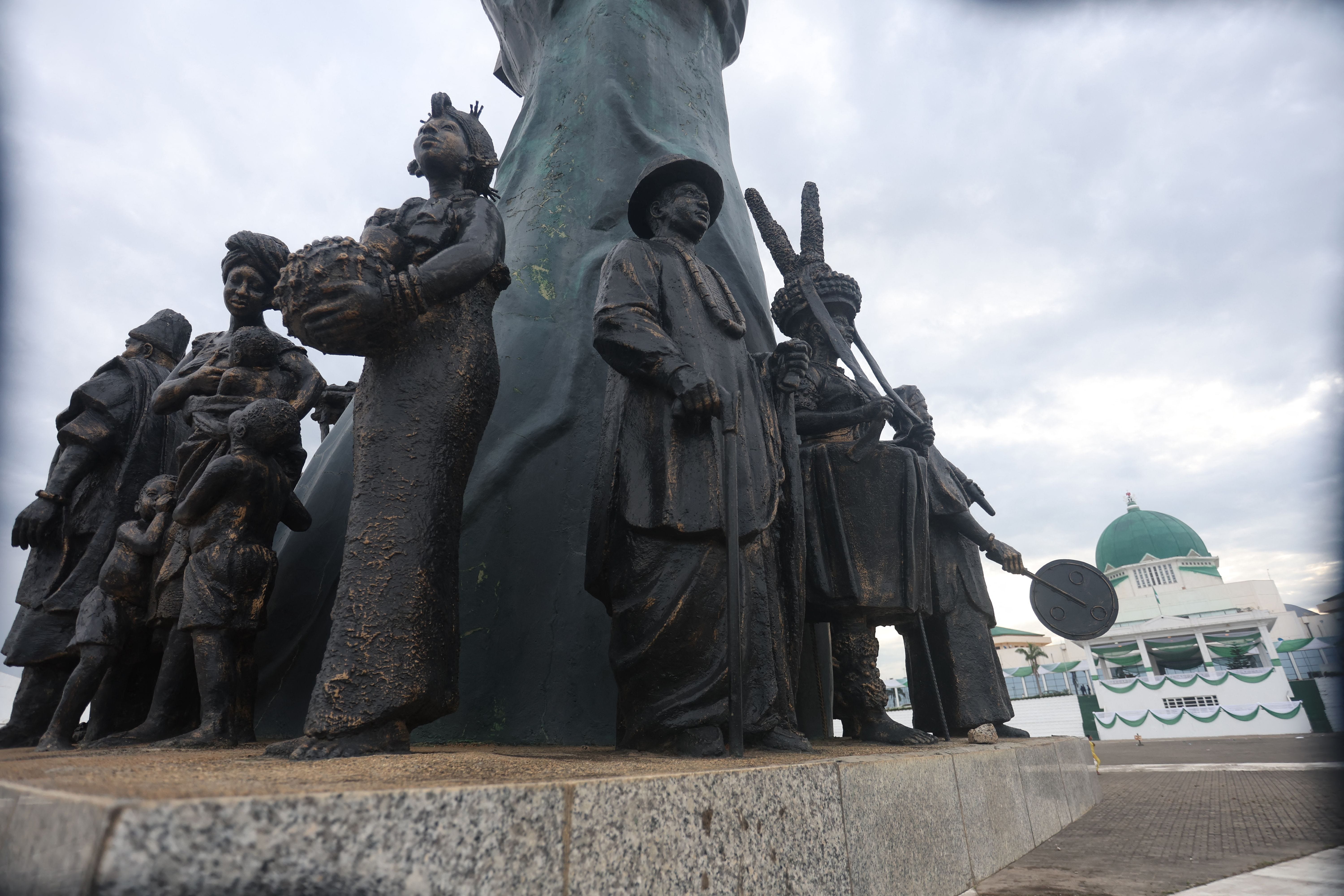
The five tickets told a story of calculated coalition-building. Obafemi Awolowo, a Yoruba Christian from Ogun, ran with Philip Umeadi, an Igbo Christian from Anambra, for the Unity Party of Nigeria (UPN) on a ticket that had only Christians and Southerners. Nnamdi Azikiwe of the Nigeria People’s Party (NPP) ran with Ishaya Audu—a Hausa Christian from Kaduna and the Sardauna’s personal physician—a pairing that produced a two-Christian ticket. Waziri Ibrahim, a Kanuri Muslim from Borno, ran with Benjamin Nzeribe, an Igbo Christian from Imo, for the Great Nigeria People’s Party (GNPP). Aminu Kano, the avowed socialist Hausa Muslim from Kano, ran with the People’s Redemption Party (PRP) with Samuel ‘S.G.’ Ikoku, an Igbo Christian from Imo. The winning ticket was Shehu Shagari, a Fulani Muslim from Sokoto, who ran with Alex Ekwueme, an Igbo Christian from Anambra, for the National Party of Nigeria (NPN).
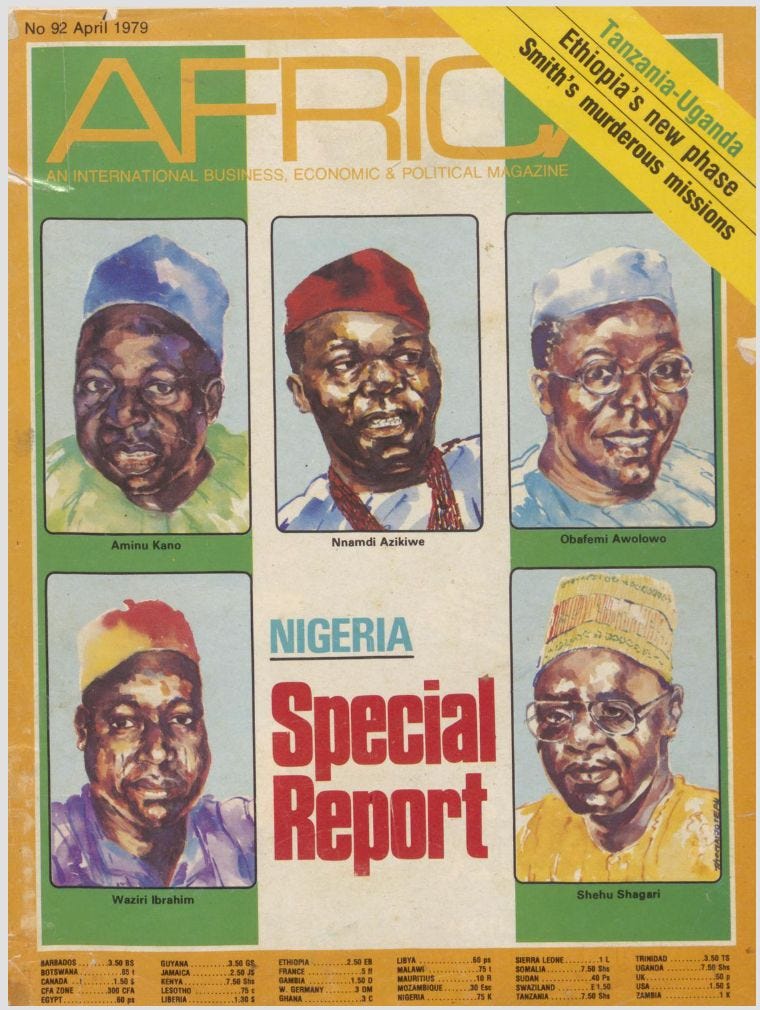
Two parties featured a same-faith ticket; one went further and fielded a ticket from the same region. The political class accepted that Igbo participation was needed for the country to cross the deepest fault line of the civil war. There was also a political consideration—the 1979 constitution required a candidate to win a quarter of the vote in two-thirds of the then 19 states. But the partnerships that emerged showed a proposed approach to governance that transcended mere power-grabbing. Ibrahim and Nzeribe, GNPP’s ticket, campaigned under the slogan ‘Politics without Bitterness’. Kano chose Ikoku, a fellow socialist with extensive union credentials during the First Republic.
But the elections and their outcomes also laid the seeds for how Nigerian politics would unfold. Shagari and Ekwueme, one of the truly ‘balanced’ tickets, won the elections. Awolowo reportedly could not convince any of his preferred northern running mates to support his ticket. The results were largely decisive in the areas where the parties or their candidates had strongholds—the winning candidates in 13 of the 19 states won with 60% of the votes—showing a strong base despite the approach to balanced tickets. Similar numbers would come about in the 2023 elections. Parties would later avoid such ‘risky business’ in seeking votes and become pragmatic, practical and pitiless in their approach to seeking power.
The 1979 tickets were composed before the rules hardened. They were messier, more improvisational, and more genuinely national for it. What followed was a slow consolidation, in which the pragmatism of 1979 was replaced by the rigid arithmetic that now defines Nigerian elections.
Governing without Origin
Nigerian politics today is dominated by identity. The fixation on identity is driven not merely by a desire for equity, but by a deeper concern: that the Nigerian state, in its current form, is incapable of meeting the needs of all the people it must serve. This is behind the clamour for zoning, representation and accommodation on tickets. It is an acknowledgement that the system has yet to prove itself capable of taking care of the many, rather than a few.
Ethnicity is the most potent political language Nigeria has. Parties, politicians, and platforms lead campaigns that define their candidates’ and opponents’ backgrounds—and why it matters. Notably, in 2023, there was discourse on whether it was fair that Atiku, a Northern Muslim, should succeed Buhari, another Northern Muslim. Or if Bola Tinubu, a Southern Yoruba, should be in power after eight years of a Yoruba vice-president and after the last southern president was another two-term Yoruba. Or if Nigeria had reached a post-civil-war maturity to allow an Igbo man to succeed to the presidency, and if the north would allow him. These questions abound in democratic Nigeria, but there is one area and one time when they did not.
Analysts and historians rightly point to the military era’s institutional damage as the source of Nigeria’s long and difficult path towards democratic consolidation. But the military era also shows that the ethnic question is not so much a question as a fixation. The practice of posting administrators to states different from their home states engaged with this question and forced officers to build infrastructure, manage crises, and earn legitimacy in communities they were not from.
During the 2023 elections, Peter Obi won the presidential vote in Lagos. Tension followed, with blame directed at Igbo traders and residents for supporting Obi over Tinubu, a Yoruba and two-term governor of the state. People cited the claim that Lagos, a former capital, was ‘no man’s land’, and others responded by stating its ancestral Yoruba heritage. This led to concerns around insecurity in Igbo-dominated areas and how Nigeria could be truly national.
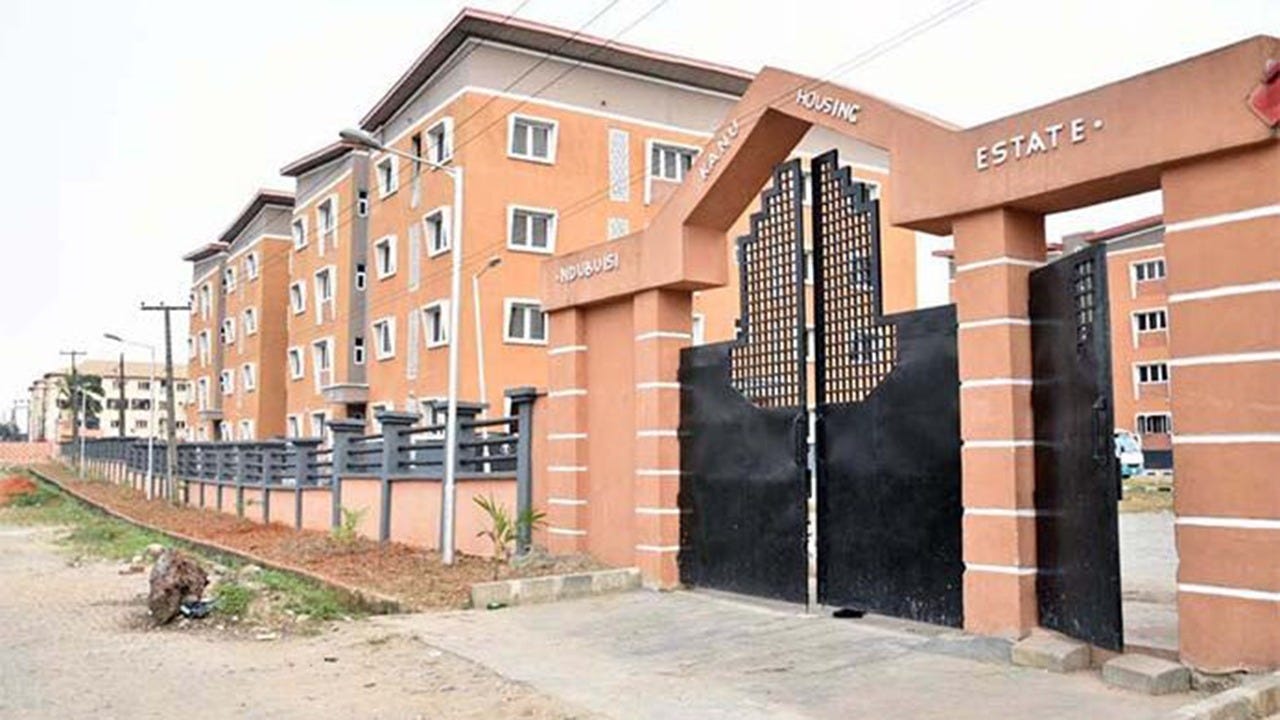
Many forget that Lagos has been home to two former Igbo military administrators. Ndubuisi Kanu, born in Abia state, was a naval officer who fought for Biafra during the civil war. Afterwards, he was reabsorbed into the Nigerian Navy and became military governor of Imo at 32. His performance was lauded, and he was redeployed to Lagos. His legacy was such that when he passed in 2021, current Governor Babajide Sanwo-Olu hailed him as a ‘detribalised Nigerian’ and named a housing estate in Gbagada after him.
Kanu was succeeded by Ebitu Ukiwe, another Igbo and former Biafran combatant from Abia state. After being reabsorbed following the war, he became the military administrator of Niger in 1977, then of Lagos until the return to democracy in 1979. He would later become de facto vice-president under Babangida.
Cross-posting in the military was systemic and produced administrators whose authority derived from office rather than ancestry. This did not make military rule less authoritarian, but it did create a political culture where Nigerians were expected to govern and be accepted outside their states of origin, in ways that democratic politics now makes difficult. It is ironic that a repressive military era may have done more to create national leaders than democracy has.
How the Rules Locked
There is an argument that the incursion of ethnic and regional zoning in Nigerian politics began with the NPN’s allocation of party and potential government roles ahead of the 1979 elections. The NPN’s success proved that deliberate ethnic allocation was not just equitable but electorally effective. The lesson would be learned too well. But by 12 June 1993, when Nigerians went to the polls during the Third Republic elections, it was clear that a generation of politicians had learned, studied, and now crystallised these norms.
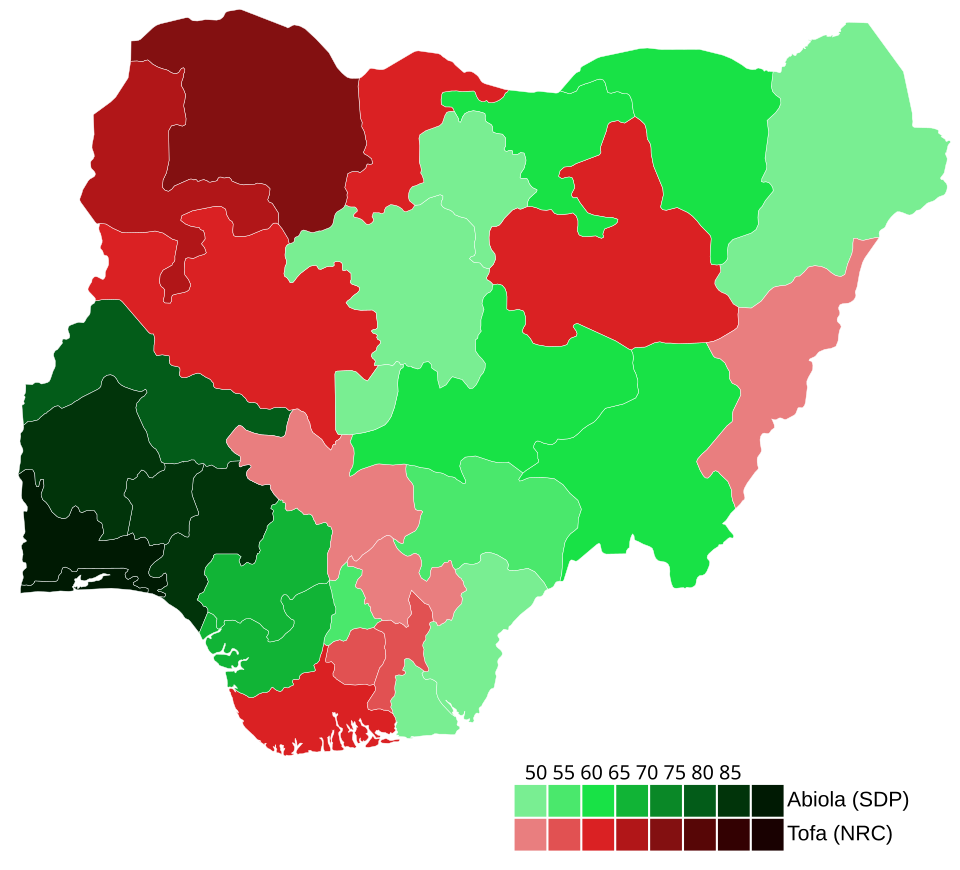
After winning the Social Democratic Party (SDP) presidential primaries, M.K.O Abiola, a Yoruba Muslim billionaire from Ogun, needed a northern running mate. Conventional political logic pointed towards a Northern Christian to balance geography and religion. Ibrahim Babangida, then military dictator, reportedly advised Abiola to follow this. The Christian Association of Nigeria (CAN) reportedly also pushed back against the choice of a Northern Muslim for Abiola and is rumoured to have shared a list of Northern Christians to consider.
Meanwhile, SDP’s Strategies Committee argued for a more pragmatic approach. They argued that the leaders of both chambers of the National Assembly were both Christians and that the National Republican Convention’s (NRC) presidential nominee, Bashir Tofa, a Northern Muslim, was likely to sweep the north if they did not field a northern candidate to appeal to their interests. Their final recommendation was that “MKO Abiola’s running mate should come from the Kanuri ethnic group in the Hausa-Fulani-Kanuri-Nupe grouping and should be a Muslim.” What the NPN had improvised in 1979, the SDP had systematised by 1993. The ethnic arithmetic was no longer a background consideration but the strategy itself. Babagana Kingibe, a Kanuri Muslim, diplomat and party chair, was picked. While the result was never declared, Babangida belatedly acknowledged that their ticket won the election.
The emphatic and national support for a Muslim-Muslim ticket, in a divided country, has often been cited among reasons for 1993 being the ‘freest and fairest election’ in Nigeria’s history. It has been hailed as proof that Nigerians value competence over indigenous interests. Tofa lost his home state, Kano, and neighbouring North West states. But this attempts to underplay the role ethnicity played, even in the way the parties approached selecting their tickets in the first place.
The discussions of SDP’s Strategies Committee easily mirror the NPN’s informal zoning formula and more recent conversations about allocating roles among successive ruling parties in the Fourth Republic. Electoral viability has trumped governance. Parties have struggled to ensure their electoral appeal across as many parts of the country as possible through the composition of their tickets. They have also worked with allocating other senior roles in a prospective government.
But expecting that zoning will cater to certain constituencies has clearly not worked. Under Buhari, the pattern was visible: by 2019, the heads of the army, navy, air force, DSS, and NIA were all northern Muslims. The appointments were technically zoned, but the concentration was stark enough to become a recurring grievance among southern and Middle Belt communities—not because the individuals were unqualified, but because the concentration demonstrated exactly what the zoning convention exists to prevent—power consolidating along ethnic and religious lines rather than being distributed across them. This fixation on representation has reframed the relationship between citizens and leaders into one of ethnic accounting.
The Grand Bargain
The grand bargain of zoning is not a national consensus. It is an elite one. Zoning conventions are not grassroots demands but negotiation mechanisms among a narrow political class. This ‘grand bargain’ of rotation and balancing happens among a narrow political class and is then presented to voters as representation. The zoning is still prohibitive for aspirants who might be within the zoned area but outside the political elite.
The convention also explains nothing about what an elected official does in office. First Republic parties had ethnic bases but also had policies. The Action Group offered free primary education; the Northern People’s Congress championed northern development. Today, party platforms are incidental to the identity settlement. Where parties offer no programmatic reason to support them, many remain vehicles for accessing power rather than institutions for exercising it. Where parties offer no programmatic reason to support them, ethnicity and regional identity become the only campaign points.
Voting patterns reinforce this trap. Parties have long depended on regional, and by extension, ethnic strongholds to remain competitive. The ruling All Progressives’ Congress (APC) has relied on the South West and North West, while the People’s Democratic Party has historically relied on a base in the South South and South East. This creates a feedback loop: parties become responsive to those strongholds’ sectional demands, and this reinforces ethnic mobilisation. This further reinforces the idea that elections must be identity-driven.
As a result, parties that began as genuinely broad coalitions, such as the PDP, narrowed over time into vehicles for rotating sectional access. This means ethnic groups face the choice of adopting their own party, which is often unlikely to gain national control, or joining broad-tent coalitions and seeking favourable zoning at some point. This is the end of the loop: at this stage, when in control, it is best to appropriate and reward kinsfolk, since the next term will see another group or coalition come to power. There is no governance; only rotation.
A Result of Concentrated Power
The identity arithmetic would matter far less if the presidency were not so powerful. Indeed, in the First Republic, while control of the centre was still preferred, many Nigerians were far more affected by their regional governments. But Nigeria’s fiscal and political architecture makes Aso Rock a winner-takes-all prize, and this structural reality is the engine driving the fixation on who controls it.
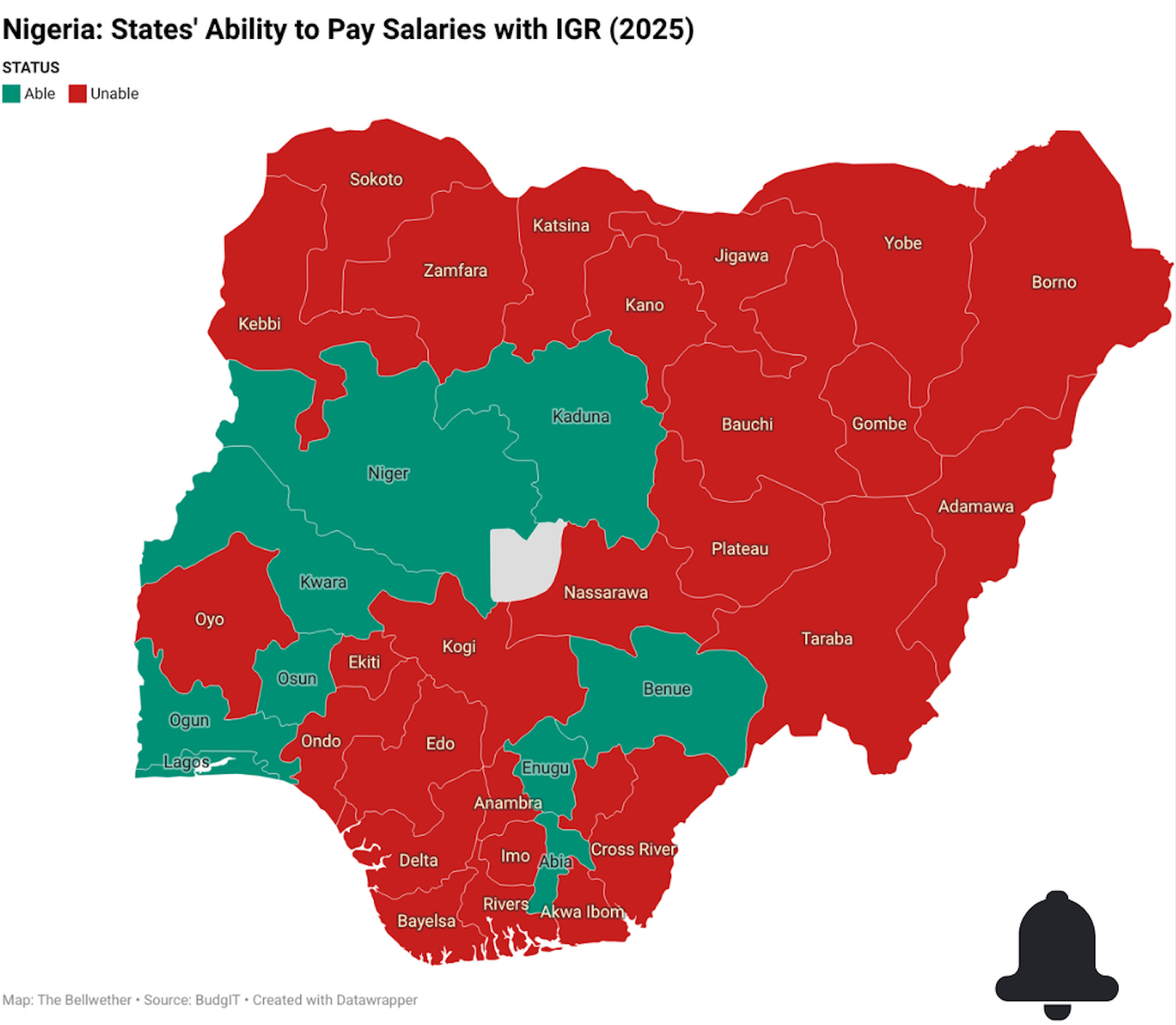
Key functions, ranging from security control and regulatory authority to key appointments and revenue allocation, flow from the centre. Many states are unable to deliver basic duties without federal support. In 2025, 27 states could not meet salary obligations without their monthly FAAC allocation—their internally generated revenue covered less than 15% of recurrent expenditure. When there is too much control and influence at the centre, communities compete for this existential power. This also compounds ethnic arithmetic because whoever is in control determines where the money goes. It can be the difference between a hospital in your state and one an hour away, good roads in your area and a pothole-ridden main road, and, increasingly, attention to your security issues and the numbers on a fatality sheet. There is a tacit acknowledgement that a president from ‘another part’ cannot realistically be expected to address ‘our’ issues.
The consequence is a telling irony: Ethnic mobilisation dominates both national and sub-national politics— yet even at the state level, where ‘ethnic arithmetic’ should be balanced enough to produce accountability, the scrutiny is yet again absent. Weak institutions, compromised legislatures, patronage systems and limited civic enforcement all deepen this insulation. Barring former military heads of state, all elected presidents in the Fourth Republic have been former governors. The 2023 elections notably featured three frontline candidates who had been former governors, and a fourth who was elected governor but resigned to serve as vice-president. But most governors operate with minimal accountability because the public conversation is fixed upward. Where there is no need for ethnic mobilisation, there is little to no scrutiny.
The Residency Question
The political class has gradually shifted its vocabulary, from targeting specific ethnic groups (as the SDP Strategies Committee did in 1993) to allocating positions by geopolitical zone. The distinction matters more than it might seem. We cannot inherently change our ethnic group, but we can change where we live and invest.
Nigeria’s current system anchors civic identity to the state of origin. This rewards ancestral ties, but not where people live, work, pay taxes, or raise families. A person born and raised in Kano, whose family has been there for generations, is still legally identified under a local government area in Abia State on official forms. An Ijaw woman who has lived in Benue for two decades, married from the area, and raised a family will still face questions if she is appointed to a cabinet or ambassadorial position representing the state. For many Nigerians, intra-state migration remains prohibitive because it is neither rewarding nor affirming.
A solution can look simple: shift the basis of civic identity from the state of origin to the state of residence. The idea is not new. Atedo Peterside argued for it at the 2014 National Conference. In 2025, Deputy Speaker Benjamin Kalu introduced a constitutional amendment that created a pathway to indigene status after 10 years of residency. The Ohanaeze Ndigbo Youth Council supported it, citing that a Fulani man from Sokoto had become Mayor of Enugu in 1952. But newspapers framed indigeneity as a sacred cultural bond, and the bill was withdrawn. The political class has heard the argument and rejected it.
African cases provide more cautionary but instructive lessons. Côte d’Ivoire, under Félix Houphouët-Boigny, granted ECOWAS nationals living in the country citizens’ rights, such as voting. After his death, his successor, Henri Konan Bédié, weaponised the concept of “Ivoirité”, which aimed to restrict political rights to those with deep ancestral roots in Ivorian territory. This was aimed at disqualifying Alassane Ouattara, a former prime minister who allegedly had Burkinabé roots, from running for the presidency. The result was a civil war. In a country with increased movement and trade, this is a possible outcome if indigene-settler logic is continually prioritised. Tanzania offers a counter-example: in 2014, President Kikwete granted citizenship to 162,000 Burundian refugees who had lived there for forty years, on explicitly residency-based grounds. If Tanzania could extend citizenship to refugees from other countries, Nigeria can ensure the same for its own citizens.
The deeper difficulty is that state residency requires something to attach to. Ethnicities have ancestral ties and cultural norms, but most Nigerian states have existed within older demarcations. Edo, Delta, Adamawa, and Taraba might exist now, but swathes of the population, and literature, are more familiar with Bendel and Gongola states. The absence of actual relationships with the idea of these states is another challenge to this issue.
The obstacles are real. Residency-based rights could accelerate the dominance of already-wealthy states, draining poorer states of population and political influence—solving one problem while deepening another. Any implementation would need to be paired with genuine fiscal decentralisation. But the greater difficulty is that residency requires something to attach to. Most Nigerian states lack the civic identity that would make ‘I am from Plateau’ mean something independent of ethnicity. Until states become places worth belonging to—with cultural institutions, distinct governance traditions, and the fiscal independence to deliver services—residency will remain an abstraction.
In New York, a Ugandan-born Muslim of Indian descent could become Mayor because being a ‘New Yorker’ is broad enough to encompass diverse backgrounds. Few Nigerian states or cities have similar distinct brands or traditions. Ironically, especially in the wake of the 2023 electoral violence, Lagos is one of them. The same city that mourned Ndubuisi Kanu could not extend that grace to Igbo voters who chose the ‘wrong’ candidate. If Lagos, Nigeria’s most cosmopolitan state, cannot yet sustain a civic identity that holds under political stress, the challenge for the rest of the country is stark.
But a system that anchors rights to ancestry gives that tension nowhere to go except deeper entrenchment. A system that begins to prioritise residency does not eliminate it, but it changes the incentive structure, rewarding investment in where people live rather than loyalty to where they came from. Over time, it leads to the gradual dissolution of stranger-settler distinctions that poison federal-state politics and the broader debate over identity and marginalisation. It sees the weakening of federal character provisions and truly promotes meritocracy over representation.
The Unwanted Answer
A country where the most important question in an election is not what the candidate will do, but where they are from and what they worship, is a country that has settled for politics as a rotation of entitlements. The conventions built to manage diversity have now entrenched it. With each passing generation, there is a window to take advantage of millions who were born as Nigerians—and not British subjects or tied to strong ethnic ties—and truly forge a nation. But with each passing contest, an ambitious and ruthless elite narrows the opportunity.
But there is a harder question: where does this road end? When politics becomes rotation rather than governance, and when a ruling party breaks the rotation by consolidating beyond challenge, the system exhausts its own corrective mechanisms. There are instructive parallels between 1979 and 2023: a contentious result, a Supreme Court judgment on its validity, and a new president seen as starting from a fragile position.
If 1979 mirrors 2023, then perhaps we can learn about 2027 by studying 1983. Ahead of the 1983 elections, NPN aggressively secured defections and expanded its base. It moved from seven governorships to 12 and gained some high-profile opposition members. APC has done that and more, achieving a supermajority among state governorships and virtual universal control of the legislature. The 1983 elections were marred by fraud, allegations of rigging and, in some cases, violence. The worrying thing for Nigeria is a recent reminder of what came next. In 1979, five parties looked at the deepest wound in Nigerian politics and chose to cross it. The question is whether 2027 will produce leaders capable of the same, or whether the machinery will keep turning.
—
Written by: Afolabi Adekaiyaoja
Edited by: Seyi Adedoyin, Temitayo Akinyemi, ChiAmaka Dike and Hillary Essien