
Witness for the Prosecution
Femi Gbajabiamila is the latest and most definitive proof that Nigeria’s political elite is beyond contest

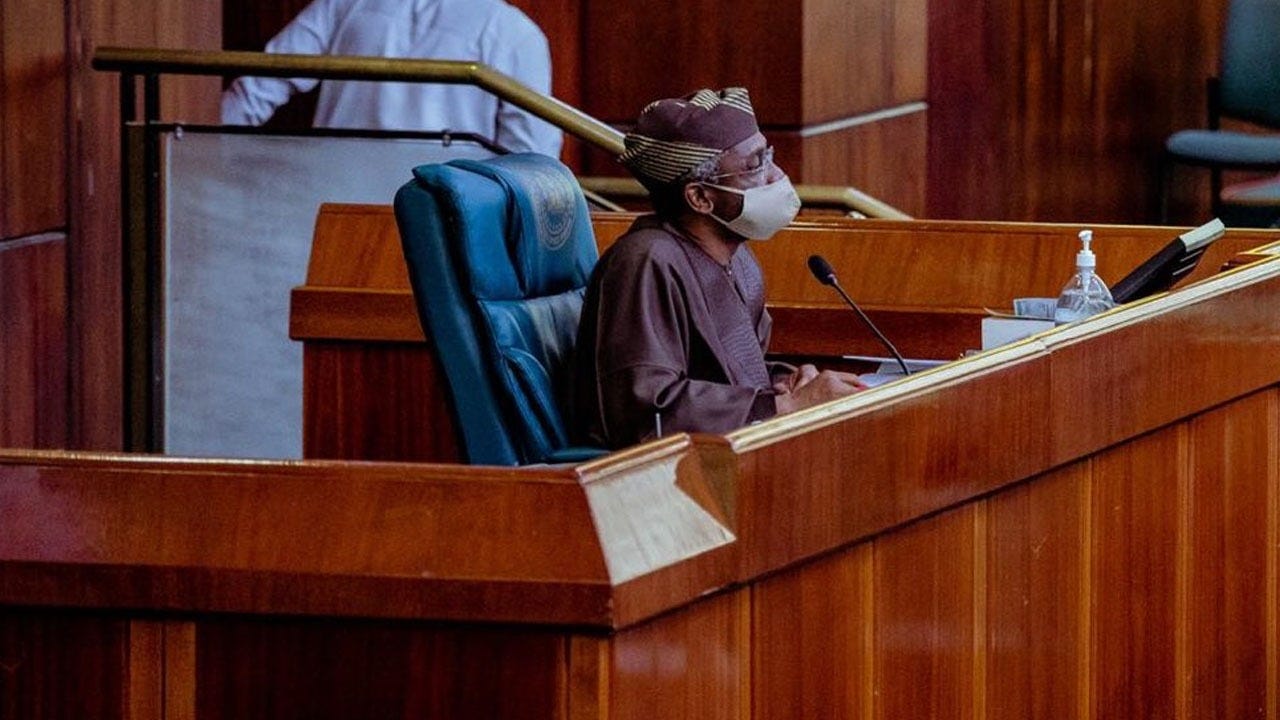
In the Agatha Christie “Witness for the Prosecution” story this piece takes its title from, the twist is that the witness for the prosecution is secretly working for the defence: her testimony is built to collapse, and its collapse is what acquits the accused. Nigeria has achieved the same design at the scale of a state.
This piece does not attempt to cast judgment on the latest scandal affecting the Bola Tinubu administration and his Chief of Staff, Femi Gbajabiamila. Citizens are seldom privy to the truth, which often leads to myths and conspiracies: it is why there are rumours around how M.K.O. Abiola died, if Buhari was ever a clone, and how close the country came to experiencing a coup last year, among others. What the piece can show is why nobody can tell you the truth of this scandal. Every jury constituted to try men like Gbajabiamila has been dismissed, and the only witness the system permits against him is one whose testimony guarantees his acquittal.
This piece asks you to sit as the jury. It also closes an argument earlier essays have opened: that Nigeria’s elite disconnect has persisted across different dimensions, and its terminal form is immunity: an apparatus of state designed to preserve those whom it currently serves. Gbajabiamila is less an outlier or a guilty party than the embodiment of the design.
Precedence
The last time an institution found Gbajabiamila guilty of taking money that was not his was on 26 February 2007. The Supreme Court of Georgia issued a unanimous order on his petition for voluntary discipline. He was found to have accepted $25,000 in settlement of a client’s personal injury claim in January 2003, failed to disburse it, withdrew it for his own use, and closed his practice before leaving the United States. The petition under consideration was for a 24-month suspension; he agreed to 36 months instead.
There are two details worth mentioning. First, when he left the US in 2003, he returned to Nigeria to contest, and win, the Surulere I Federal Constituency election in April. Second, on 2 July 2015, following an additional grievance and his failure to respond to the bar or pay his membership fees, he was suspended for five years, and on 1 July 2020, his membership of the Georgia Bar was permanently terminated. During this period, he was Speaker of the Federal House of Representatives. Gbajabiamila has always characterised this as professional negligence and not theft. He has cited his voluntary repayment of the amount, before he was formally found guilty, and the fact that a court ruled he was not disqualified from serving as Speaker of the House in 2019.
The significance of the Georgia case is not just the finding, but the fact that a finding was even possible. A single aggrieved client filed a complaint through a functioning system and received justice. The system existed and delivered on its function by issuing a verdict on Gbajabiamila, and it worked. Nigerian political science has long named the reason this machinery has never worked, even decades before Gbajabiamila entered politics. Claude Ake argued that the postcolonial state has no autonomy from those who capture it, that it is less an umpire standing above the contest for power than the prize of the contest itself. The state becomes an instrument in the winners’ hands, but this means it cannot sit in judgment of the hand that holds it. Peter Ekeh’s ‘two publics’, with a framing explored in greater length earlier, completes the picture by showing this distinction. A country with a strained primordial public, referring to its values, and a civic public, referring to its public morals, cannot effectively serve everyone.
This is why Gbajabiamila met two different outcomes in two different jurisdictions. Georgia, a single public realm where law and morality are interconnected and bind everyone, judged him effectively and found him guilty. Nigeria, an amoral civic public from which extraction attracts no sanction the state itself will enforce, could not do so. In short, Georgia’s structure belongs to no one, while Nigeria’s has owners.
The last time an institution cast a ‘negative’ verdict on Gbajabiamila was on 9 June 2015, when a majority APC caucus defied its party’s instructions. He was the candidate for Speaker, but Yakubu Dogara, a Bauchi APC lawmaker who had defected from PDP, outmanoeuvred the party leadership and rallied PDP votes to take the speakership, 182 votes to 174. By that time, he had served as Minority Leader (2011 – 2015) and was starting his fourth term in the House. He later served as Majority Leader (2015 – 2019), before clinching his goal of the speakership in 2019. By the time Gbajabiamila left the House of Representatives, two decades after he joined it, he had become one of the most influential and prepared leaders in Nigerian history.
Deference
Unlike the caricature of Nigerian politicians as inept benchwarmers until their usefulness or tenure expires, Gbajabiamila has grown with each iteration he has faced. He grew as a lawmaker, eventually gaining leadership roles and expanding his ability to navigate different interests—first as a minority leader overseeing a small caucus, then as majority leader handling the majority, and finally as speaker who would have to manage different interests nationwide. But he has also been largely beholden to the influence and whims of a single principal constituent.
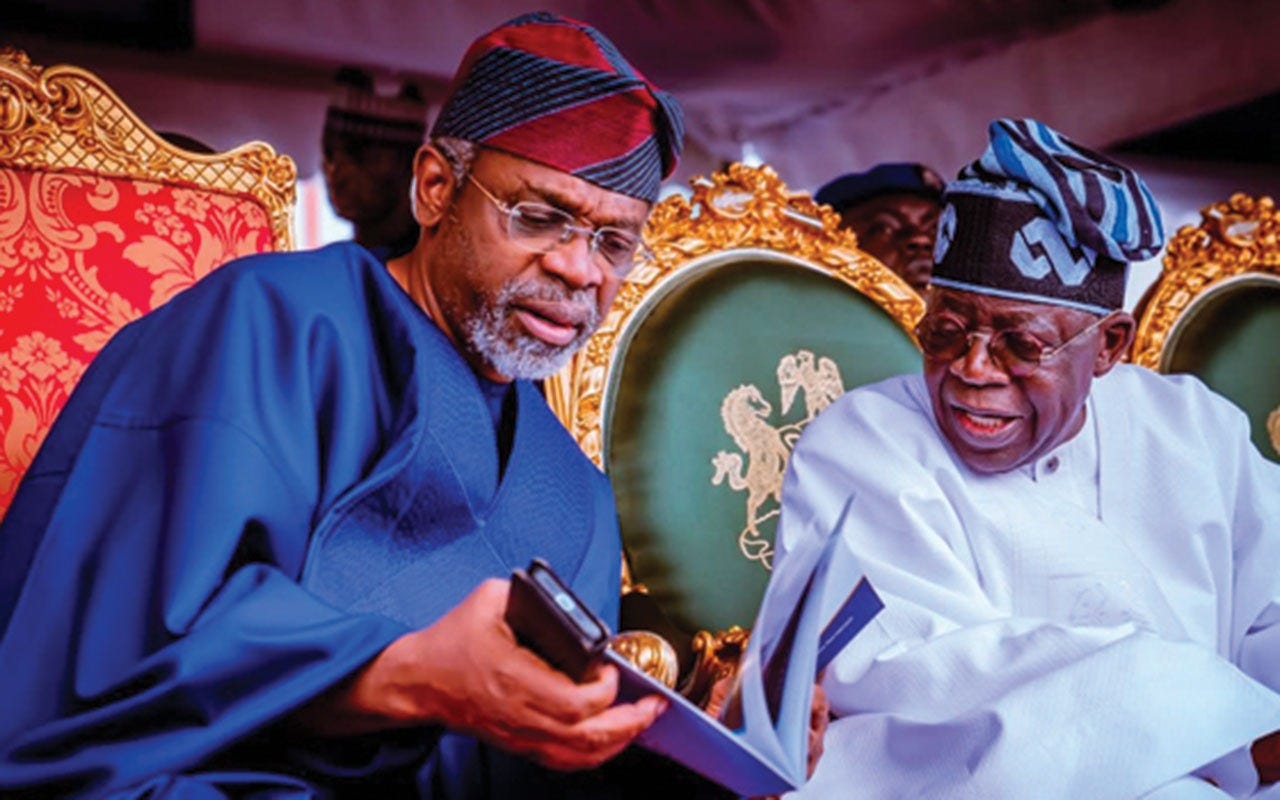
Ahead of seeking a second term as governor in 2003, Tinubu’s dominance shows in the ruling Alliance for Democracy (AD)’s slate. Of the AD’s Lagos slate, he retained eight sitting representatives and replaced the remaining 14 with his own picks. One of them was Femi Gbajabiamila in Surulere I. From there, Gbajabiamila was a devoted and loyal acolyte of his principal. When he wanted to be Speaker in 2015, it was Tinubu who tried to ensure this, even to the point of approaching Dogara to step down for his protégé. In 2019, when the APC was deferential to the leader who helped strategise Buhari and the party’s re-election, it rewarded his man by finally ensuring he became Speaker of the House. By 2023, when Tinubu was running for president, Gbajabiamila was front and centre during the campaign, cutting an ad that no other senior government official had done. It seemed apt that he would be rewarded, and he became Chief of Staff to the President on 14 June 2023.
But the problem with a single constituent is the risk of falling out of favour. Recent Nigerian chiefs of staff to the president have been the subject of repeated briefings because of their proximity to power. This really started with Buhari’s first pick, Abba Kyari, for whom the chief of staff office was his first and only real foray into Nigerian politics. Gbajabiamila, with a longer resume, has been associated with several of the administration’s failings.
He was also implicated in the 2024 controversy surrounding Tinubu’s first Minister of Humanitarian Affairs, Betta Edu. His memo was cited as a key reason Edu was empowered to carry out some of these activities, and he was also linked to attempts to block an investigative report on a reported $30 billion in recovered funds. He was also accused of leveraging his proximity to the president to divert funds without legislative approval. He has also had to navigate reports that his involvement in the ministerial appointments, including his arbitrary replacement of some expected Tinubu loyalists with his picks, led to the appointment of a Principal Private Secretary to the President. Notably, this role existed only when Yar’Adua abolished the Chief of Staff role. Coupled with the further appointment of a personal assistant to the president, the expectation was that Gbajabiamila was being weakened. However, if Gbajabiamila was being ‘weakened’, the accusation of his ability to manufacture a new government entity would speak to how much power a senior official in the executive holds. But instead the impact remains within a detached elite.
Indifference
On 25 June 2026, Prince Adeniyi Adeyemi accused Gbajabiamila of demanding 48% of the council’s proposed N27.3 billion take-off grant for the Presidential Foreign Intervention Promotion Council, a body Adeyemi claimed to head as director-general. The only problem was that this organisation was not real and had only existed as a result of a convoluted web of subterfuge and poor government management. However, the accusation was glaring because of Gbajabiamila’s track record. It was also in line with a pattern established and which benefited his principal.
Adeyemi said that he spoke to Gbajabiamila three times, using a phone belonging to an associate, Dolapo Tanimola. Unfortunately, Tanimola is now dead and is unable to corroborate or deny. The Presidency branded him a con artist, and the police have declared him wanted for forging Gbajabiamila’s letterhead and signature in documents that got him access to government office space and accounts. In his defence, Gbajabiamila’s lawyers issued a 72-hour ultimatum threatening a ₦10 billion defamation suit, and security agencies moved with unusual speed to secure Adeyemi’s sanction. This story is only made more farcical by the fact that the presidency’s denial falls flat on one key point: this fictitious body was mentioned in the budget—₦1.303 billion of it—on pages 50 and 51 of an Appropriation Act the president signed. Achille Mbembe described the postcolony as a regime in which power lives through its own performance. Such performances often involve its insignia, official forms, and the grammar of stateness. A counterfeit council with the right letterhead, a budget line, and an office in the Federal Secretariat is a forgery the state had no procedure for detecting, because the insignia verify it. This is why the crime here goes beyond the illegal structure to the fact that it has exposed the state’s weakness and failings.
Gbajabiamila’s account is the reverse of the one the accusation implies. The presidency says his office first identified the council after the Nigerian Investment Promotion Commission reported that a parallel body was operating, and that he petitioned the Department of State Services and the police on 17 October 2025 requesting an investigation. Adeyemi was arrested ten days later and charged, with two others, on 27 November 2025—seven months before he said a word in public. Read that way, the charge is not a state pre-empting its accuser but a state acting on a complaint the accused man made himself. He has denied any relationship with Adeyemi, denied demanding or receiving money, and denied interfering with any agency. The challenge is that no method of testing either account can be done without Gbajabiamila’s influence.
Tellingly, institutions of state have moved to close ranks around the chief of staff. On 8 July, the Nigerian Senate voted down a motion moved by Senator Kawu Sumaila to investigate how the allocation was made in the budget. The president issued a firm statement supporting him and clearing him of any irregularity. Security forces wrongly arrested Adeyemi’s father in an attempt to lure him out of hiding. A group of ‘civil society organisations’ that had never issued a statement before emerged to emphatically support Gbajabiamila. The president directed the ICPC to investigate the council’s creation and report within thirty days, even as his office pronounced the same man cleared. Later, when Senator Sumaila returned with the motion a second time, Senate President Godswill Akpabio ruled the matter effectively beyond the chamber’s reach. In what might be one of the most devastatingly effective psyops experiments carried out in Nigeria, the government has sought to convince citizens that a line item inserted in a budget it drafted, reviewed and passed was for an entity that did not even exist—and that this is totally normal. Ironically, Gbajabiamila’s experience as a lawmaker and his role atop the presidency’s infrastructure mean his skill set and authority would have been depended on to avoid such occurrences. But we are led to believe he is innocent.
The House of Representatives, meanwhile, constituted an ad hoc committee and began taking evidence, summoning the Secretary to the Government, the Budget Office, the Accountant-General and the Central Bank. On 1 July, the presidency said police had established that Adeyemi used forged documents to open a CBN account by misleading the Office of the Accountant-General. The Accountant-General’s office then said the council has no operational account with the CBN at all, and that the application was never completed. On 20 July, the CBN’s director of banking services, Abdullahi Hamisu, told the committee that the bank had opened two domiciliary accounts—one in dollars, one in sterling—for the ‘Presidential Economic Advisory Council/Presidential Foreign Investment Promotion Council’, on a formal mandate from the Accountant-General’s office dated 29 July 2025. Asked whether the bank had required an enabling Act first, he said it does not ask for one. The evidence of a complicit government structure is amplified by the evident falsehoods.
Nigeria does not reward witnesses who speak out against leaders. In 2016, when Representative Abdulmumin Jibrin brought budget-padding allegations against the Dogara-led leadership of the House, it was Jibrin the chamber suspended for 180 legislative days while the accused went uninvestigated. Though a court later declared the suspension a nullity, he had served roughly 17 months before the House let him back in. During the next session, in 2019, Jibrin stood on the floor of the 9th Assembly to nominate Gbajabiamila for Speaker.
In 2024, Segun Olatunji, the editor of FirstNews who reported on the handling of $30 billion in recovered funds, ended up in an underground cell because he had broken the news. The scandal, which involved Gbajabiamila and Jim Obazee, the special investigator appointed under the Buhari administration, has been largely swept under the carpet.
And when Adeyemi held his press conference, he was the one arrested after weeks in hiding and who will sit in a dock on 27 July on a forgery charge filed seven months before he ever spoke publicly. The system does not suppress testimony but converts testifying into the crime.
Sentence
As stated earlier, this piece cannot render a definitive judgment on his actions or the validity of the claims. After all, the accuser, Prince Adeniyi, has also been associated with fraudulent claims, notably claiming he had been elected president-general of the World Youth Organisation, another body that does not exist. Gbajabiamila could also be the victim of a well-coordinated, well-crafted briefing campaign against him, with many enemies stemming from his long sojourn in politics.
But Gbajabiamila’s situation does not tell us anything new or different about how governance is set up and practised in Nigeria. What it does is lead us to reflect on the calibre of leadership and on the system’s capacity to reward or protect those who continually bring it into disrepute. Beyond the list of accusations documented above, more accusations are made against the president, senior government officials, and predecessors across most of these elected and appointed offices.
Chinua Achebe’s most quoted diagnosis held that ‘the trouble with Nigeria is simply and squarely a failure of leadership’—a problem, that is, of the calibre of persons. The easiest solution would be to improve the quality or training of our leaders. Gbajabiamila is the sternest test that thesis has ever been given, and the result complicates it. It can be assumed that less-educated candidates can emerge and be quickly spat out, but when experienced career professionals and seasoned politicians are behind such activities, there is cause to pause. Gbajabiamila exemplifies academic qualifications, career formation and experience in the necessary institutions that should help produce a qualified and helpful government appointee. In almost any democracy, Gbajabiamila is a model presidential candidate—and two of his recent predecessors as Speaker have sought the presidency.
In almost any election, when candidates present their pedigrees for office, their experience in legislative and executive policy would be hard to compete with. If Achebe was right, the cure should be visible in him. Instead, the arena does not resist such formation but actively recruits and cultivates it. Credentials, in a system where the rules are personal and not national in its true sense, certify entry rather than submission to the law. This is why the trouble with Nigeria may be less the quality of its leaders than the design of the arena that receives them: one that converts qualification into title deeds.
Finally, we can revisit the forthcoming outcomes of the case. On 14 July, the Federal High Court in Abuja issued a bench warrant for Adeyemi. Justice Mohammed Umar noted that he had appeared before the court once since the charge was filed and had missed four consecutive hearing dates; his counsel said he had stayed away because of threats to his life. He was arrested days later, and the arraignment has now been listed, adjourned and relisted five times. On 20 July, Gbajabiamila appeared before the ICPC and gave his testimony; the commission has since asked for more time.
Whenever it reports, it will report to the person who has backed him, fought for his speakership, appointed him and has already cleared him. A famous lawyer and Senior Advocate of Nigeria, Femi Falana, has argued that no Nigerian constitution has ever conferred a power of exoneration on the presidency. The situation is being handled by those who are most implicated, and the witness cannot reliably be brought to the stand.
The case, as argued here, cannot demonstrate guilt or establish innocence. What it does show is the completed construction of a state that preserves those it has selected for immunity. In Christie’s story, the trick was that the witness for the prosecution actually worked for the defence. In Nigeria’s story, the witness, investigators, Senate and the judge, or the president, all work for the defence. Gbajabiamila might only find respite or a guilty verdict with this jury, the court of public opinion. However, Nigeria has shown that regardless of how it rules, this verdict will carry no sentence.
—
The Village
Hillary Essien first suggested tackling this piece, which looked at how a detached elite functions when asked to be accountable. ChiAmaka Dike forced a more engaged and punchier set of edits, and ‘made do’ with this version. Seyi took me to task for several of the theoretical inclusions. Problem is, this piece then went back to 3,000. So I guess its 2-1.
If he could become a legislator after fleeing from justice in the US, he will also become vice president and then president. Nigeria will only reward people with his peculiar skill set.