
All the Presidents’ Men
Nigeria actually has policy congruence, just not where expected

Same-party handovers between elected presidents are rare in multiparty democracies, even in systems that alternate between two main parties.
It has never happened in Ghana. In the few African instances where it has occurred, it has been driven by dominant parties: South Africa’s African National Congress (ANC), Tanzania’s Chama Cha Mapinduzi, and Botswana’s Botswana Democratic Party. It is even rarer in the U.S; Republicans last achieved this in 1988, when Bush Snr. succeeded Reagan. For Democrats, the last instance dates back to 1856.
When voters return candidates from the same party, the assumption is that they prefer continuity. It affords parties to entrench their policies, build institutional knowledge across administrations, and ensure that later governments inherit rather than restart what came before.
Nigeria is the only African country where this has happened twice with different parties. PDP elected Yar’Adua to succeed Obasanjo in the controversial 2007 elections. But APC elected Tinubu to succeed Buhari in the highly contested 2023 polls. In theory, this should have given both parties a rare opportunity to consolidate their governing projects.
But these intra-party transitions have only been surface-level. The radical personnel and policy overhauls that followed each handover reveal that what Nigeria calls a ‘ruling party’ is, in practice, a revolving presidential coalition. When a presidency changes, the coalition is dismantled and rebuilt, regardless of the party label. The consequence is a country that restarts its governing project every four to eight years.
Ready on Day One
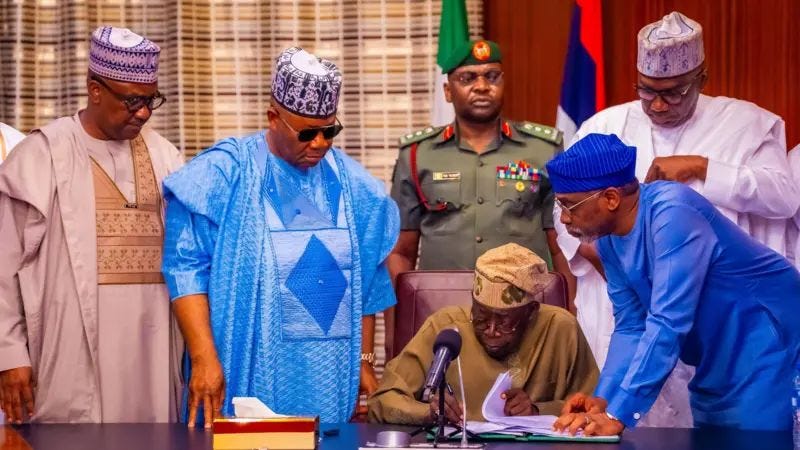
If intra-party transitions are supposed to produce continuity, the first place to look is the handover itself. Presidential transitions are among the most consequential moments in governance—when expectations are highest, public goodwill is at its peak, and the incoming team should be building on what came before. In functioning party systems, this is when institutional knowledge transfers. In Nigeria, it is when the demolition begins.
Other systems have built infrastructure for this. The U.S. has the Presidential Transition Act, first enacted in 1963, which mandates cooperation between outgoing and incoming administrations. South Africa’s ANC created a deployment committee to manage governance during leadership changes. These structures exist because parties that intend to govern continuously need mechanisms to transfer knowledge, not just power.
Nigeria has never managed a structured handover. While U.S. presidential campaigns have transition teams ready to run the moment they are projected to win, Nigerian presidents-elect have never effectively prepared for governance. Yar’Adua only named a transition committee in May 2007, barely a month before his inauguration. The next transition, when Buhari succeeded Jonathan, whose succession was dramatic for its unique nature, followed a similar pattern. Buhari did not inaugurate a 19-person transition committee until 29 April 2015—a month after his election and a month before his inauguration. Tinubu would only receive two nomination spots on a presidential transition council, which he filled nearly a month after his declaration as president-elect.
This lack of preparation shows in the lack of structured coordination across key government departments. Nowhere is this clearer than in cabinet formation, the first concrete test of actual governance, which most Nigerian presidents have conspicuously failed. Obasanjo took months to name a cabinet in 1999. Yar’Adua took two months before naming a new team in 2007. Buhari infamously ran his administration without a cabinet for six months. Tinubu took three months. Each was presented as a president being deliberate, but each had months after being named their party’s nominee to prepare. Each was a seasoned politician running multiple election bids. And each had months between being elected and taking office.
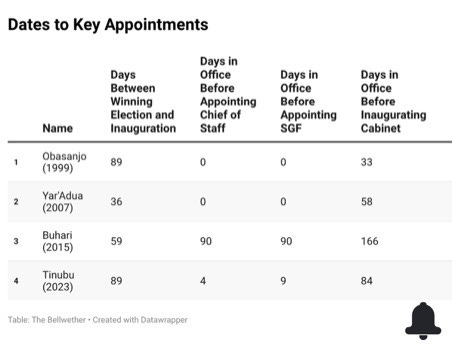
If parties were serious governing institutions, there would be structures to prepare and support a nominee to ease into governance. There would be vetting of potential appointees, briefings on ongoing programmes, and continuity plans for key departments. Instead, government appointments become coalition payments, tools for managing patronage, and in some cases, instruments for dismantling whatever the predecessor built. The delay is not deliberation. It is the time required to construct an entirely new governing coalition from scratch.
The Heir He Could Control
PDP was at its height in 2007. Key officials had beaten back Obasanjo’s purported third-term bid. But true to form, despite losing, Obasanjo obtained enough grip to control the selection for his successor, and the party was helpless to stop him. Few people were more aware of how powerful the presidency was and how much a combative successor could dislodge him. He sidestepped more ambitious southern governors such as Peter Odili. He ignored consensus picks such as then-Kaduna Governor, Ahmed Makarfi, because the party was drifting away from his grasp. Yar’Adua was from a well-known family, a moderately popular two-term governor in the north, and was not seeking the presidency.
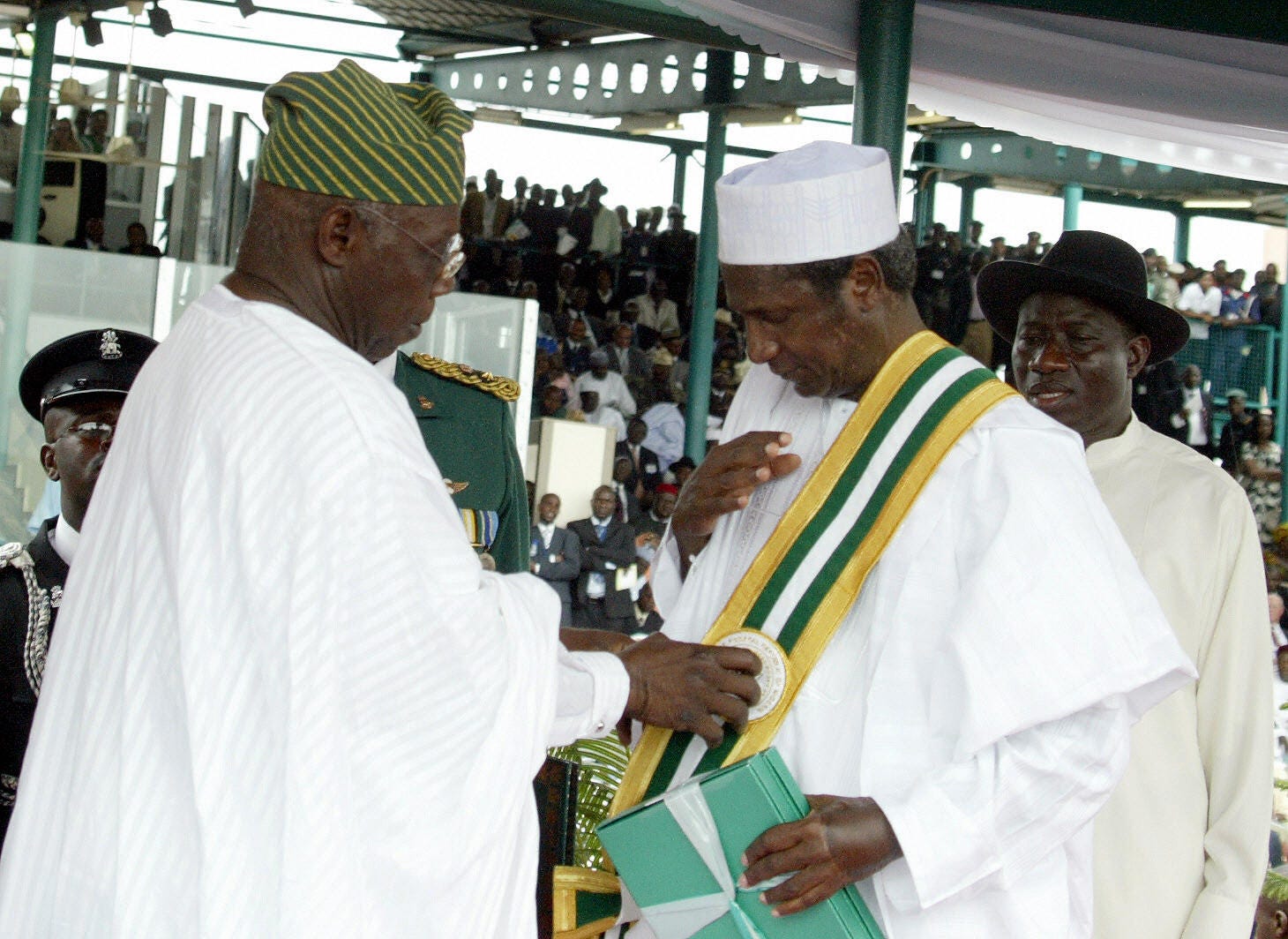
Obasanjo picking Yar’Adua spoke to the challenge of a big-tent PDP. Neither man had much in common politically. Yar’Adua had not been an active supporter or endorser of Obasanjo’s reforms and had played no role in shaping them. As Governor of Katsina, Yar’Adua was cited as a financially prudent administrator who devoted extensive resources to healthcare, education, and infrastructure. He was widely regarded as an avowed socialist, and one who was less likely to actively curry favour with the business elite that Obasanjo had cultivated. Finally, Yar’Adua’s disposition to governance was collegial, whereas Obasanjo’s was dictatorial. He reportedly refused to name either Bauchi Governor Adamu Muazu or Kaduna Governor Ahmed Makarfi as his chief of staff, so as not to be in a position to dictate orders.
This meant that Yar’Adua’s coalition was not as immediately straightforward. But his key appointments were a mixture of patrician Northern elite and leveraging connections with his fellow governors. Babagana Kingibe, a former ambassador and running mate to Abiola and Yayale Ahmed, former head of civil service, served as his government secretaries. Cabinet members were often nominated by governors, whose opinions he placed a premium on as he developed his team. It meant that, while there was no distinct Yar’Adua group, one quickly emerged to empower those seeking to control the party and the government in the post-Obasanjo void.
Yar’Adua might have given the impression of being weak and quiet, but his term was forged with a steely determination to distance himself from Obasanjo. He retained only three ministers from Obasanjo’s term—Ojo Madueke, Aliyu Modibbo and Abba Sayyadi Ruma—while he moved the long-serving Secretary to the Government of the Federation, Ufot Ekaette, to head the newly formed Niger Delta Ministry. He retained Abdullahi Mohammed, the chief of staff, but dispensed with him after a year and abolished the role altogether.
During his term, prominent figures in the Obasanjo administration, such as El-Rufai, fled into exile. Nuhu Ribadu was unceremoniously removed as head of the anti-corruption agency. Key financial stalwarts were not retained. Finance Ministers Ngozi Okonjo-Iweala and Nenadi Usman were not named to cabinet, and Central Bank Governor Charles Soludo was not given a second term. Obasanjo’s government had largely been replaced by a new governing coalition that wrestled for power and soon became a distraction from governance.
But beyond the personnel overhaul, it was the change in reforms that showed the divergence between the two men. Yar’Adua cancelled sales that would have privatised refineries and sold shares in oil companies to private owners. He revoked the partial sale of the national telecoms carrier to private hands and reversed privatisation efforts in the power sector. He reintroduced fuel subsidies and was a much more demure personality on the global stage. A different governing coalition was running the country; one that clearly did not share its predecessor’s priorities, regardless of the party label above the door.
The cost of this rupture was tangible. Strong, experienced hands from the Obasanjo era were unavailable to help Yar’Adua hit the ground running—a loss magnified by his extensive health challenges. Some of Obasanjo’s picks, notably Okonjo-Iweala, would return when Jonathan assumed office, but the intervening three years stalled processes Obasanjo had put in place. The party label had not preserved a single governing relationship. What PDP had built under one president, it dismantled under the next.
The Heir Who Didn’t Need Permission
The major difference between 2007 and 2023 was that Tinubu was not Buhari’s choice. There is extensive literature supporting the assertion that Buhari appreciated the role Tinubu played in his eventual electoral victory, but did not want to hand over to a career politician. The irony was that the very thing Buhari never wanted—Tinubu’s extensive political network— was what enabled him to navigate a crowded primary and win.
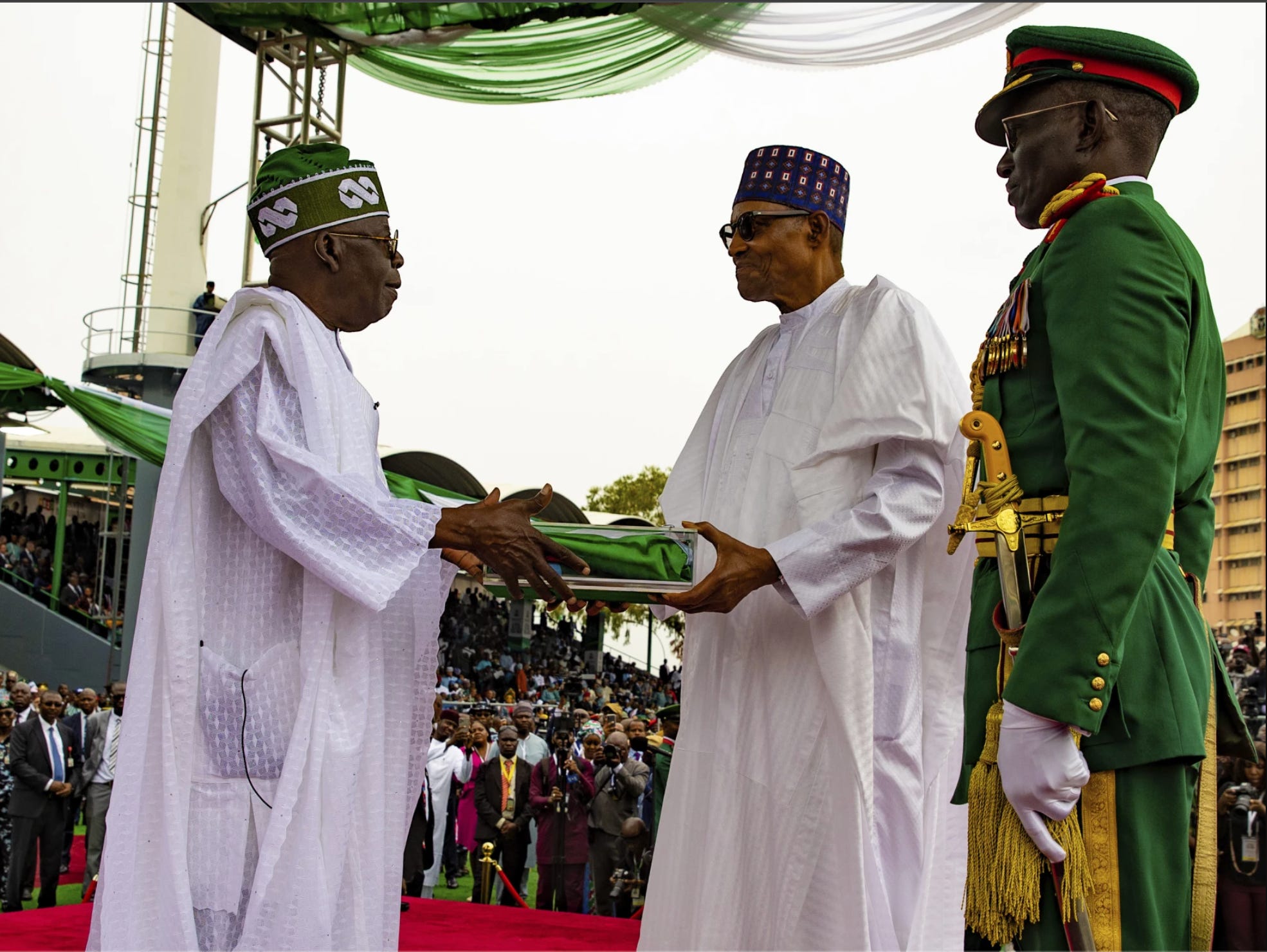
Unlike Yar’Adua, who owed his candidacy entirely to the outgoing president, Tinubu had his own power base, financial network, and political machinery built over two decades in Lagos. His claim to the presidency predated and arguably exceeded Buhari’s ability to grant or withhold it. APC governors, especially those in the north, were instrumental in his primary victory. They consolidated behind Tinubu at the June 2022 primary, defeating Osinbajo, Amaechi, and several other candidates. Buhari was unable and perhaps unwilling to impose his choice.
Once elected, Tinubu cleared house. Within four days of inauguration, he named Femi Gbajabiamila as Chief of Staff and George Akume as SGF. Both had served as House Speaker and cabinet minister, respectively, during the Buhari presidency. But both are also long-standing personal allies, and neither was considered a strong continuity appointment from the Buhari era. The cabinet followed in August, three months after the inauguration, and it was assembled almost entirely from Tinubu’s own networks. Of Buhari’s approximately 43 second-term ministers, only Festus Keyamo and Heineken Lokpobiri received ministerial appointments. Like all new appointees, they were deployed to ministries entirely different from the ones they had held under Buhari. Muhammadu Dingyadi, Buhari’s Police Affairs Minister, was not added until the October 2024 cabinet reshuffle, over a year into the administration, and he, too, was moved to an entirely different portfolio. Not a single Buhari-era minister was retained in the same role.
The most prominent Buhari-era figures were not merely unrewarded; they were displaced. Rotimi Amaechi, who served as Transportation Minister and director-general of Buhari’s two presidential campaigns, received no appointment. Nasir El-Rufai, the powerful Kaduna governor and key Buhari ally, was initially nominated to cabinet, then rejected, and later became a public critic. Rauf Aregbesola, Buhari’s Interior Minister and a former Tinubu protégé, was not retained. Babatunde Fashola, who had served as Works Minister for eight years and was Tinubu’s own successor as Lagos governor, was not appointed. Several of these figures—Amaechi, El-Rufai, Aregbesola—are now in the opposition ADC. The governing class of one APC administration has reconstituted itself as the opposition to the next.
Policy reversals confirmed what the personnel overhaul suggested. Within weeks, Tinubu removed the fuel subsidy, unified the exchange rate, and reoriented economic strategy away from what Buhari’s team had built. Notably, Tinubu’s fiscal policy has been less strictly artificially propped up and more market-driven. This has meant changing from Buhari’s interventionist and protectionist strategies. These included his border closure, import restrictions and subsidised credit schemes. Tinubu has instead followed a market-oriented strategy, with deregulation, free-floating exchange rates and liberalised trade. These are remarkably different economic policies pursued by consecutive administrations from the same party.
The APC manifesto offered no constraint because it bore little relation to either president’s actual governing priorities, and the two sets of priorities contradicted each other on fundamental questions. The party could not ensure continuity because it had no independent policy position apart from its current president. Tinubu appointees have been at pains to cast blame on their predecessor without alienating his supporters.
Different Parties or Different Coalitions
In both intra-party presidential transitions, there have been no substantial transfers. No personnel were retained. No policy was expanded upon. No institutional knowledge was leveraged. But the second conclusion is more subtle and more damaging to the idea of parties. The greatest policy continuity in Nigeria’s Fourth Republic has not been within parties, but across them.
We are presented with two ideal pairings for continuity. Obasanjo and Tinubu are Yoruba leaders from the South West. Both are market liberalisers who believe in an assertive, Nigeria-first foreign policy. Obasanjo pursued privatisation, attempted downstream deregulation, pursued an active foreign policy, and also attempted to remove subsidies. He was key to the transition to the African Union and helped stop the coup in São Tomé and Príncipe. Similarly, when faced with issues in a state, he declared a state of emergency and removed the governors in Ekiti and Osun.
Tinubu, assuming office 16 years later, has revived and extended reforms that were attempted, but not fully realised under Obasanjo. He also followed through with the subsidy removal. He has engaged foreign policy challenges with similar assertiveness, including the coup in Niger and efforts to counter one in Benin. Like Obasanjo, he has also embarked on extensive state visits and trips in his first term. He also declared a state of emergency and appointed an administrator to replace the governor in Rivers. There is an irony: these two presidents displayed notable mistrust and enmity when Obasanjo was president, and Tinubu was governor.
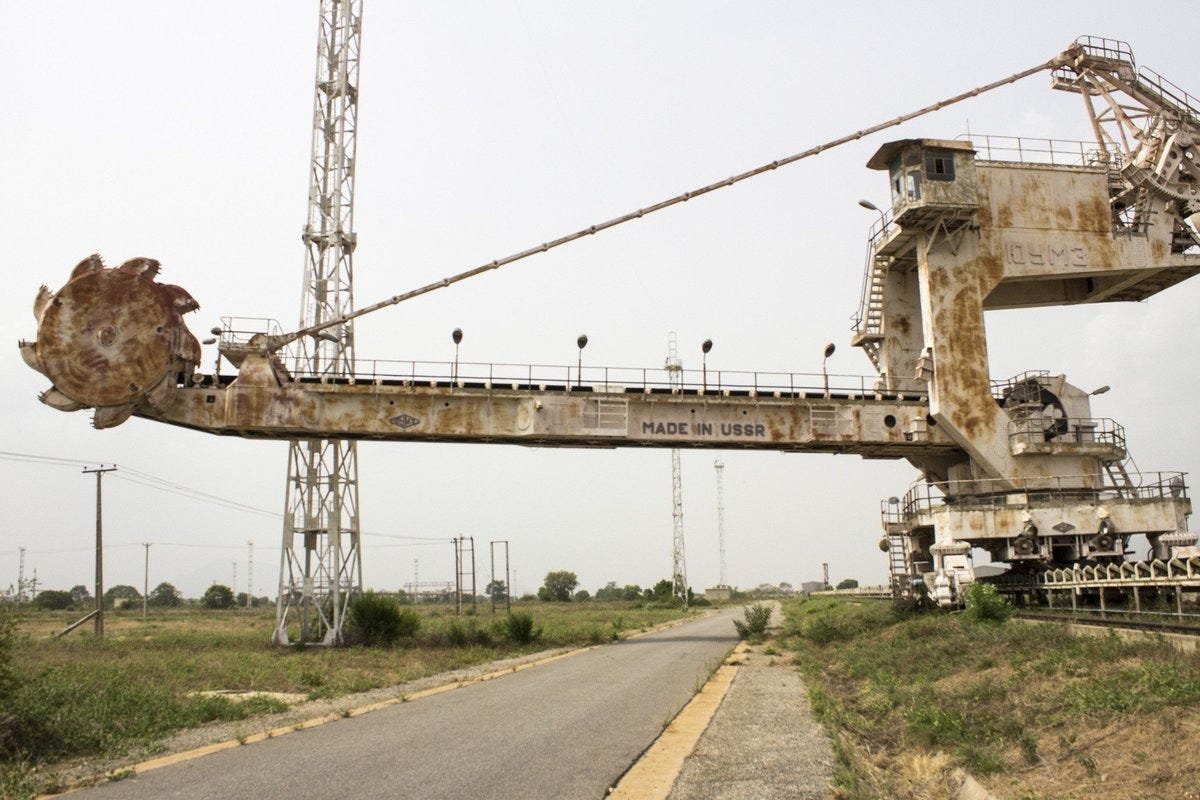
A major counterfactual is how different the electricity sector would look. Tinubu restarted and extended many Obasanjo-era reform initiatives, such as using the 2023 Electricity Act to decentralise power generation and unbundle state authority. Other attempts, not yet complete, include the attempt to rehabilitate Ajaokuta Steel Mill—a white elephant that has stymied successive governments. An Obasanjo-Tinubu transition would deliver a radically different power dynamic in the country.
The second pairing is Yar’Adua and Buhari. Both were from Katsina and instinctive statists suspicious of market orthodoxy. Both domestically focused and inclined towards state intervention and subsidy as instruments of governance. Yar’Adua reversed Obasanjo’s privatisations, reintroduced fuel subsidies, defanged EFCC and turned inwards. Buhari, five years later, governed similarly: maintained fuel subsidies he once decried, defended multiple exchange rates and closed borders to protect domestic producers.
Where Yar’Adua had ‘rule of law,’ Buhari had ‘anti-corruption’—both were brand identities more than governing programmes. Both were products of and influenced by the famed Kaduna mafia—Yar’Adua through his family connections, and Buhari through his key appointments. Shehu Yar’Adua, the elder, was a major part of the Kaduna mafia and established the family as a major recipient of their support. Similarly, Mamman Daura, a key adviser to Buhari, was also a major part of this group. Both were also sceptical of Lagos-led market liberalism. The irony here is that both men contested the 2007 elections, which Yar’Adua won, and also experienced health challenges in office.
A counterfactual involves the preference both had for state control of strategic assets. Yar’Adua reversed several government asset sales and concessions that Obasanjo had approved towards the end of his term. Similarly, Buhari was resistant to privatisation efforts, which notably contributed to his government’s failure to do so in the power sector. Another shared trait was their comparatively milder approach to diplomacy, especially compared with their southern counterparts.
The pattern is an indictment: parties have not developed genuine policy structures. Obasanjo and Tinubu should not be as ideologically aligned as Yar’Adua and Buhari—they belong to different parties, different generations, different political traditions. Yet, we face the grounded speculation that if Tinubu had succeeded Obasanjo, and if Buhari had succeeded a two-term Yar’Adua, Nigeria would be approaching 32 years of policy cohesiveness and coordination. The party system, as currently constituted, has prevented this.
This leads to another dividing line in Nigerian politics: not by political party, but coalition type. A presidency is determined by the coalition they assemble, the regional base they draw on, the technocratic network they trust, and the ideological background they bring. These are not based on party membership; these are personal traits.
The absence that makes all of this possible is the absence of policy infrastructure—within the party, and increasingly within the civil service that should provide continuity regardless of who holds the presidency.
PDP lacked a policy shop, and APC has yet to articulate what the governors in Sokoto and Ogun have in common beyond wearing the same broom insignia. This lack of planning makes it similarly susceptible to volatile shifts in governance. This lack of continuity also raises the question: What is the point of a party if the people do not share values? If parties are merely ballot vehicles, the case for independent candidacies becomes harder to dismiss — but that is a question for another piece.
The Next Governing Coalition
If the pattern holds, we already know what the next transition will look like. Barring death or incapacitation, Tinubu will be the APC’s presidential nominee in 2027, and the fractured opposition makes re-election likely. Northern politicians will be content to see off a president and prepare for the next poll.
The question is not whether the next president will be a liberaliser or a statist—though that will matter for policy. The question is whether the party label will tell us anything about the answer. So far, it has told us nothing. What will matter, as it has in every transition since 2007, is the governing coalition they assemble, the networks they draw from, and the instinct they bring to office. The party will provide the vehicle. It will not provide the destination.
Could this change? In theory, a party that has held the presidency for three consecutive terms should have had time to develop genuine policy infrastructure. But the APC remains beholden to the constituent wings of the merger that created it. Perhaps that is all it was ever meant to do: serve as a vehicle for revolving coalitions. Buhari and Tinubu have both governed through it, and neither has been constrained by it.
The lifecycle of a Nigerian ruling party, it turns out, is really the lifecycle of a presidential coalition wearing party clothes. The party provides the legal vehicle, but not the governing infrastructure. And the cost of this arrangement is not merely political instability. It is that Nigeria restarts its governing project every four to eight years. No administration inherits institutional knowledge from the last. No policy survives its architect. A country of over 200 million people is perpetually stuck at Year One.
_____
Written by: Afolabi Adekaiyaoja
Edited by: ChiAmaka Dike and Hillary Essien
"Tinubu restarted and extended many Obasanjo-era reform initiatives, such as using the 2023 Electricity Act to decentralise power generation and unbundle state authority. "
Is this not the other way round? Obasanjo was more for centralizing power under the National Grid while Tinubu is more for decentralising it, a fulfilment of the Buhari-era constitutional amendment moving power from the exclusive to the concurrent list.
And generally, Obasanjo was more unitarist while Tinubu is more federalist...
And one could argue that the Jonathan government was actually a successor to the Obasanjo one, compared to the Tinubu government.
By the way, while Obasanjo is undoubtedly the best head of state we have ever had, a lot of Tinubu supporters want us to believe he was the worst. This is because while Obasanjo is nationalist, Tinubu is more "tribalist".
Finally, if there is any politician that can ensure continuity, it is Tinubu. He's the only politician that has demonstrated that -- in Lagos. So, you just might get your wish.
The parties are vehicles to win elections. That's all. No ideology , no governance. It is only politicking that the parties know.