
The Opposition Cannot Hold
Nigeria's opposition movement is limited by design

When Nigerians go to the polls in 2027, they are meant to have a choice. For much of the past decade, they have had something closer to a foregone conclusion. The All Progressives Congress has held the presidency since 2015, and the parties arrayed against it. The People’s Democratic Party, the African Democratic Congress, and the Labour Party are in such visible disarray that calling them an “opposition” feels generous. They are chronically underfunded, hollowed out by internal feuds and unable to articulate a coherent political identity.
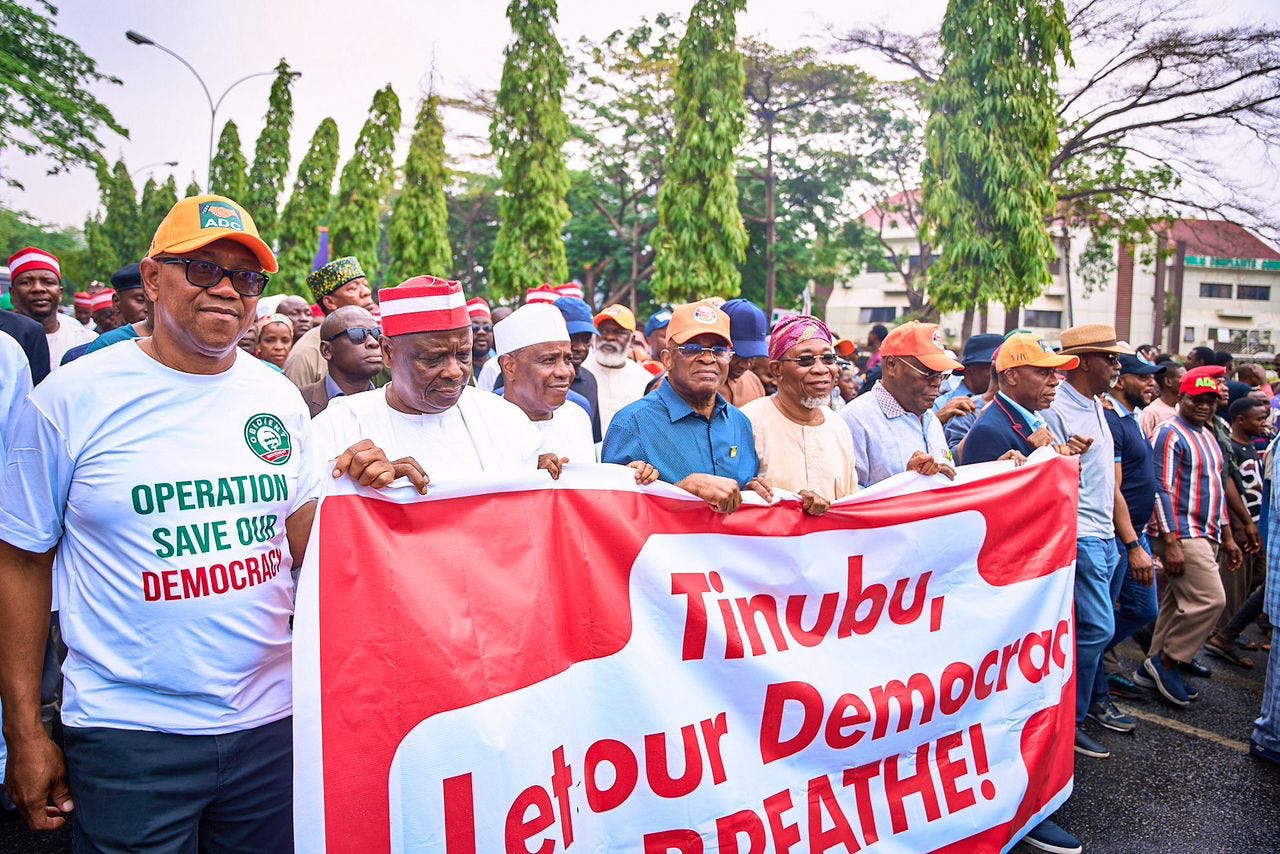
APC heads into 2027 with supermajorities across the board. The more troubling question is not how these numbers came to be, but what their imbalance signifies. In the absence of a credible opposition, who holds a struggling government to account? There is no clean answer.
The collapse of Nigeria’s opposition is neither sudden nor accidental. It is the product of decades of institutional erosion, a steady misdirection of political talent, and structural choices in party financing, in the design of government, and in the state’s treatment of organised dissent. Together, these have made viable opposition extraordinarily difficult to build and even harder to sustain.
The Architecture of Opposition
Before asking why opposition in Nigeria has failed, it is worth being precise about what the opposition is actually supposed to do. The easy answer is that it provides an alternative: if citizens dislike the current government, they can choose another. But this is quite a simplistic definition, and it sets the bar too low.
Oppositions perform two distinct functions: they offer an alternative government and constrain the one in power. A party that can replace a government but cannot hold one to account is not performing the full democratic function. As the history that follows shows, Nigeria has occasionally achieved the former while failing almost entirely at the latter.
That failure begins with structure. Nigeria’s First Republic operated under a Westminster parliamentary model, which creates a formal architecture for opposition: a recognised leader, a shadow cabinet, and a built-in expectation that the opposition is a government in waiting. In practice, the three major parties were anchored in regional bases where their majority membership resided, meaning opposition functioned primarily as a coalition of those excluded from federal power rather than as a structured alternative to it.
Awolowo’s Action Group, through his programme of free primary education, industrialisation, and social welfare, came closest to functioning as a genuine national opposition by presenting a serious policy alternative. But when that national project began to threaten the dominant coalition’s hold, the response was not political competition but political destruction. The Western Region crisis of 1962, the state of emergency, the treason charges, all of it ended the only party attempting to build opposition on programmatic rather than ethnic grounds.
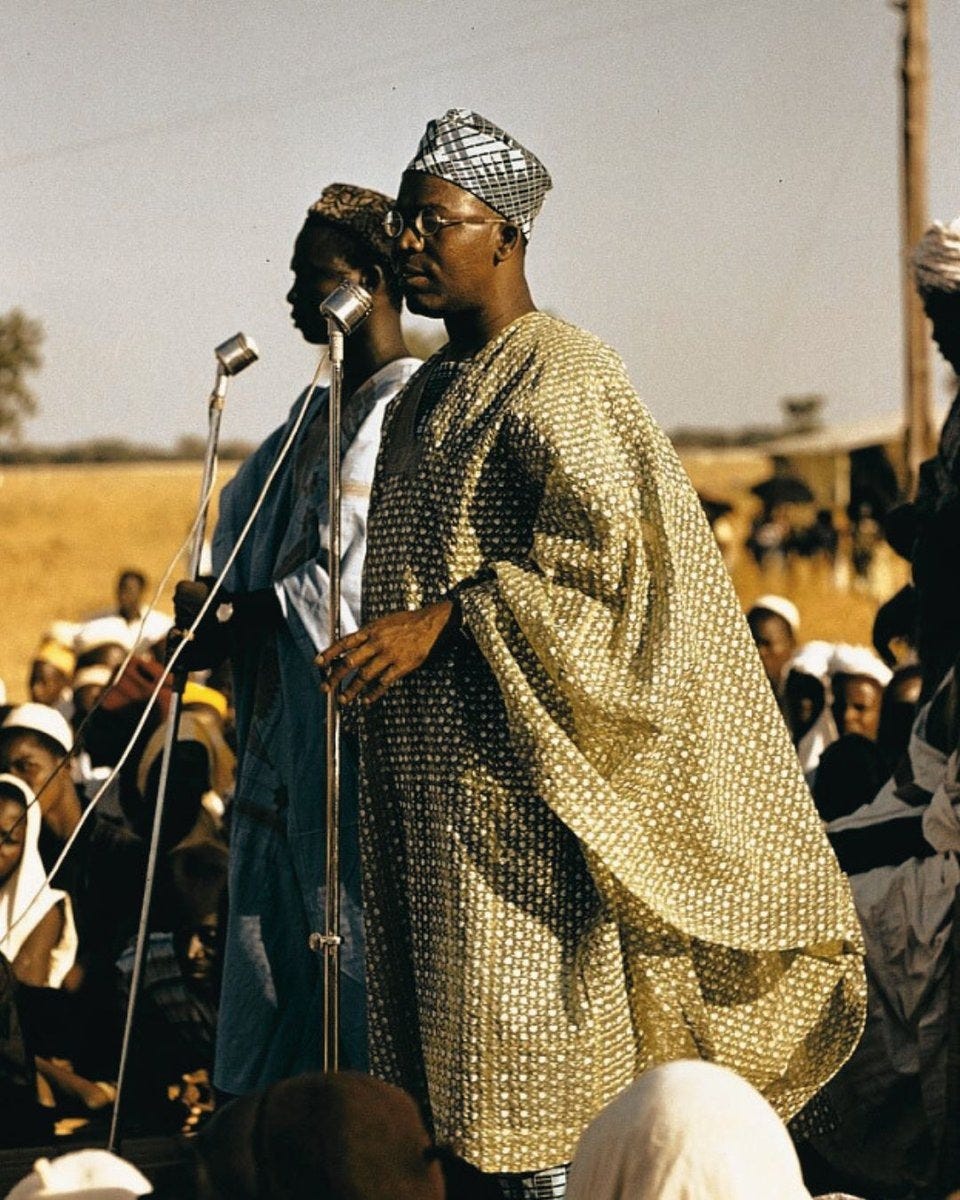
The move to a presidential system in the Second Republic of 1979 was meant to correct this by forcing candidates to build national coalitions, rather than rely on regional blocs. It did not. The structural pressure of the presidency, the concentration of resources and patronage at the federal centre, made controlling that centre the primary political objective for every significant actor.
The Unity Party of Nigeria held five southwestern states and advanced a distinct policy platform, but without access to federal patronage, it remained a regional force. The same was true of the Nigerian People’s Party, which drew largely from Igbo political networks in the east without meaningfully expanding beyond them. Organised opposition could hold states; it could not, under this architecture, constrain the centre.
The lesson was clear: opposition that threatened power would not be met with competition, but dismantled. That lesson has never been unlearned.
Opposition Under the Military
Ibrahim Babangida’s governance style explains much of how opposition capacity was dismantled. Babangida earned the nickname ‘Maradona’, not just as praise but as a description of his political style. His most effective tool was not censorship or outright repression, but co-optation, used deliberately and consistently. His administration cultivated relationships with editors and columnists, offering access in exchange for coverage that softened criticism. Technocrats became the public face of controversial policies, giving them a veneer of neutrality that blunted resistance.
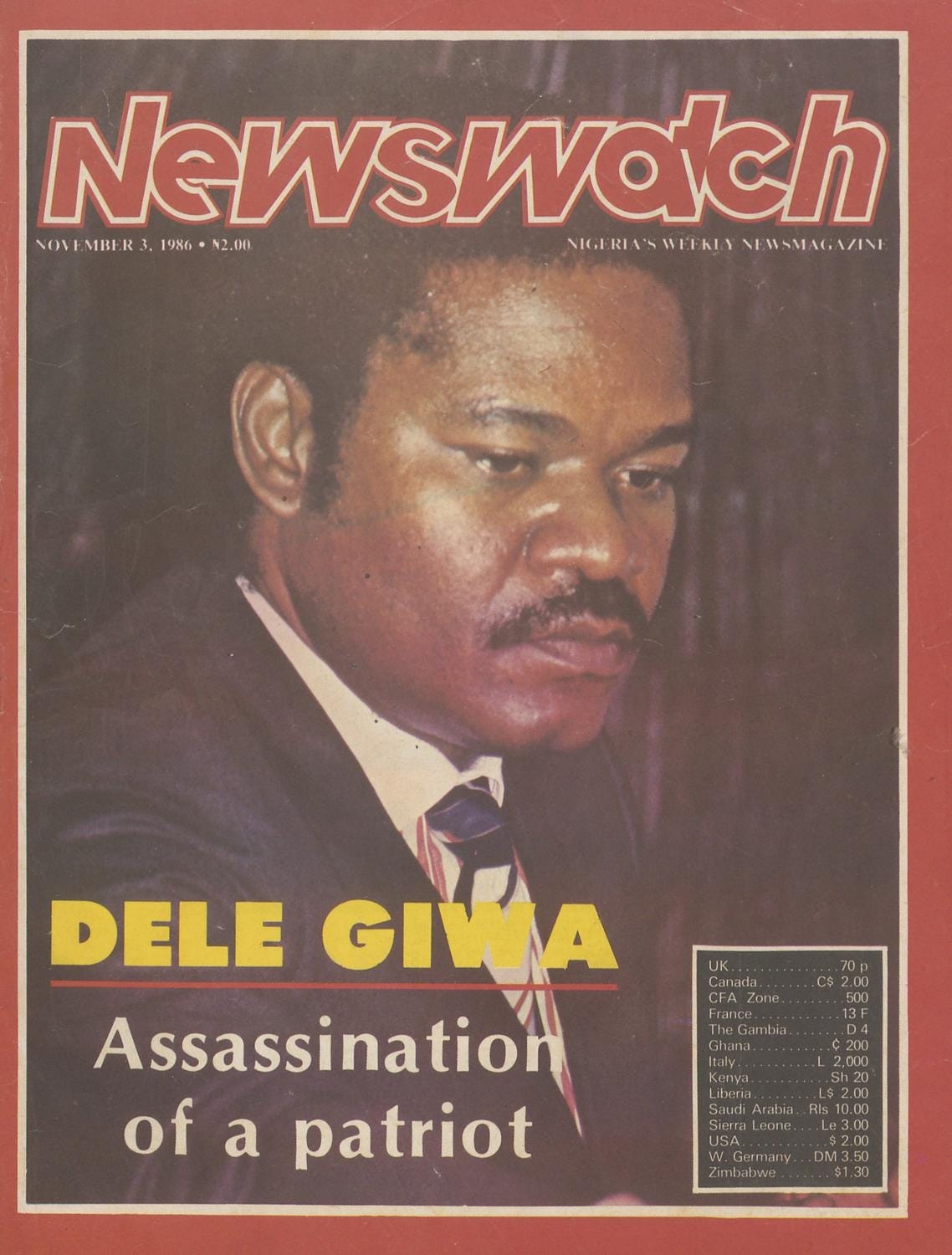
Independent student unions, professional bodies, and media organisations were either taken over or broken. Newswatch, The Guardian, and Concord were raided or shut down. Dele Giwa, who co-founded Newswatch, was killed by a letter bomb. The aim was simply to weaken the broader network of institutions that enabled organised opposition. The same approach, drawing critics inward through appointments, contracts, and access, has been used by every government since, though rarely as systematically.
Ironically, it was Babangida’s own transition process, marked by repeated delays and culminating in the annulment of the 1993 election, widely believed to have been won by MKO Abiola, that produced Nigeria’s most significant opposition movement.
The National Democratic Coalition (NADECO) did not emerge spontaneously. Earlier pro-democracy formations had been organising around the question of power shift and democratic reform well before the 12 June crisis. When Babangida annulled the election, and Abacha subsequently seized power from the Interim National Government of Ernest Shonekan, these groups converged into a single, nationwide coalition with a clear objective: the restoration of Abiola’s mandate and the return of democratic rule. Its leadership and membership cut across regions and professions.
The movement drew on a broader ecosystem of support. International pressure from Western governments, diaspora advocacy networks, and foreign-funded civil society organisations gave NADECO both resources and visibility at a moment when domestic institutions were being systematically repressed. The Campaign for Democracy coordinated street protests. The National Union of Petroleum and Natural Gas Workers mounted industrial action that placed direct economic pressure on Abacha’s regime. And crucially, the opposition understood that controlling the information environment was as important as controlling the streets.
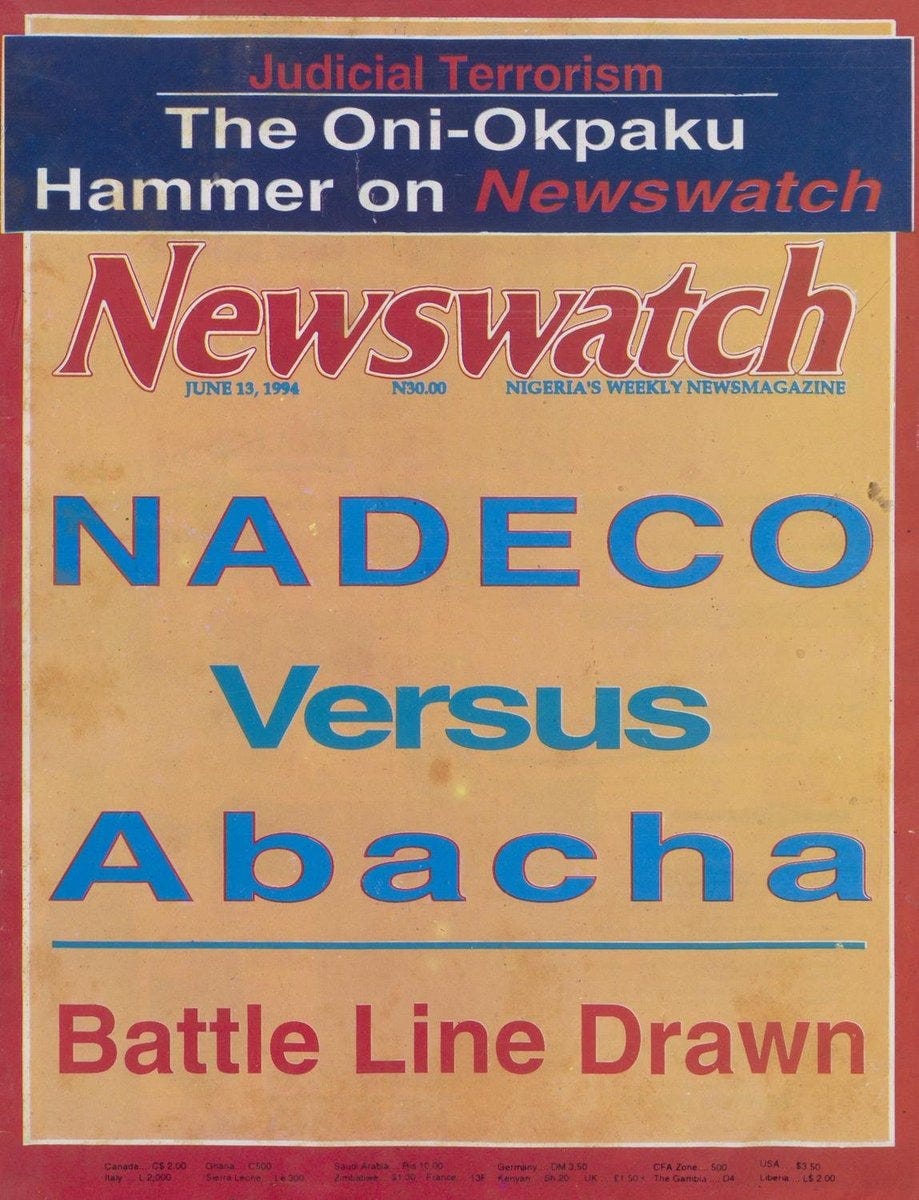
The pioneers of NADECO operated at considerable personal risk. Alfred Rewane, widely acknowledged as the main financier of the movement, was assassinated. Kudirat Abiola, who was adept at mobilising rallies and was directly involved in the 1994 oil workers’ strike, was killed. James Bagauda Kaltho, a prominent investigative journalist, went missing. Others were imprisoned or forced into exile. NADECO sustained pressure, absorbed cost, and kept the democratic argument alive.
But, in 1998, it was not a decisive opposition victory but Abacha’s sudden death that broke the impasse. The transition that followed was managed by the military on its own terms, through a process it designed and controlled. What NADECO had done was narrow the regime’s options and raise the cost of continued repression. It did not compel the handover. The distinction matters because it means 1999 established a template: not of opposition winning, but of opposition outlasting, and outlasting is a much harder and more fragile form of political success.
Building the Machine
The energy that had sustained the anti-Abacha struggle seemed to fuel active opposition when democracy arrived in 1999. Labour unions, civil society organisations, and an increasingly assertive media, all of which had been forged in the resistance to military rule, became the primary sites of opposition in the early Fourth Republic.
The Nigeria Labour Congress, under Adams Oshiomole, mounted confrontations over fuel subsidy removals and economic policy, demonstrating that opposition could be waged through institutions rather than simply through party structures. The rise of independent newspapers and broadcast outlets, many with direct ties to opposition political figures, gave the opposition a communication infrastructure the PDP could not easily neutralise. Most prominent southwestern politicians owned or were closely associated with media houses. Politicians who understood opposition understood that narrative infrastructure and political infrastructure had to be built together.
What was still missing was a political structure capable of converting resistance into electoral power. Bola Tinubu set out to close that gap. After surviving the 2003 elections as the only opposition governor in the southwest, he rebuilt the Action Congress and pursued consolidation through patient legal strategy and direct financial intervention. After the contested 2007 elections, he financed challenges to disputed results in Osun, Ondo, Ekiti, and Edo, restoring mandates through the courts. Each victory added a state. Each state added resources and credibility.
In the north, Muhammadu Buhari’s failed election bids had produced a constituency that treated his losses as manufactured and his candidacy as a moral cause. That loyalty, accumulated across years of defeat, was not the product of legal strategy or media architecture but was a form of political commitment rooted in personal trust and regional grievances.
This opposition was tested twice, each proving the fallibility of the PDP’s machine. First was empowering Jonathan to assume office when Yar’Adua was sick and unable to constitutionally hand over the presidency. Second was against Jonathan himself when he sought to remove the subsidy. Both showed the organisational capacity that this newfound democratic opposition had built. This coalition included civil society and organised labour and was able to draw international pressure. By the time it coalesced into a functional political party, with its divergent but allied components, it was ready to win.
The Paradox of Winning
The APC’s victory in 2015 was, in structural terms, the worst thing that could have happened to Nigerian opposition politics. The transition brought the entire ecosystem of Nigerian opposition expertise into government in a single transfer, and there was no mechanism to replace it.
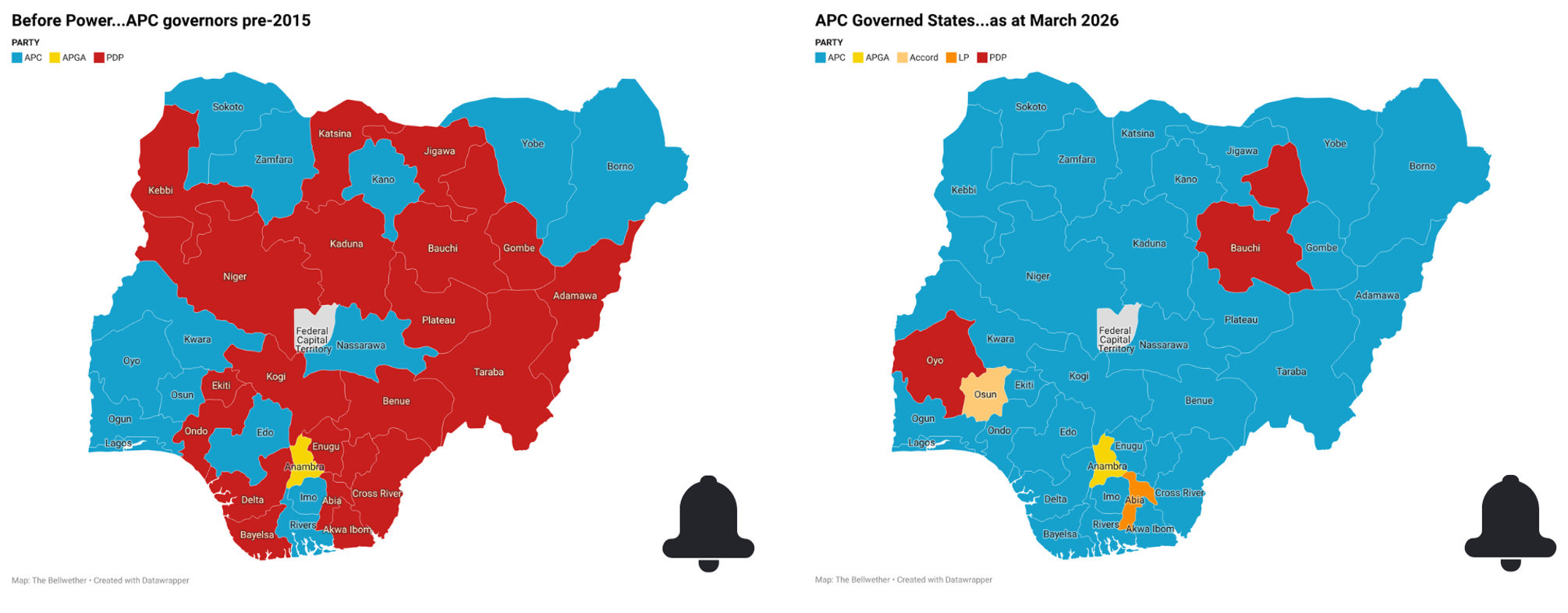
Over two decades, the institutional knowledge required to challenge power had been concentrated in a relatively small network of individuals. When the APC won, that network walked into the executive branch, state houses, and cabinet rooms.
Kayode Fayemi, who had built his political credentials through democratic reform networks, became a minister. Adams Oshiomole, whose mastery of mass mobilisation had been forged on the picket lines of the Nigeria Labour Congress, became the APC party chair. Nasir el-Rufai, long a critic of PDP governance, became Kaduna governor. Rotimi Amaechi, who had fought a celebrated legal battle to reclaim his own governorship in Rivers State, became a cabinet minister. The people who had spent careers studying how to challenge power now had power. No architecture remained to challenge them.
Beyond this, the fact that they had perfected the playbook meant they were more adept at countering it. Oshiomhole, who had led several major strikes against the Obasanjo government, was now adept at talking groups down, and he was branded a traitor by a labour union. While many APC leaders had played key roles in opposition protests, they presided over a crushing response to the #EndSARS protests. They even leveraged Buhari’s military background and complacency in managing military promotions to co-opt retired officers, including former army chiefs.
The media followed the same logic. Journalists and commentators who had chronicled, and in some cases actively championed, the opposition cause over the preceding decade found themselves, after 2015, inside the new establishment. Babafemi Ojudu ran for the Senate, and Bayo Onanuga headed NAN before becoming Tinubu’s spokesperson. Some moved into government communications. Others became editors and anchors at outlets now aligned with the ruling party. The media ecosystem that had helped bring the APC to power did not survive the transition as an independent force. It was absorbed.
The PDP, reduced to opposition, discovered it had no usable toolkit. Its membership was largely composed of career incumbents, politicians who had governed rather than organised, whose institutional memory ran to managing state resources rather than contesting them from the outside. Opposition was not a craft they had developed but a condition they had never imagined inhabiting. They did not know how to organise without incumbency, how to fundraise without state resources, how to build alliances that did not rest on shared access to government patronage. They also did not know how to hold governments to account, because they were aware of how the system had benefited them and that accusations could easily be traced to their time in office. And when the distance from power proved too much to bear, many of them simply crossed.
Lastly, civil society organisations pivoted towards institutional capacity-building to benefit from the increasing foreign donor largesse allocated to these efforts. As a result, it became hard for many organisations to actively engage when their criticism of PDP and tacit endorsement of APC also meant they bore some of the responsibility for the government in power. It left the opposition without allies precisely when it needed them most.
APC’s victory came at a moment when it manoeuvred two structural factors that explain the current fragility of the Nigerian opposition, and they are not independent of each other. Current opposition parties have failed to adapt the playbook.
The first is resources. Opposition costs money: for legal challenges, for candidate recruitment, for maintaining party structures between election cycles. Tinubu’s Lagos resources sustained the legal battles that preserved Action Congress gains across the southwest after 2007. Rotimi Amaechi’s Rivers State became a significant source of funding for the 2015 campaign. Without a comparable financial architecture, opposition exists mostly on paper and disintegrates under pressure. Since 2015, the PDP’s wealthiest governors have either left office or defected to the APC, leaving the party's financial base in disarray. The party’s most reliable backer in recent years has been Nyesom Wike, but a single wealthy patron is not a party finance operation. It is an unhealthy dependency.
The second factor is organisational capacity. Effective opposition requires people with transferable skills. It needs lawyers capable of electoral litigation, mobilisers with union or community organising experience, and communicators who can frame political arguments for mass consumption. It needs strategists who understand the patience required to build durable coalitions. It also requires media operations, relationships with editors, the capacity to place stories, and a narrative architecture that can withstand a news cycle hostile to the opposition’s interests. The PDP has had governors, senators, and former ministers in abundance, but it has rarely had any of these things. Its internal elections have been characterised by violence, litigation, and faction warfare rather than competitive politics that produce leadership capable of running a national campaign.
A third factor, unique to opposition politics post-2015, is interference. Every major opposition party currently contesting the APC’s dominance is simultaneously embroiled in internal conflict severe enough to render it functionally impaired, and this is worth examining carefully rather than attributing entirely to self-infliction. Some of it genuinely is. The Labour Party’s post-2023 internal crisis reflects real tensions over resources and political identity that its rapid growth made inevitable. But external pressure has also played a role. A party long in power understands opposition tactics intimately. The mechanisms available to the state are numerous: electoral commission rulings, court proceedings, financial regulation, and the selective deployment of regulatory pressure against sympathetic media outlets. Each can be deployed in ways that are difficult to prove and easy to observe.
Where Today’s Opposition is Failing
The current opposition appears to coalesce around ADC chieftains such as Atiku Abubakar, Rotimi Amaechi, Nasir El-Rufai and Aminu Tambuwal. But Atiku and Tambuwal sought electoral office under the APC, and Amaechi and El-Rufai thrived under Buhari’s presidency. Their ambition is largely seen as self-serving because they’ve been schemed out of the party.
This is why the most instructive opposition role, at least now, belongs to the one person who built the closest movement to previous opposition successes. It is also why his failure to maintain it is the biggest tragedy.
In 2023, Obi built something genuinely rare in Nigerian politics: a multi-ethnic, youth-driven movement that disrupted the traditional two-party contest and delivered a credible third-place finish by official count, with strong evidence of far deeper support across the south and among urban voters. The Obidient movement was not merely a campaign. It was, briefly, the closest thing Nigeria had seen since NADECO to a politically energised popular coalition operating entirely outside the established patronage networks. It also had something NADECO never had: an organic digital media operation, driven by young volunteers who flooded timelines, organised viewing parties, and produced content that outpaced anything the major parties were doing online.
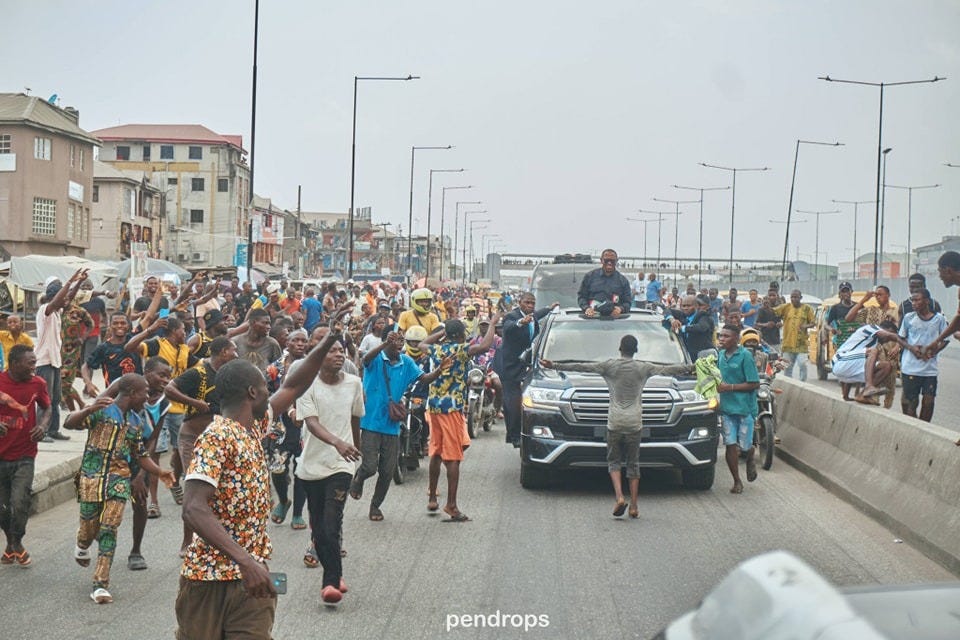
Regrettably, what followed was a masterclass in how not to consolidate a movement. The years between 2023 and 2027 demanded one thing above all else: converting energy into institutions. Obi did not do it.
Instead, he became consumed by legal battles over the election result and by the Labour Party’s increasingly bitter internal feuds, which descended into parallel executive crises and open warfare between factions that had never agreed on much beyond his candidacy. He failed to build on the gains he did have: a Labour Party governorship in Abia, a wave of legislators who owed their seats to his coattails. He neither expanded his legislative footprint through targeted recruitment nor strengthened the loyalty of those already in his camp. Figures who had invested genuinely in his 2023 campaign, among them Valentine Ozigbo, drifted away. The digital energy that had made the Obidient movement so visible dissipated without any institutional structure to channel it. The movement that had looked, briefly, like the seedbed of a new political force was allowed to idle.
To be fair to Obi and the movement he built, that failure is not unique to newer entrants. Even the architects of the 2015 coalition, some of whom now find themselves on the wrong side of the party they helped build, have struggled to apply the lessons of that success to the task of rebuilding opposition.
Obi eventually left the Labour Party, citing fears that the federal government was engineering his exclusion from the 2027 ballot, and decamped to the African Democratic Congress. That choice has since been complicated further: INEC has suspended ADC’s recognition, rendering it, for now, a discontinued political party. Whether Obi’s bet on that platform will pay off through a legal challenge, a reversal, or a further move elsewhere remains deeply uncertain. A man who mobilised millions in 2023 now finds himself negotiating for relevance in a vehicle that is not currently permitted to field candidates, and dependent on the goodwill of allies whose interests do not straightforwardly align with his.
Nigerian politics has a habit of eventually producing what it needs. The APC itself was unthinkable in 2003 and inevitable by 2014. The forces that will eventually challenge the current government are probably already in motion: in state houses where governors are quietly building networks, in courts where lawyers are testing electoral precedents, and in a young, deeply frustrated population that is running out of patience with all of them.
NADECO showed that organised, disciplined opposition can challenge even a military dictatorship. It also showed that such a movement requires more than aggrieved former insiders relaunching themselves under a different banner. It requires a cause that is larger than the ambitions of those carrying it, institutional anchors capable of outlasting any single election cycle, and figures whose authority does not depend on voters forgetting what they were doing five years ago.
The country that produced NADECO still exists. So is the need for another one. Whether the opposition figures currently assembled around the ADC can build that, or whether they will prove to be a gathering of men who understand opposition as theory and cannot quite execute it as practice, is the question that will define Nigeria’s next political chapter.
___
Written by: Kunle Adewumi
Edited by: Afolabi Adekaiyaoja, ChiAmaka Dike, and Hillary Essien
This article is really good and i was going to write on it.
If foreign funding is the lifeblood of Nigeria's civic organizations, does true, organic grassroots democracy even stand a chance? Or have we, through the mechanics of international aid, simply outsourced the revolution to the highest bidder? Think about what happens when the funding inevitably stops, or when the geopolitical interests of donors shift to another country. Who is left to actually speak for the people? The fight for democracy was not organic and that is a serious problem. A lot of their activities were simply milestones, and now that funding is drying up, a lot of the grantees have switched side to the ruling party unfortunately.
After the June 12 annulment, and especially under Abacha, Western donors, particularly U.S.-backed channels, shifted support toward urban civic associations that presented themselves as the democratic vanguard. NED’s own president, Carl Gershman, told Congress that NED committed more than $1 million to Nigeria in 1998 alone, across 20 grants for human rights groups, independent press projects, women’s political empowerment, conflict resolution, and democratic action training. Sovereignty doesn't even exist.
"Most political prisoners were freed, including NED grantees Beko Ransome-Kuti and Malam Shehu Sani of the Campaign for Democracy, Olisa Agbakoba of the United Action for Democracy, and trade unionists Frank Korkori and Milton Dabibi."
Read the Africa section on NED https://www.ned.org/carl-gershmans-statement-to-the-subcommittee-on-international-operations-and-human-rights-committee-on-international-relations/
"USAID provided significant support to the electoral process by providing some $4 million in funding for international election observation," Source: https://1997-2001.state.gov/background_notes/nigeria_0008_bgn.html?safe=1
Usman A. Tar’s The Politics of Neoliberal Democracy in Africa makes the structural problem even clearer. He describes these NGOs as donor-driven civic associations, argues that neoliberal donor funding was the key factor in their privileging over more rooted forces like labour, and says the first and most important “audience” for many civic associations was donor agencies. A lot of the problems of this country started from the formation of these groups.
It’s challenging to be an opposition party in a country where the promise of financial incentives can quickly turn your team against you. The APC’s only success in 2015 was due to its party’s substantial funding and the incumbent government’s refusing to use money or violence to hold onto power.
Today, it’s evident that every opposition party is being bought through manufactured crises. These crises are orchestrated in collaboration with an INEC that is completely complicit. The media houses’ make efforts to suppress news that portrays the government negatively. Yet, are quick to give airtime to every political faction. The opposition does have challenges deciding a front runner which to anyone looking should be a no brainer but again—money.
Finally, Nigerian politics is still a politics of big men. Nigerians are waiting for big men to spend, pay them for their votes or pay them to campaign. People keep saying Obi should share money like others but they fail to realise that a person who shares money that way must recoup his expenses by taking the funding bridges, roads, healthcare facilities etc.