
The Consensus Republic
Nigeria’s primaries have always been decided before they began. This has been true in the Fourth Republic, and long before it.


On 21 May 2026, Rivers State Governor Siminalayi Fubara withdrew from the APC governorship primary. For some, this was the final chapter in an ongoing saga that started with his open revolt against Nyesom Wike, his predecessor and the current FCT Minister. This drawn-out battle included impeachment threats, presidential efforts at reconciliation, the declaration of a state of emergency, Fubara’s removal from office and his defection to APC ahead of a failed attempt at re-election. Nigerian politics is notoriously volatile, and Fubara could yet stay on as governor or could return in the future. But at this time, his political ambitions and prospects appear dead.
Fubara’s loyalists were also disqualified at the screening stage, and he is the only serving APC governor denied a second-term ticket. Rivers presents an interesting example of how political party primaries have evolved and changed over the course of this presidential administration.
Ordinarily, they would provide an opportunity for members to replace unpopular leaders and shape how their parties are run. But this has not been the case in the ruling party. It has also not been the case in other opposition parties. This reveals how Nigerian politics collectively distributes power. It also shows who politics currently works for, and how that reflects its priorities.
What Primaries Are Meant To Do

Political scientist Giovanni Sartori defined a political party as “any political group identified by an official label that presents at elections, and is capable of placing, through elections, candidates for public office”. This highlights the importance of candidate selection. Primaries are meant to aggregate competing interests within the party, test candidates against one another and produce a nominee whose selection gets the legitimacy of the party. Scholar Richard Katz and Peter Mair call primaries the “…screening device in the process through which the party in office is reproduced.”
Nigerian political parties have historically struggled to manage this process. Richard Sklar’s Nigerian Political Parties, which looks at the First Republic (1960—66), argues that they were a means of “the crystallisation of emergent class interests.” These parties were elite coalitions first and mass-membership groupings later. Their candidate selection process reflected bargaining among notables and established families, rather than a competitive internal process.
This pattern was also present during the Second Republic (1979—83). In 1979, the NPN’s presidential nomination was effectively decided at a Northern Caucus meeting in Kaduna, where power brokers shortlisted Shehu Shagari, Maitama Sule, and Adamu Ciroma. The formal convention in Lagos ratified what the caucus had already determined: Sule and Ciroma conceded to Shagari before a runoff could take place. In the Third Republic (1992—93), when Babangida launched his transition programme, he created two parties from above —the Social Democratic Party (SDP) and the National Republican Convention (NRC)—with government-provided funding, government-built offices, and government-approved constitutions. The candidate selection process was so tightly controlled that Babangida cancelled the first set of presidential primaries in 1992, banned all 23 candidates, and started again. Even the freest election in Nigerian history, 12 June 1993, emerged from a primary system designed by a military government to produce controllable outcomes.
By the Fourth Republic (1999—date), this was largely maintained through prohibitive candidate form fees, prominent godfathers who handpicked candidates and the rotation of certain positions. Researchers Hamalai, Egwu, and Osori show that the primary process is money-driven and does not reflect internal democracy.
The consensus primary of 2026 is not a Fourth Republic innovation. It is the latest expression of a succession logic that has run through every Nigerian republic: elites managing candidate selection through controlled internal processes, with the democratic form maintained while the democratic function is performative.
Sometimes, this can mean incumbents being tested within their party before a general election. But the growing consensus approach is why Fubara’s primary defeat is highlighted by the fact that others won their primaries. His counterparts in Benue and Kaduna were returned with handy margins. In many more states, notably in the voter-heavy North West, they were returned through consensus and without any primary contest. Even among governors who similarly defected to APC, such as those of Delta, Enugu, Kano, Plateau, Zamfara and Taraba, they largely received automatic tickets. These governors ran against APC candidates in 2023, but they were absorbed and returned.
Fubara could easily, and could very much still, decide to move to another party to contest. Other former PDP governors who ran afoul of Wike’s influence similarly moved to other parties where they could be more assertive. Osun’s Ademola Adeleke moved to Accord, Bauchi’s Bala Mohammed moved to Allied People’s Movement (APM) to seek the Senate, and Oyo’s Seyi Makinde will likely use APM for his presidential bid. These examples also show the limits of some parties: a living party would have been able to see divergent voices persist, pushing back and convincing members of their position in primaries. Instead, they have since left to find vehicles for their ambitions.
The anti-defection provisions of the Electoral Act add a final irony. Serving senators who defected to the APC were denied automatic return tickets, but six governors who made the same journey, from opposition to the APC, were immediately given tickets. The rules apply differently depending on how much power you bring, with the Electoral Act affecting those without the necessary leverage.
The Succession Conveyor Belt
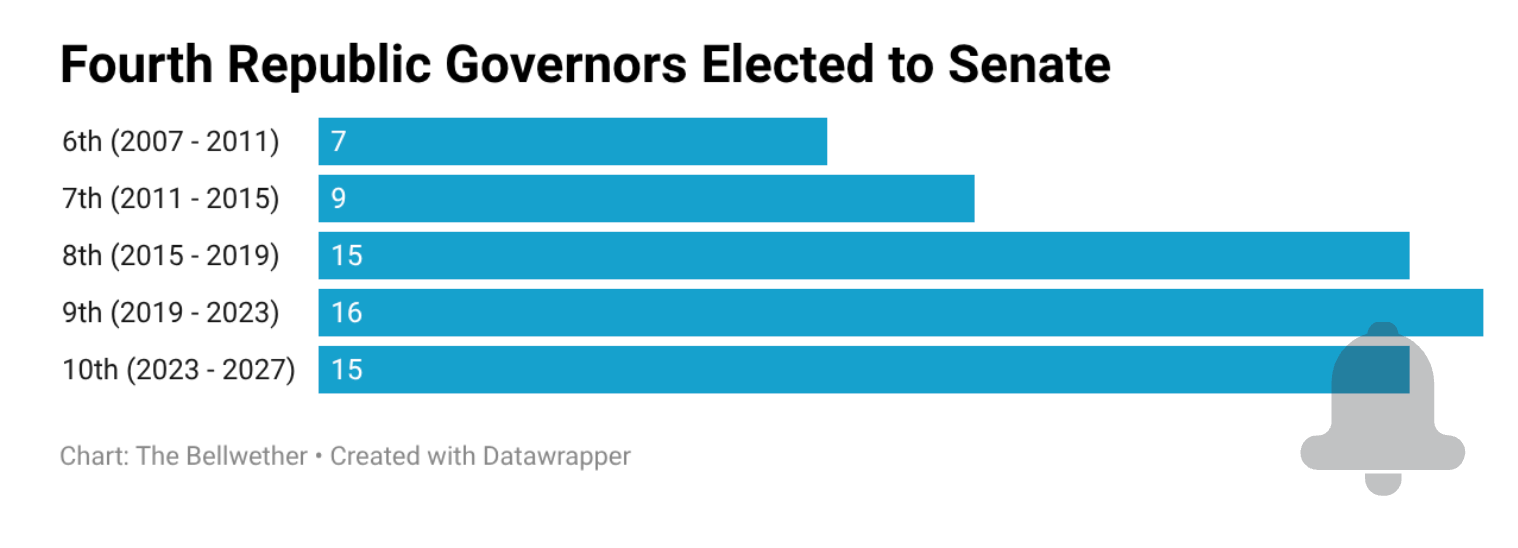
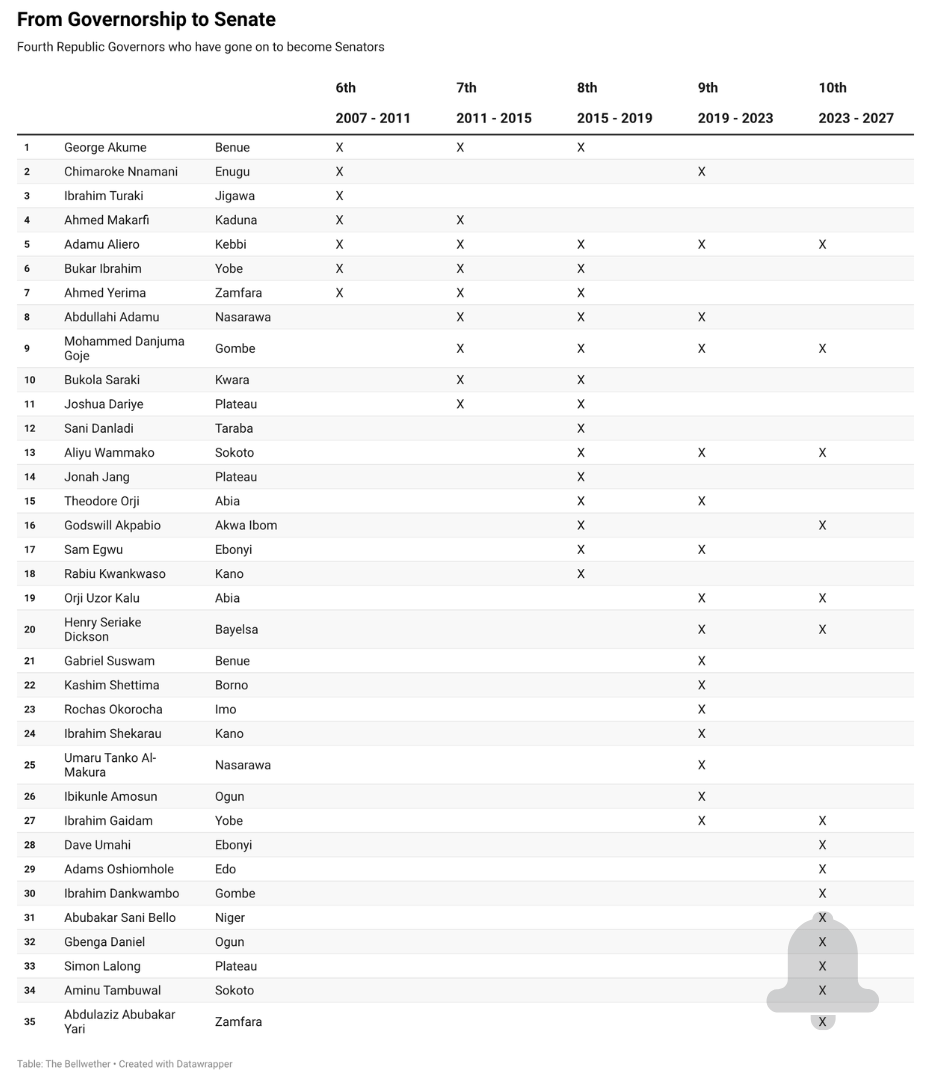
The lifecycle of Nigerian ruling parties has followed a set template: expansion through opposition absorption, consolidation through patronage, and bloating until internal contradictions fracture them. The primaries are where that lifecycle operates in practice. If primaries ratify incumbency and select choices for the governorship, they also manage succession in other positions. Term-limited governors have moved towards Senate seats, following well-established precedent. Governors Fintiri (Adamawa), Yahaya (Gombe), Uzodinma (Imo), Sule (Nasarawa), Abiodun (Ogun), and Buni (Yobe) secured senate nominations. In Ogun and Gombe, this came at the expense of other former governors who have been schemed out. Even other former governors, such as Yahaya Bello (Kogi) and 2023 PDP vice-presidential nominee Ifeanyi Okowa (Delta), were able to parlay their experience into senate bids.
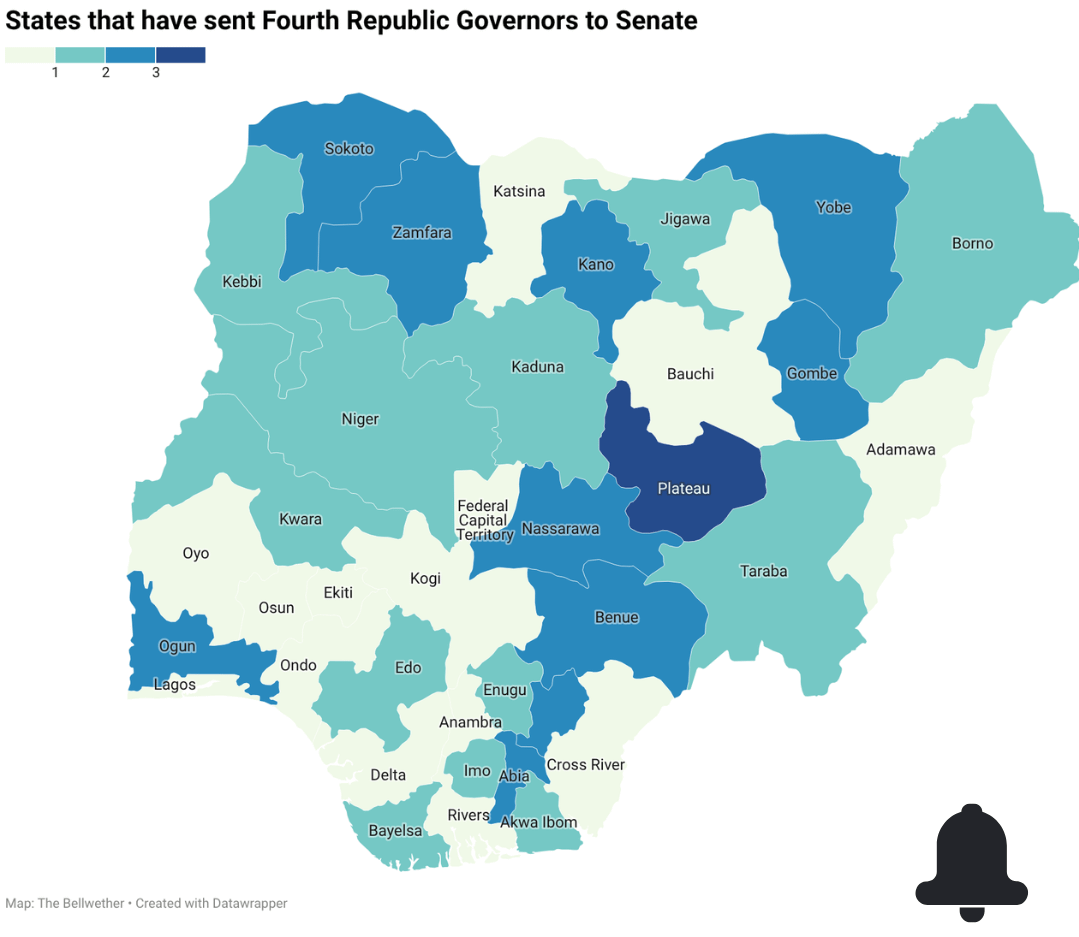
The current 10th Assembly has 15. If the 2026 primary results hold through the general election, the 11th Assembly could include nearly 20 ex-governors, the highest in the Fourth Republic. What began as an occasional career move has become an institutionalised succession route, with the Senate functioning less as an independent legislative body and more as an upper chamber of former state executives.
This move, which might reinforce the preference for executive experience in lawmaking, also represents a reversal of traditional power flows. In theory, because of the independence and absence of term limits, federal lawmakers could build their own power bases. However, the longevity that would have enabled the building of power bases is becoming the exception rather than the rule. One such exception is Ahmed Lawan, who has been in the Senate since 2007. His term will overlap with a fourth state governor when Mai Mala Buni steps down, ahead of his own bid to join him in the Senate next year.
Lawmaker independence has been further negated by the primary process and by the governors’ ability to control it. At least 54 APC members of the National Assembly have lost their bids to return. The implication is a form of federalism in party management. However, this concentrates power at the state executive level rather than distributing it across members. Each governor operates as the effective party leader in their state, controlling nominations, managing succession, and directing legislative representation. The national party handles broader disagreements, but a governor in a ‘drama-free’ state provides the power. This is Sklar’s elite coalition structure updated for the Fourth Republic.
This reversal has been building across election cycles. In 2014, five PDP governors who opposed Goodluck Jonathan’s re-nomination formed a dissident bloc and eventually defected to the APC, taking their state’s party structures with them. In the 2022 APC primaries, governors controlled delegate allocation in their states and delivered them for Tinubu’s emergence. The same machinery is now being used to control gubernatorial and senatorial nominations.
This creates a paradox for national governance. If each state’s nominations are controlled by its governor, then the national party has no independent mechanism for ensuring there is coherence. A national party is limited in its ability to ensure that elected officials pursue a party-wide legislative agenda or even check an errant governor who holds power in the state. A ruling party is not national in any programmatic sense; it is a federation of gubernatorial machines operating under a common label.
Who the System Produces
Primaries can crown potential, but they also end careers. All three of Tinubu’s cabinet members who resigned to run for governor—Yusuf Tuggar (Bauchi), Saidu Alkali (Gombe), and Adebayo Adelabu (Oyo)—lost their primaries. Their successors have already been nominated for their cabinet roles, closing the door they walked through.
The departures that followed tell us more than the defeats. Former Inspector-General of Police Mohammed Adamu resigned from APC and joined the SDP, calling the Nasarawa primary ‘a disgraceful charade that masqueraded as an election.’ Former Chief of Air Staff Sadique Abubakar, who had already moved from APC to ADC, quit politics entirely, bidding ‘goodbye to the murky waters of Nigerian politics.’
These are not marginal figures: Adamu led the entire Nigerian Police Force, Abubakar commanded the Air Force, and Tuggar served as Foreign Minister. While there is no direct correlation between their experience and their political prospect, it is clear that what they lacked was not competence or name recognition, but placement within the gubernatorial machine that controls the primary process.
This raises a question about selection effects. If the primary consistently selects for alignment with gubernatorial machinery rather than for competence, public profile, or policy vision, then it is producing a specific type of political class—one optimised for navigating patronage networks rather than governing effectively. The primary does not channel popular preferences upward, but instead directs elite preferences downward. As a result, the candidates who emerge are not those with the broadest support but those with the right patron. With each successive election, independent-minded candidates are filtered out at the expense of the more compliant. Nigeria might complain about the leadership system, and the main diagnosis is that it is not designed to produce good leaders, but instead rewards loyal ones.
The Opposition Mirror
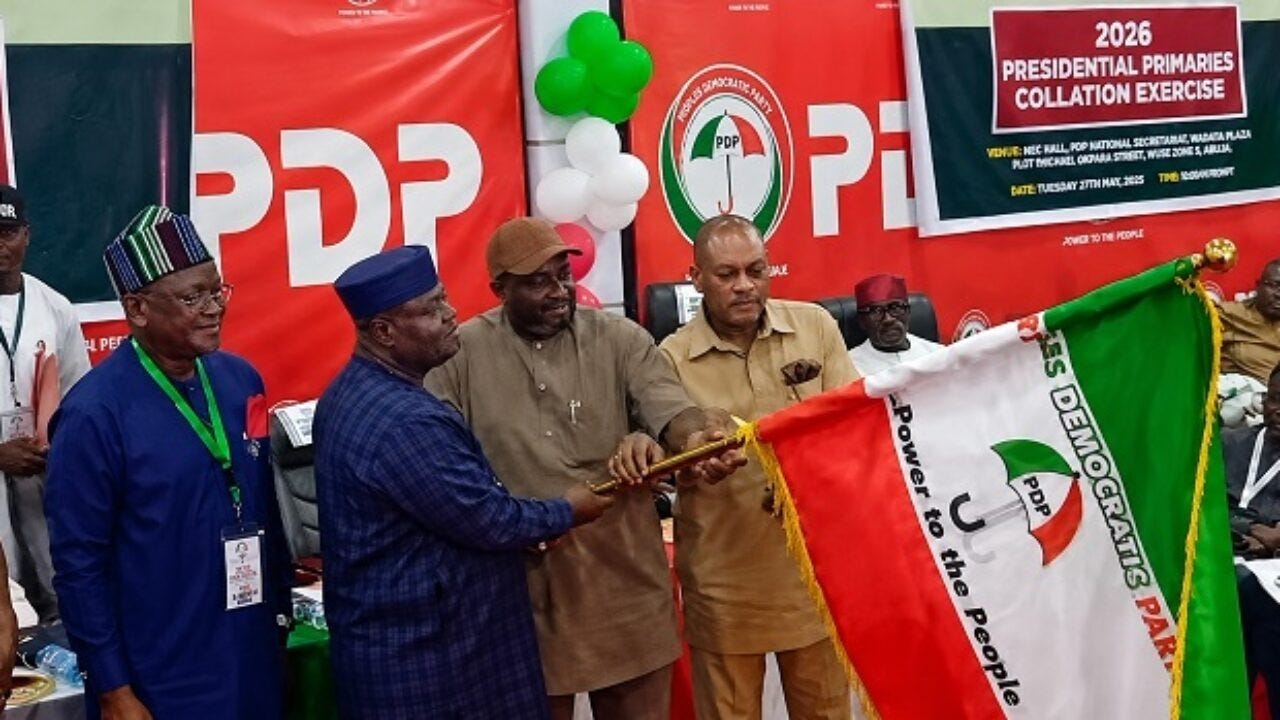
The assumption might be that the consensus model is an APC phenomenon or a product of ruling-party dominance and the resources that come with it. But opposition primaries have fared no better.
PDP’s governorship primaries, held on 24–25 May, replicated the pattern. The party produced consensus candidates across the board, including third-time nominees in Jigawa (Mustapha Sule Lamido, son of former Governor Lamido) and Katsina (Senator Yakubu Lado), a recycled 2023 candidate in Ogun (Oladipupo Adebutu, sole contestant), and unanimously endorsed candidates in Lagos and Benue. A faction of the party has named Sandy Onor, a one-term senator from Cross River, as its consensus presidential nominee.
The serial candidates are a problem in themselves. The opposition primaries are not refreshing the candidate pool, but are instead recycling it. This challenges the familiar refrain that “all politics is local.” If all politics were genuinely local, and party members in Katsina or Jigawa had meaningful agency in selecting their candidates, then three-time nominees who have lost twice would face serious internal challenges. The absence of challenge suggests that local party structures are not arenas for democratic contests but instruments of control by the same local elites who dominate the broader political landscape.
The consensus model is a feature of how party structures operate at every level. The PDP’s inability to refresh its candidate pool is not separate from the party’s structural death. By recycling losing candidates again, with no clear case for such choices, it is proving its inability to produce an internal politics worth staying for.
The fragmentation compounds the problem. The opposition now fields candidates across three separate platforms—PDP, ADC, and NDC—each attempting the same consensus model and reproducing the same elite selection logic. The Rivers ADC primary descended into a parallel congress dispute, with rival committees declaring different winners. NDC, registered only in February 2026, is still assembling state-level infrastructure. The consistent use of consensus across all parties confirms that this is not a ruling-party problem. It is a structural feature of Nigerian party politics. The spectre of a one-party state is not built only through electoral dominance. It is built by reproducing the same selection logic across all parties. When the opposition uses the same consensus model as the ruling party, the system is not competitive: it is restrictive.
What the Primary Decides
Do primaries in Nigeria galvanise support, test popularity, and select viable candidates? The 2026 evidence suggests they achieve the opposite. They demobilise internal challengers, bypass the question of popularity entirely through consensus, and select candidates whose primary qualification is alignment with the existing power structure.
Katz and Mair’s “cartel party” thesis anticipated this convergence. They argued that modern parties evolve from instruments of the civic public into arms of the state, using state resources and institutional advantages to protect themselves from genuine competition. In a cartel system, parties collude to ensure their collective survival. The primary serves as a mechanism for managing the distribution of power among elites who have already agreed to the terms. The 2026 primaries confirm the thesis not just for the ruling party but across all four major parties: APC, PDP, ADC, and NDC. They all produced predetermined outcomes and reproduced existing power arrangements. The specific mechanics varied: pure consensus in the North West, contested-but-controlled in the North East, absorption in the South South, and succession in the South West. The method might have been different, but the function was identical. The primary formalised what had already been decided in private.
This is not a 2026 anomaly caused by an unusually high number of incumbents seeking re-nomination. The 2022 APC primaries produced the same gubernatorial control of delegate allocation. The 2014 PDP primaries that renominated Jonathan were managed by the same governor-led machinery. Each cycle deepens the pattern. While a consensus model might have been seen as a random and new imposition, it is really more of the status quo.
There is a risk when parties conform to this norm and cater to a certain group. Peter Mair, in Ruling the Void, warned that when parties retreat from civil society into the state, they create “a growing gap between rulers and ruled” that “hollows out democracy from within.” The Nigerian primary system is the institutional expression of that gap. The democratic form, such as primaries, delegates, ballot papers, and vote counts, persists. But the actual democratic function, which includes aggregation of preferences, competitive selection, and accountability to constituents, does not. Citizens actively supported 2023 Labour Party candidates because of a perception that a Peter Obi-led party was a protest vote against the entrenched APC-PDP duopoly. Down-ballot candidates won on that promise. But as elections consolidate, the ideas and fixtures of a political elite continue to grow and appear further removed from society.
In Kwara, the primary season’s sole genuine upset offers a final data point. Governor Abdulrazaq initially endorsed Ambassador Yahaya Seriki as his preferred successor. Factional resistance, rooted in demands for zonal rotation from Kwara North and South, forced the primary’s suspension overnight. When it resumed, Abdulrazaq had switched his endorsement to Speaker Salihu Yakubu Danladi, who won against 15 aspirants. But even here, the governor did not lose control. He repositioned himself on the winning side before the result was declared. The succession machine did not break down. It recalibrated.
The Illusion of Reforms
The legal architecture around primaries does not constrain this system. The Electoral Act 2026, signed into law in February, was designed to address precisely the problems the primary season produced. Section 84(2) abolished indirect (delegate) primaries entirely, restricting nominations to direct primaries or consensus, a reform intended to reduce the influence of money and gubernatorial control over small delegate pools. To improve the process for direct primaries, Section 77 mandated that digital membership registers be submitted to INEC 21 days before primaries to prevent last-minute defections and ensure that only genuine party members could vote. The consensus option was hedged with a requirement that all cleared aspirants provide written consent.
Yet, the primaries revealed the limits of these reforms. Consensus was used in the majority of states, but the written-consent requirement was either met through coerced withdrawal or simply bypassed. The digital registers were reportedly submitted on time, but the registers themselves were compiled by party officials under gubernatorial control, meaning the governor decided who counted as a member. The direct primary option, which was supposed to empower ordinary party members, was used in several states but produced margins (657,917 to 1 in Lagos, 459,393 to 0 in Kaduna) that suggest the electorate was curated rather than consulted.
On 21 May, the same day the APC primaries began, Justice Mohammed Umar of the Federal High Court ruled that INEC lacked the statutory power to prescribe timetables for party primaries or to shorten the deadlines provided under the Electoral Act. The ruling extended the window for membership registers to September 2026, reopening the door for defeated aspirants to defect and contest on other platforms. A second ruling, by Justice Omotosho on 26 May, partially contradicted the first by affirming INEC’s power to set primary timetables while voiding its ability to shorten statutory deadlines for candidate substitution. This inconsistency will surely be litigated. INEC will have to balance these legal issues ahead of key elections. Lastly, a major element of the entire reform, the ability to constrain delegate defection, has currently been weakened.
The consensus republic is not just a political reality. It is a historically produced, legally maintained, and structurally reinforced one. From the NPN’s Kaduna caucus to Babangida’s manufactured parties to the Fourth Republic’s gubernatorial machines, the logic has remained constant: elites select candidates through controlled internal processes. The 2026 primaries simply repeated this logic. The primary is not where Nigerian democracy fails; ironically, it is where it actually works, but for the political class it was built to serve.
—
Written by: Afolabi Adekaiyaoja
Edited by: Seyi Adedoyin and ChiAmaka Dike
This is a useful piece, but I think it overstates gubernatorial control as the dominant explanation for legislative turnover and underweights zoning and rotation as independent forces in Nigerian politics. In many senatorial districts, longevity is naturally constrained by pressure to “share” the seat among constituent blocs or sub-zones within the district. This makes Senate seats structurally harder to retain than House seats, where smaller constituencies may allow deeper local entrenchment. Turnover among senators, therefore, does not necessarily prove that governors are dislodging incumbents; it may also reflect local rotation bargains and intra-zone competition.
Similarly, where incumbents lost in direct primaries for legislative seats, the article appears to treat those defeats as evidence of governors imposing preferred candidates. That causal link needs to be demonstrated more clearly. Direct primaries tend to favour candidates with better ground operations and street credibility among party members. In contrast, the old delegate system often gave governors and party executives clearer leverage because they had greater influence over delegate lists and elite bargaining. In my views, the ouster of many incumbents in APC legislative contests reflects more this view as against gubernatorial control. If the argument is that governors still controlled direct primaries in legislative contests through membership registers or party machinery, the article should show with concrete state-level examples.
Thirdly, the claim that consensus was used in the majority of states also needs clearer numerical support. A state-by-state breakdown distinguishing consensus and direct primaries would strengthen the argument. Lagos, for instance, appears to complicate the broad claim if its APC primaries were conducted largely through direct contests. If Lagos is being treated as “controlled” rather than competitive, the basis for that classification should be shown.